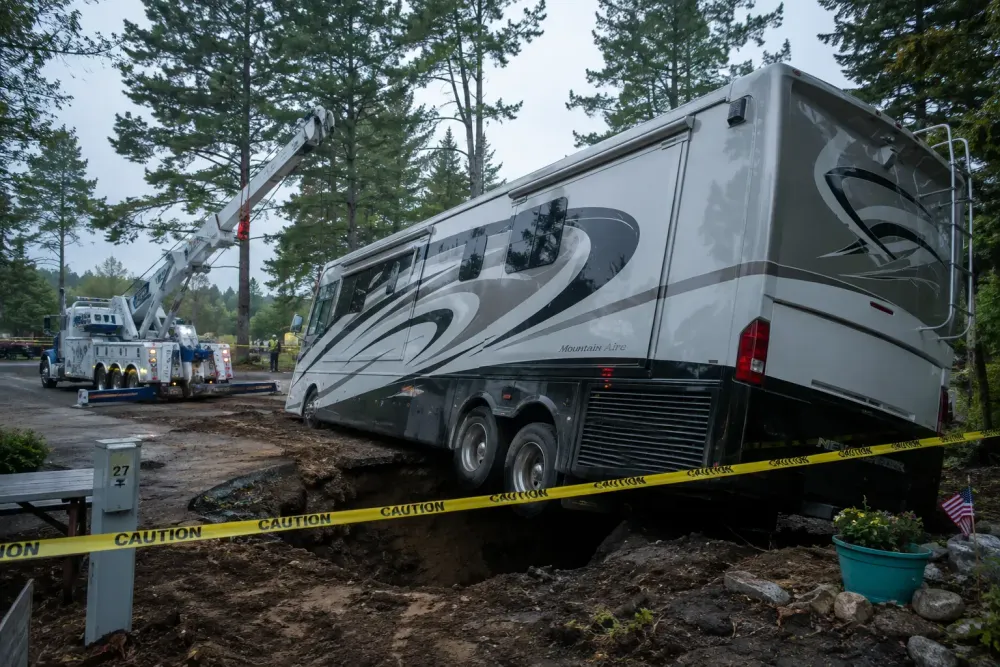
A South Carolina couple says a routine departure from a Vermont campground became a specialized heavy-recovery operation after the ground beneath their nearly new motorhome collapsed. The account raises broader questions about campground site safety, abandoned wastewater infrastructure and the limits of roadside-assistance coverage.
Consumer | Consumer Watch
A nearly new 2025 Tiffin Allegro Bay Super C dropped sharply toward its driver's side on Aug. 16 after the ground beneath its rear wheels collapsed as the owner was pulling out of a Vermont campsite, according to a first-person account now circulating publicly online. The couple says the opening was ultimately identified as a buried septic tank or former wastewater structure, and that extracting the motorhome required a three-axle rotator recovery truck and cost more than $4,000.
The account supplied to The American Quorum is now publicly indexed in several Facebook locations, including a personal post and reposts in RV and camping groups. A search of publicly indexed sources on Aug. 23 did not surface an independent local news report identifying the campground or a public response from campground management. The details therefore remain a firsthand consumer account rather than independently adjudicated findings.
The couple had been on a five-week New England trip and had spent six nights at the private campground. Their site was described as level, shaded and surfaced mainly with dirt and grass. On the morning they planned to leave, the owner's wife pulled their Jeep onto the campground loop road so the motorhome could be brought forward and connected for the trip south.
The motorhome moved only about eight feet.
According to the owner, the driver's-side rear suddenly dropped, sending the coach into a severe lean. The driver was thrown against the cab door and initially could not open it because the motorhome had twisted enough to bind the door. After several attempts, he was able to force it open and get out.
Outside, the rear wheels had fallen below grade. The owner says all three exhaust outlets were buried in soil, exterior baggage doors had buckled or been forced upward, two doors remained jammed after recovery, and the hood appeared misaligned while the coach was twisted.
The couple feared the motorhome could continue rolling toward trees bordering the site. Two miniature dachshunds remained inside in a crate. The owner says a campground manager who arrived at the scene would not permit anyone to reenter the RV because of concern that the coach could overturn.
Tiffin's specifications for the 2025 Allegro Bay list all three floorplans at 39 feet 4 inches long, with a gross vehicle weight rating of 33,000 pounds and a rear axle rating of 21,000 pounds. Those are maximum ratings rather than proof of the coach's actual weight that morning, but they illustrate the scale of the vehicle involved.
From a suspected water leak to a septic tank
At first, the owner says, those at the scene suspected an underground water-line failure had washed away soil.
A conventional heavy wrecker arrived and considered pulling the motorhome forward. The owners rejected that approach because portions of the coach were already in contact with the ground and they feared dragging it would cause additional underbody and drivetrain damage.
A larger rotator truck was then summoned from the Albany, New York, area. Once the motorhome was lifted and stabilized, the owner says the recovery operator could see a large opening beneath it containing dark liquid. The operator inserted a long digging shovel and could not reach the bottom. After the liquid was disturbed, those present concluded that the motorhome had dropped into a septic tank or wastewater structure rather than an ordinary soil washout.
The operator kept the passenger-side tires on stable ground, suspended the coach with the crane and applied forward tension while the driver controlled the brakes. The coach was moved far enough forward to reach firm ground and then lowered.
The operator followed the couple for roughly 10 miles while they checked whether the vehicle drove normally. It did, according to the owner, and the couple later completed the trip to South Carolina.
The owners say they have nevertheless been advised to have the chassis, frame alignment, suspension, driver-side tires, exhaust system and other components inspected, along with repairs to damaged exterior compartments. They plan to seek inspection and repair in Red Bay, Alabama, where Tiffin Motorhomes is based.
More than $4,000, and a coverage dispute
The specialized recovery cost more than $4,000, according to the account, and the couple says they had to pay the charge at the scene.
They also report a dispute with Coach-Net, their roadside-assistance provider. According to the owner, Coach-Net initially approved dispatching a wrecker but later declined to pay the rotator bill after the service was characterized as a "recovery" rather than a "tow."
Publicly available Coach-Net sample terms show why those distinctions matter. A sample Premier Coach plan describes towing and limited winching or extraction benefits while also imposing conditions and exclusions on some recovery situations. The document is not the couple's verified 2026 contract, however, and cannot determine whether this particular charge should have been covered.
The couple says its motor-vehicle insurer is now involved. The total claim remains unknown because mechanical and structural inspections have not been completed.
What Vermont law says
The campground, according to the owner's account, has said its current owners did not know the buried structure existed when they purchased the property several years ago.
That assertion may matter factually, but it does not by itself answer the legal question.
In a 2026 decision, Tiedemann v. Wheeler, the Vermont Supreme Court reaffirmed that a property owner is not automatically liable simply because a dangerous condition exists. A claimant must establish, among other things, that an unreasonably dangerous condition existed, that the owner knew or should have known of it, that reasonable care was not exercised to protect against it or warn of it, and that the condition caused the injury or damage.
The court also emphasized that Vermont law requires a property owner to exercise reasonable care to discover dangerous conditions. There is no fixed period a hazard must exist before that duty can arise; the question is what a reasonably prudent property owner would have discovered or foreseen.
That means "we did not know" and "we could not reasonably have known" are not necessarily the same thing.
Whether this campground should have discovered the buried structure cannot be determined from the public account alone. That would likely require property records, wastewater permits, site plans, prior-owner disclosures, maintenance records and evidence about the site before the collapse. A prior owner or contractor could also bear some responsibility depending on facts not yet public.
A Vermont wastewater rule may also matter
Section 1-930 of Vermont's Wastewater System and Potable Water Supply Rules addresses systems that are no longer serving a building, structure or campground.
Such a system may remain in place provided its tanks, including septic tanks, pump stations and dosing siphons, are pumped and then either broken in place or filled with soil.
The rule does not prove that the campground violated Vermont law. The status and history of the specific structure are not publicly established. It is not known when it was built, when it stopped being used, what permits govern it or how it was decommissioned.
But if investigators confirm that an abandoned septic or wastewater tank remained as a deep, liquid-containing void beneath an active RV site, Section 1-930 would be directly relevant to understanding how that condition was allowed to remain.
What consumers can take from the incident
For RV owners, the case exposes a hazard travelers have little ability to evaluate themselves. A customer can inspect a site for mud, slope, standing water and visible obstacles. A buried tank or subsurface void is different. A guest ordinarily has no access to a campground's historical utility maps, wastewater permits or acquisition records.
The episode also shows why getting a vehicle back onto stable ground is not the same as knowing it is undamaged. A large motorhome that has been severely tilted and supported unevenly can appear to drive normally while still requiring inspection of tires, suspension, frame alignment, exhaust components and body structures.
And it shows why roadside-assistance language matters. "Tow," "winch," "extraction" and "recovery" may sound interchangeable to a stranded traveler but can carry different meanings in a service contract.
The largest unanswered question remains straightforward: How did a buried structure capable of creating a void large enough to swallow the rear wheels of a heavy motorhome remain beneath an active commercial campsite?
The campground's reported lack of knowledge is one part of that inquiry. Vermont premises law asks another: What should reasonable care have discovered?
Until the campground is identified publicly, its records are reviewed and the motorhome is fully inspected, it is too early to assign a final dollar amount or make a definitive legal finding.
What is already clear is narrower.
On Aug. 16, a family says an ordinary campground departure turned into a dangerous heavy-recovery operation involving a nearly new motorhome, a concealed underground wastewater structure and more than $4,000 in immediate out-of-pocket cost.
The questions that follow are not about whether "holes can happen anywhere."
They are about what was beneath a commercial campsite, how it came to be there, whether it should have been discovered, and who ultimately bears the cost when the ground gives way.