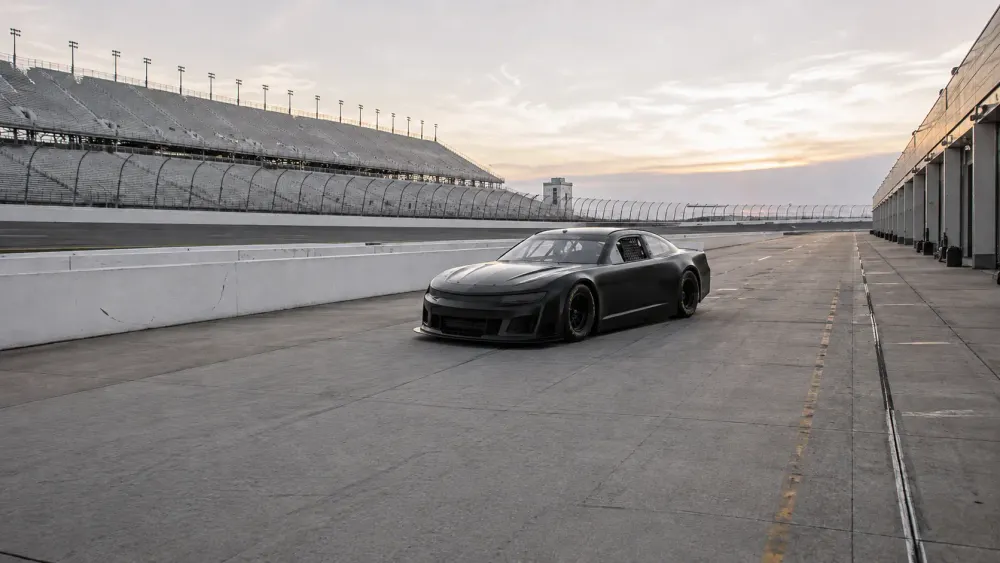
Thirty-eight years after Days of Thunder reached theaters, Paramount Pictures has scheduled a sequel for June 2, 2028, with Tom Cruise returning as NASCAR driver Cole Trickle and Anne Hathaway joining as a team owner and engineer. Cruise announced the project Saturday at Daytona International Speedway before NASCAR’s regular-season finale, turning what had been a long-discussed possibility into a dated studio release with principal cast and filmmakers attached. The announcement places another legacy property at the center of Paramount’s theatrical strategy.
Jonathan Levine is set to direct a screenplay by Will Staples, while Cruise will produce with Jerry Bruckheimer and Tommy Harper. Hathaway’s character is one of the few plot details Paramount has disclosed, and the studio has not announced a production start, budget or additional cast. Even so, a specific release date more than 21 months away signals a substantially firmer commitment than the exploratory conversations first reported in 2024.
The sequel is not simply a bet on recognition for a 1990 title. It joins two commercially powerful ideas: Cruise’s demonstrated ability to revive an old screen identity and Hollywood’s renewed confidence that motorsports can sell large-format spectacle. The evidence is encouraging but not conclusive. Top Gun: Maverick became a rare global phenomenon, while F1 showed that racing can travel internationally; neither result guarantees that a NASCAR story with a more modest original legacy can reproduce the same economics.
A Long-Discussed Project Becomes a Release
The new announcement closes several important gaps that remained after the project surfaced nearly two years ago. In November 2024, the Hollywood Reporter described Cruise as discussing a follow-up with Paramount, but development depended on a workable story and his crowded schedule. By July 2026, Variety reported that Levine was in talks to direct. Saturday’s event added Hathaway, confirmed the creative team and put the film on the calendar.
That sequence matters because announced projects routinely stall between an actor’s interest and actual production. Paramount is now marketing the film around a defined pairing: Cruise’s older driver and Hathaway’s owner-engineer, a role that could shift the story’s center of authority beyond the driver’s seat. The studio has not revealed whether the relationship will be adversarial, collaborative or romantic, so any fuller description would be speculation.
The choice of Levine is also notable without predetermining the finished tone. His filmography includes character comedies and dramas as well as genre work, while Staples has written action-oriented material. Bruckheimer connects the sequel to the original production and, more recently, to both Top Gun: Maverick and F1. The project therefore combines continuity in star and producer with new creative leadership rather than attempting to recreate the 1990 team.
The Maverick and F1 Precedents
Paramount’s strongest argument for returning to Cole Trickle is the performance of Top Gun: Maverick. A company SEC filing records $1.5 billion in worldwide box office for the 2022 sequel, which arrived 36 years after the original Top Gun. That result showed how an older property can reach beyond nostalgia when the returning star, practical spectacle and a new-generation story are built into a theatrical event.
Racing supplies a second, more recent benchmark. Disney says Bruckheimer’s F1 grossed more than $631 million worldwide and became the highest-grossing sports movie, while earning four Academy Award nominations and winning for sound. The company’s account is promotional, but the box-office figure establishes that modern racing imagery can attract a global cinema audience when paired with recognizable talent and premium presentation.
The parallels also expose the risk. Formula One markets itself as an international championship with races across continents, whereas NASCAR’s identity is more deeply rooted in the United States. Top Gun began as a much larger cultural property than Days of Thunder, and Maverick benefited from exceptional reviews and repeat viewing. Paramount can borrow the production and marketing logic of those successes, but it cannot assume their audience size.
NASCAR Sees a Cultural Opening
Announcing the film at Daytona made NASCAR more than a backdrop. Cruise told drivers and industry officials that the sequel would emphasize the teams, community, speed and danger surrounding the sport. The venue also allowed the project to arrive as sports news and entertainment news at once, reaching committed race fans before Paramount begins the broader campaign.
NASCAR has evidence of durable television demand, though its audience picture is uneven across series and platforms. An official NASCAR release said its second-tier series averaged 1.1 million viewers in 2025, up 17 percent from the prior season, with 19 of 23 races exceeding one million. Separately, Prime Video’s first Cup race averaged 2.72 million viewers and drew a younger audience than typical linear broadcasts, according to Nielsen data reported by the Associated Press.
Those numbers do not measure demand for a feature film, but they explain the strategic opportunity. NASCAR offers a large existing community, recognizable venues and built-in promotional moments, while a movie can reach viewers who do not follow a full racing season. The original film is remembered inside the sport even though it was criticized for exaggeration; the sequel’s challenge is to use that familiarity without treating the fan base as sufficient for a global release.
The Original Was Successful but Not Dominant
Days of Thunder earned $82.7 million domestically and $157.9 million worldwide after its June 1990 release, according to box-office records. Its reported production budget was about $60 million. Those figures describe a meaningful commercial run, especially before home-video revenue, but they do not make the original equivalent to the biggest franchises now returning after long absences.
The film’s critical standing was also mixed. It has a 38 percent critics score on Rotten Tomatoes, and contemporary criticism often treated its stock-car narrative as a repetition of the Top Gun formula. Over time, however, its lines, characters and racing sequences developed a following among NASCAR fans. That split legacy gives the sequel both a recognizable foundation and room to improve on the original’s thin characterization.
Hathaway’s disclosed role may be an early indication of how the filmmakers intend to update the world. A team owner who is also an engineer can participate in decisions about machinery, strategy, money and organizational control, rather than serving only as a spectator to a driver’s risk. Whether the screenplay gives that role genuine technical and dramatic substance remains unknown, but the premise creates a mechanism for explaining how contemporary racing differs from the sport depicted in 1990.
Authenticity Will Carry Unusual Weight
The original production became known for practical driving and its proximity to real NASCAR environments, yet authenticity now involves more than putting cameras near fast cars. Team data, simulation, safety engineering, sponsorship and media distribution have all become more visible parts of the sport. A sequel that wants credibility will need to make those systems understandable without turning the film into a technical demonstration.
The June 2028 date gives the filmmakers time to negotiate access, coordinate with NASCAR teams and build a campaign around major races. It also creates exposure to schedule changes, rising production costs and an increasingly crowded market for event films. The most important unanswered facts are basic ones: when cameras will roll, how much Paramount will spend, which real racing organizations will participate and what story will justify returning to Cole Trickle after nearly four decades.
What the Sequel Must Prove
Paramount has already cleared the first hurdle by converting development reports into a dated release with two major stars. The next measure will be whether the film can distinguish itself from a cycle of sequels that rely principally on recognition. Maverick worked because its older hero confronted succession, consequence and technological change inside a story designed for theaters; F1 demonstrated the global appeal of racing spectacle. Days of Thunder will need its own dramatic reason to exist.
For now, the evidence establishes a real studio commitment, not a completed film or a likely hit. Cruise, Hathaway, Levine, Staples and Bruckheimer give Paramount a marketable package, and Daytona gave the announcement cultural specificity. What remains unproven is whether a cult favorite rooted in NASCAR can become a broad 2028 event without merely repeating the commercial formulas that made its revival possible.