
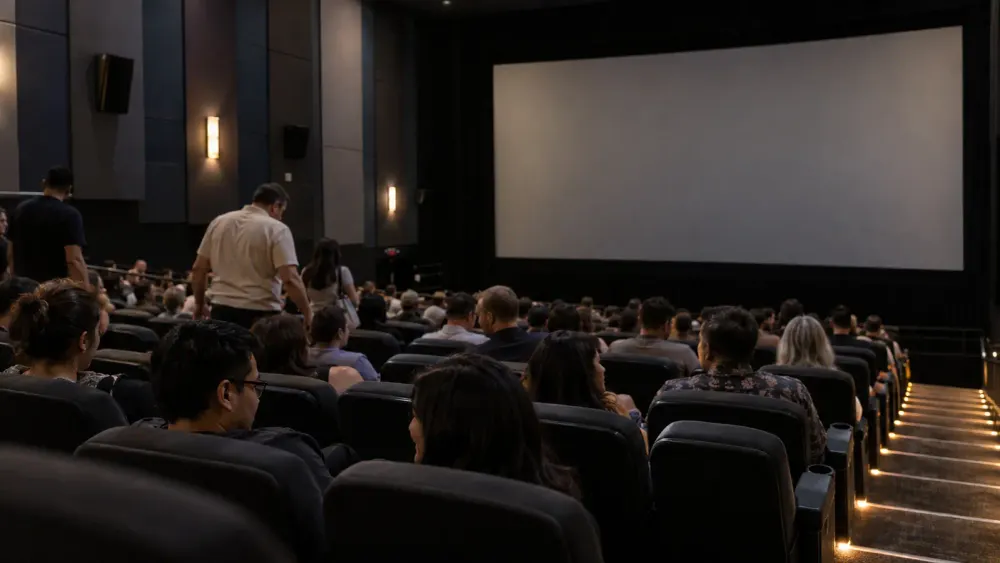
The U.S. and Canadian box office collected $4.61 billion from May 1 through August 31, a 26.1% increase from summer 2025 and the strongest summer total since 2013, according to figures from Rentrak reported Friday by the Associated Press. The gain marked the clearest post-pandemic demonstration that theaters can still produce a mass-market season, even as ticket volumes remain substantially below their pre-2020 level.
The rebound was broad enough to resist a simple explanation. Sony’s “Spider-Man: Brand New Day,” Universal’s “The Odyssey” and Pixar’s “Toy Story 5” led the summer, but inexpensive horror films, filmmaker-driven originals, family releases and sequels also contributed. Reuters counted 34 wide releases, two more than in 2025 but still 10 fewer than the 44 available in summer 2019.
That distinction matters because box-office dollars measure both attendance and price. Premium-format surcharges helped lift revenue, while data cited by AP showed 547.1 million tickets sold through mid-August this year, compared with 795.9 million over the equivalent 2019 period. The season therefore establishes a commercial recovery, not a complete restoration of the old audience. Hollywood has found a more productive mix of films and higher-value screenings; it has not yet rebuilt pre-pandemic admissions.
A rebound built on range
The leading films covered unusually different parts of the market. Box Office Mojo listed “Spider-Man: Brand New Day” at nearly $900 million domestically for the season, followed by “The Odyssey” at about $572 million and “Toy Story 5” at roughly $479 million. Together, those three titles supplied about two-fifths of the $4.61 billion total, giving theaters reliable anchors without making the season dependent on a single weekend.
The titles below them are more instructive for future programming. “Obsession,” made for less than $1 million, reached about $263 million domestically and more than $500 million worldwide, AP reported. “Backrooms,” directed by 21-year-old Kane Parsons and budgeted at $10 million, took about $198 million domestically and $394 million worldwide. Those results do not prove that low-budget films are safer investments, but they show how creators with online followings can convert digital awareness into theatrical demand.
At the same time, several established properties underperformed. The theatrical “Star Wars: The Mandalorian and Grogu,” Disney’s live-action “Moana” and DC Studios’ “Supergirl” finished behind less conventional releases. That pattern complicates the industry’s familiar debate between franchises and originals: Spider-Man and “Toy Story” remained enormous draws, while other brands offered no guarantee. The useful dividing line was not intellectual property versus novelty, but whether a film created a specific reason to attend now.
Gen Z becomes the core audience
Moviegoing’s youngest adult cohort increasingly supplies that urgency. People ages 14 to 29 were already the most frequent theatergoers before this summer, AP reported. A Cinema United study found that Gen Z averaged 6.1 theater visits in 2025, up from 4.9 a year earlier, while 41% attended at least six times. The trade group represents exhibitors, so its optimistic framing warrants caution, but the underlying trend aligns with the season’s film-by-film results.
“Obsession” and “Backrooms” turned that cohort’s online discovery habits into ticket sales rather than treating social video as a substitute for cinema. Their directors emerged from YouTube, and their films offered communal horror experiences that were difficult to reproduce in a feed. The industry report also found that moviegoers ages 13 to 34 bought 73% of North American horror tickets in 2025, giving studios a measurable base for this summer’s bets.
Women also returned in force for “Michael,” “The Devil Wears Prada 2” and “Scary Movie,” according to Reuters, while “Spider-Man” broadened the season’s appeal to young men and couples. That mix is more consequential than any claim that one demographic “saved” theaters. A viable multiplex needs different audiences to arrive across successive weekends. This summer’s programming distributed demand among superhero spectacle, horror, animation, music biography, comedy and auteur filmmaking instead of asking every customer to want the same event.
Premium screens lift dollars
The other engine was pricing. “The Odyssey” made 70-millimeter film and large-format presentation part of the product, encouraging customers to plan around specific screens and pay more for them. IMAX said it generated a company-record $257 million worldwide in July, 47% above its previous monthly high, with “The Odyssey” contributing $221 million by August 3. In North America, IMAX accounted for 43% of the film’s third-weekend domestic gross across just 443 locations.
Premium formats help explain how revenue can approach historical highs while attendance does not. A dollar earned from an IMAX or other large-format seat is not equivalent to a standard ticket, and neither is directly comparable with a 2013 dollar without adjusting for inflation. The $4.61 billion tally is therefore meaningful as current cash flowing to studios and exhibitors. It is a weaker measure of how many people formed the moviegoing habit or how frequently the average household attended.
Yet higher prices alone cannot manufacture a record month. Premium auditoriums are scarce, and customers must consider a film worth the schedule constraint and surcharge. “The Odyssey” succeeded because its production and marketing made format visible to consumers; “Spider-Man” later expanded across IMAX screens as demand persisted. The commercial lesson is narrower than “bigger is better”: distinctive presentation can reduce the gap between cinema and home viewing when it is attached to a film audiences already value.
Admissions and supply still lag
The admissions deficit remains the strongest limit on comeback language. Selling 547.1 million tickets through mid-August, versus 795.9 million at the same point in 2019, leaves a gap of nearly 249 million visits. Some of that difference may reflect changes in measurement windows or release patterns, but the scale is too large to dismiss. Theaters are producing more revenue from fewer transactions, making them more exposed if customers resist premium prices or a future slate lacks true event films.
Film supply presents a related risk. The current release calendar defines a wide opening as at least 2,000 North American locations, and this summer’s 34 such films remained 23% below 2019’s 44. The pandemic shut productions, and the 2023 writers’ and actors’ strikes delayed later slates. Output is recovering, but theaters cannot screen films that have not been delivered, and weak weeks cannot be recovered through concessions or better seating alone.
The concentration at the top also deserves attention. The six biggest summer releases generated well over half of the seasonal total in the seasonal chart. That is normal for a hit-driven business, but it leaves smaller theaters dependent on studios maintaining a steady cadence of broadly available titles. A record at a premium-format chain does not automatically translate into the same economics for a rural single-screen cinema or an operator without access to the most sought-after presentation.
The next test is consistency
Rentrak analyst Paul Dergarabedian told Reuters that the full-year domestic box office could exceed $10 billion for the first time since 2019, with “Avengers: Doomsday” and “Dune: Part Three” due in December. Reaching that threshold would improve on the roughly $9 billion 2025 market reported by exhibitors. It would still need to be read alongside admissions, average ticket prices and the distribution of revenue across films and theaters.
The summer also offers studios a practical portfolio argument. A few expensive franchises provided scale, but the season’s upside came from spreading risk across genres, budgets and creative sources. Original or director-led films did not replace franchises; they filled demand that familiar properties missed. If studios respond only by copying the most visible horror success or extending the largest brands, they could reproduce the narrow slate that made exhibition vulnerable in the first place.
What changed in summer 2026 is measurable: revenue rose by more than a quarter, younger audiences attended frequently, women supported several major releases, and premium screens converted interest into higher receipts. What remains unresolved is whether Hollywood can repeat that balance while expanding the number of wide releases and narrowing the 2019 admissions gap. The answer will come from several slates, not one season, but $4.61 billion gives theaters their strongest operating evidence in years.