Saudi Arabia said Friday that multiple drones launched from Iraq struck its East-West oil pipeline, injuring people and forcing a temporary shutdown of the kingdom’s most important land route around the disrupted Strait of Hormuz. Riyadh said it would refrain from immediate retaliation at the request of Iraq’s prime minister, while reserving the right to defend its sovereignty and critical infrastructure, according to the Saudi Foreign Ministry account reported by Reuters.
The new official attribution materially widens the geography of the regional oil conflict. The attacks occurred Thursday at pipeline sites in the Riyadh and Medina regions, the Saudi Energy Ministry said. It did not disclose how many people were hurt, identify the launchers or provide a timetable for full operations. State media said the injured received medical treatment and described the closure as temporary, according to a separate report.
Those limits matter. Saudi Arabia has officially identified Iraq as the launch point, but no group had publicly claimed responsibility by late Friday afternoon in Washington. The statement did not establish that Iraq’s government ordered, supported or knew of the attack. Baghdad’s request that Riyadh hold its fire, and Saudi Arabia’s decision to do so for now, indicate an effort to keep the incident from becoming a direct interstate confrontation while attribution and responsibility are investigated.
A strategic bypass under pressure
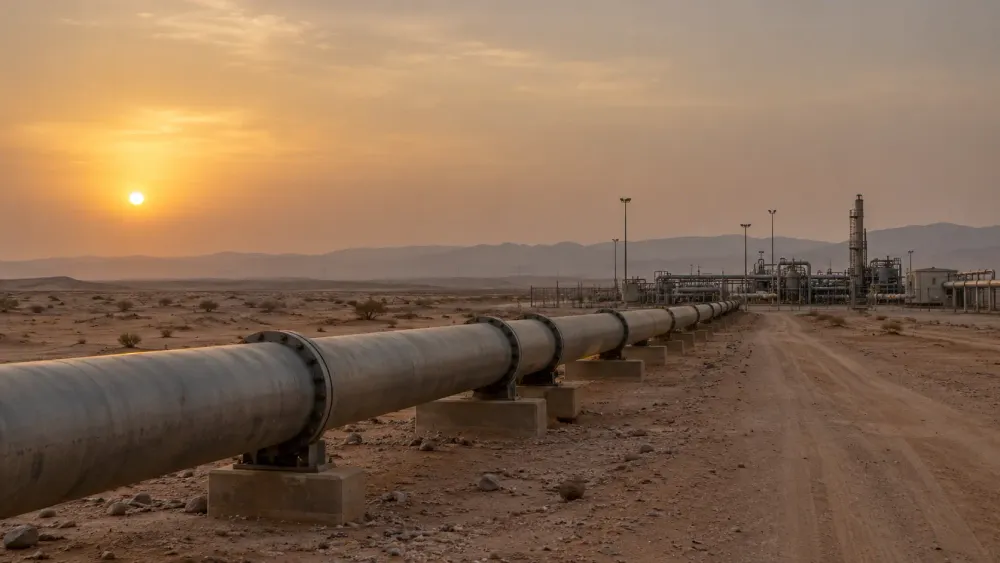
The East-West system carries crude from Saudi Arabia’s producing heartland near the Persian Gulf across roughly 750 miles of the kingdom to the Red Sea port of Yanbu. It can move as much as 7 million barrels a day, according to the Journal. That capacity does not mean the line was transporting 7 million barrels when it was struck, but it shows why attacks on its pumping infrastructure have consequences beyond the damaged sites.
The pipeline’s strategic value has risen sharply because it lets Saudi crude avoid Hormuz. Long before the current war, the U.S. Energy Information Administration described the East-West line and the United Arab Emirates’ Abu Dhabi pipeline as the principal alternatives for Gulf oil that cannot safely pass through the strait. Together, those routes could bypass about 4.7 million barrels a day under normal operating assumptions, the agency’s analysis said. The difference between that effective bypass estimate and the Saudi line’s higher nameplate capacity reflects other infrastructure limits, including ports, storage and connected facilities.
Saudi Arabia had more than doubled exports from Yanbu to more than 5 million barrels a day by early June as Hormuz traffic deteriorated, the Associated Press reported, citing the International Energy Agency. The pipeline therefore became a pressure valve for a market already losing supplies elsewhere. Friday’s AP account said the Saudi Energy Ministry called the shutdown precautionary and did not name an attacker in its initial statement.
Later reporting added the cross-border attribution. The Financial Times said the attacks caused injuries and forced the 1,200-kilometer system offline, threatening a route that had allowed Saudi Arabia to move crude west while Gulf shipping remained constrained. The exact physical damage, the duration of the interruption and any effect on scheduled export cargoes remained unconfirmed.
Why the Iraq link changes the risk
The launch-point finding does not settle who directed the drones. Iraq contains state security forces, autonomous armed factions and Iran-aligned militias with different chains of command. Establishing the operator will be central to any Saudi decision about retaliation and to Washington’s assessment of whether the attack represents a coordinated expansion of the Iran war or an action by a militia acting with greater independence.
The restraint announced Friday is consequential precisely because the target was not marginal. Saudi Arabia said it was honoring a request from Iraq’s prime minister and would not retaliate immediately, but the kingdom also reserved the right to take “all necessary measures” to protect its security and facilities. That formulation pauses escalation; it does not remove the option. It also gives Baghdad a short window to identify the responsible network and demonstrate that Iraqi territory will not remain a launch platform for attacks on Saudi energy assets.
The attack comes as Saudi Arabia faces simultaneous pressure at both ends of the pipeline. Iran-backed Houthi forces seized Mayun, also known as Perim, in the Bab el-Mandeb Strait on Friday after advancing through the Yemeni port of Mocha. That development, covered earlier by TAQ, threatens shipping from Yanbu through the southern Red Sea. The Houthis said navigation would remain safe for companies other than Saudi vessels, a distinction shippers and insurers cannot treat as a guarantee.
The two developments form a single strategic squeeze: the East-West pipeline is meant to bypass danger at Hormuz, but the pipeline itself has now been hit and its Red Sea outlet faces a more capable Houthi position near Bab el-Mandeb. The pipeline attack is therefore not a repeat of the territorial story. It is a new strike on the inland infrastructure that makes the western export route possible, coupled with an official claim that the drones came from a third country.
Immediate economic stakes
The International Energy Agency said Friday that world oil supply is projected to fall by 5.7 million barrels a day in 2026, 1.3 million barrels a day more than it estimated a month earlier. Its September market report said more than 10 million barrels a day of Gulf production remained shut in during August, global inventories fell by 95 million barrels that month and Saudi output dropped to 5.97 million barrels a day.
Those figures are not a measure of losses from Thursday’s drone attacks. They describe the unusually tight market into which this disruption landed. The IEA said benchmark Brent crude was trading around $105 a barrel when it prepared the report, 45% above its prewar level, while U.S. diesel prices had moved above the equivalent of $200 a barrel. A brief pipeline shutdown can be absorbed through storage and scheduling; a prolonged outage or repeated attacks would be harder to offset when inventories are already falling and alternative corridors are exposed.
Oil prices had eased Friday after reaching nearly $110 earlier in the week, but the supply outlook remained severe. Markets will now watch for evidence that the line has restarted, whether pumping stations sustained lasting damage, and whether Saudi export nominations from Yanbu are delayed. Until those facts are available, estimates of lost barrels remain speculation.
What happens next
The first test is operational. Saudi authorities have not said whether the entire line was halted or whether segments can be isolated and restarted. They also have not released an injury count, a damage estimate or a restoration schedule. Confirmation from the Energy Ministry or Saudi Aramco about throughput would show whether the interruption is primarily precautionary or a material constraint on exports.
The second test is political. Iraq must investigate the launch sites and identify the operators without allowing the inquiry to become a pretext for unilateral action on its territory. Saudi Arabia’s promise to hold off creates space for that process, but its warning preserves escalation if attacks continue or Baghdad cannot contain the responsible faction.
The United States also has a direct interest. High oil and diesel prices are already feeding inflation, and Washington is trying to protect navigation through Hormuz while encouraging regional partners to manage the Red Sea crisis. A Saudi-Iraqi confrontation would stretch that strategy across another border and could pull U.S. forces or intelligence assets deeper into a widening conflict.
For now, the verified facts are narrower than the worst-case scenario: drones launched from Iraq struck multiple points on a vital Saudi pipeline; people were injured; the system was temporarily shut; and Riyadh deferred retaliation. What remains unknown—who launched the drones, how much capacity is offline and how long Saudi restraint will last—will determine whether the attack becomes a contained infrastructure incident or the opening of another front.