
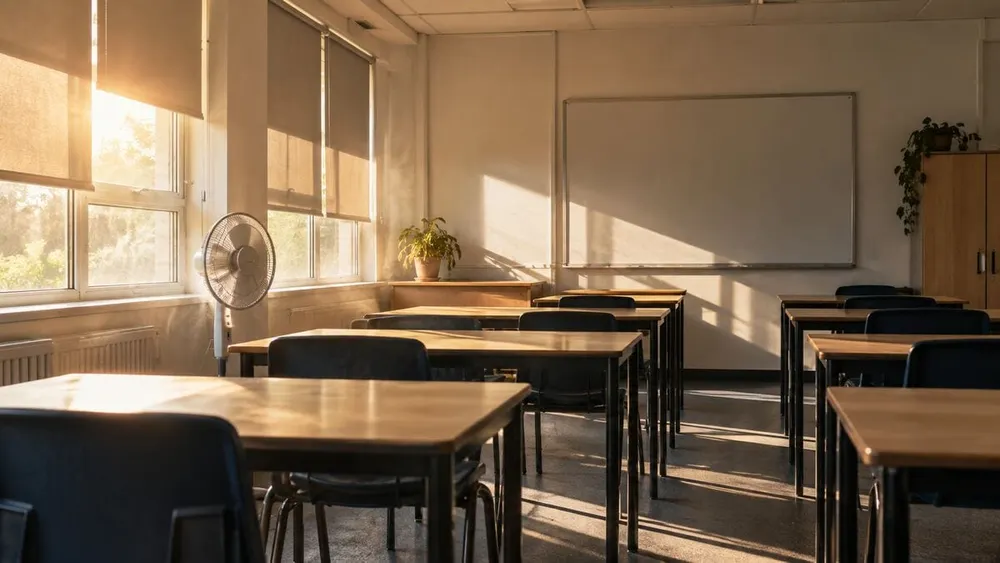
More than 15 million hours of teaching were lost across England and Wales during the June 2026 heatwave, according to new research that counted at least 760,000 pupils affected when more than 1,700 schools closed or shortened their days. The estimate converts a weather emergency into an education measure: direct closures accounted for about 5.9 million lost hours, while elevated absence at schools that remained open accounted for another 9.5 million.
The findings, published Friday by investigative outlet DeSmog, are not an official national attendance census. They combine identified closures and reduced schedules with regional absence data, so the total should be read as a modeled estimate rather than a precise administrative count. Still, the scale aligns with contemporaneous reporting that roughly 1,000 schools had already closed or altered hours during the most intense period, suggesting extreme heat is becoming a measurable threat to instructional continuity.
Counting disruption
The research separates two mechanisms that are often blurred together. Some pupils lost class time because school leaders closed buildings or dismissed students early when indoor conditions became unsafe. Others were absent from schools that stayed open, either because families kept them home or because heat-related illness prevented attendance. The distinction matters because a closure is visible and easy to document, while dispersed absenteeism can produce a larger but less obvious loss of learning time.
On the hottest days, absence rates reportedly doubled the annual average in parts of southern England and exceeded 36 percent in Wales. An account in The Independent said classroom temperatures surpassed 40 degrees Celsius in some buildings and described reports of heat stress, nausea, fainting and dehydration among pupils and staff. Those reports explain why formal closure totals alone understate the educational effect.
The Department for Education offered an important qualification. It said nine in 10 pupils attended normally where schools remained open and credited staff with keeping children learning safely. That response does not negate the estimated loss, but it places it in context: most schools continued operating, and most enrolled pupils attended. The disruption was concentrated rather than universal, with the greatest burden falling on particular buildings, regions and families.
Buildings exposed
Many British schools were designed primarily to retain heat during cool weather, not to keep crowded rooms safe during prolonged high temperatures. Reporting by the Associated Press found that aging buildings, limited ventilation and windows that open only slightly left some classrooms effectively unusable. Air conditioning is uncommon, while asbestos in many older structures can complicate major mechanical retrofits.
Newer construction is not automatically resilient. A London head teacher told the AP that a portion of his campus built in 2017 overheated more severely than a 1908 schoolhouse with high ceilings and thick brick walls. Building orientation, glazing, insulation, thermal mass, shading and air movement can matter as much as age. That makes the challenge more complicated than replacing old schools or buying portable air conditioners.
The government’s current ventilation guidance recommends monitoring carbon dioxide, temperature, humidity and pollutants to identify poorly performing spaces. It describes natural ventilation, mechanical systems and environmental sensors as tools for managing indoor conditions. Yet ventilation and cooling can pull in opposite directions during severe heat: opening windows may improve air exchange but admit hotter outdoor air, while closing them may retain cooler indoor conditions but allow carbon dioxide levels to rise.
Learning effects
Lost hours are an operational measure, not direct evidence of how much academic progress pupils surrendered. A shortened day does not translate mechanically into a proportional decline in test scores, and schools may recover some content later. Even so, heat can impair learning before a building closes. Reuters cited research finding that reducing classroom temperature from 30 to 20 degrees Celsius improved student performance by 20 percent, while teachers across Europe described fatigue and reduced concentration in overheated rooms.
The effects are also unlikely to be evenly distributed. Families with flexible work, reliable internet, quiet study space and effective home cooling are better positioned to manage an unexpected dismissal. Children who depend on school for meals, special-education services, counseling or structured supervision may lose more than instruction. The Sutton Trust warned that heat closures could widen attainment gaps in ways resembling pandemic disruption, especially when disadvantaged families lack resources for home learning or cooling.
Health protection remains the immediate constraint. Official school guidance advises hydration, shade, reduced heat-producing equipment and careful use of fans, which may not prevent illness above 35 degrees Celsius and can worsen dehydration. It lists confusion, seizures, loss of consciousness and a body temperature of at least 40 degrees as signs of heatstroke requiring emergency action. Keeping a school open is therefore not an educational success if indoor conditions create an unacceptable medical risk.
Adaptation choices
Short-term measures can reduce exposure: external shades, reflective films, night ventilation, lighter clothing, adjusted physical activity and use of cooler rooms. Trees and planted areas can lower solar gain and surface temperatures over time. Scheduling exams and demanding lessons earlier in the day may preserve performance during forecast heat. These interventions are generally less expensive and less energy-intensive than cooling every classroom mechanically.
They will not be sufficient everywhere. Britain’s independent climate advisers have projected that, without adaptation, the number of days on which indoor temperatures reach 35 degrees in thousands of English schools could rise 70 percent by 2050. The AP reported that the advisers recommend passive cooling first but expect air conditioning to be necessary in the most vulnerable schools, hospitals and care homes, preferably using low-carbon systems such as reversible heat pumps.
Other European systems are already combining approaches. Reuters reported that Barcelona directed €100 million in tourist-tax revenue toward cooling roughly 170 schools by 2030, while France had 6,200 school adaptation projects underway with €800 million allocated. Southern European countries also use earlier summer breaks and shortened days, but calendar changes can shift childcare and income costs onto families. Each option redistributes financial, educational and environmental burdens rather than eliminating them.
Funding limits
England has begun larger capital programs, though their reach and heat-specific impact remain uncertain. The Department for Education’s £710 million retrofit program is intended to extend building life, reduce emergency repairs and strengthen climate resilience. Its initial phase focuses on selected schools in Yorkshire and the Humber, the East Midlands and the South East, with possible measures including replacement of deteriorated modular classrooms, solar panels and building-controls optimization.
A separate rebuilding program lists 524 projects and prioritizes buildings with the highest condition needs or severe safety risks. Those investments address a substantial maintenance backlog, but neither program means every heat-vulnerable classroom will be upgraded quickly. Selection by structural condition may also miss buildings that are sound but thermally poor.
Local school budgets create another constraint. Leaders must weigh cooling and shading against leaking roofs, staffing, accessibility work and other urgent needs. Capital grants can purchase equipment, but schools also incur maintenance, electricity and replacement costs. A credible adaptation plan therefore needs building-level assessment, operating funding and standards that prevent new construction from reproducing current problems.
What follows
The 15 million-hour estimate provides a useful baseline, but stronger administrative data would improve future decisions. Governments could require standardized reporting of heat-related closures, early dismissals, classroom temperatures and absence, then link those measures to building characteristics and neighborhood deprivation. That would help distinguish isolated management choices from predictable infrastructure failure and identify where public investment preserves the most learning.
The evidence now establishes that extreme heat can interrupt education at national scale even when most schools remain open. It does not yet establish the exact academic loss attributable to one heatwave or prove that any single cooling strategy is optimal. The next test is whether capital programs, building standards and operational guidance reduce closures and absenteeism during comparable heat, particularly in schools serving children least able to absorb another source of missed learning.