
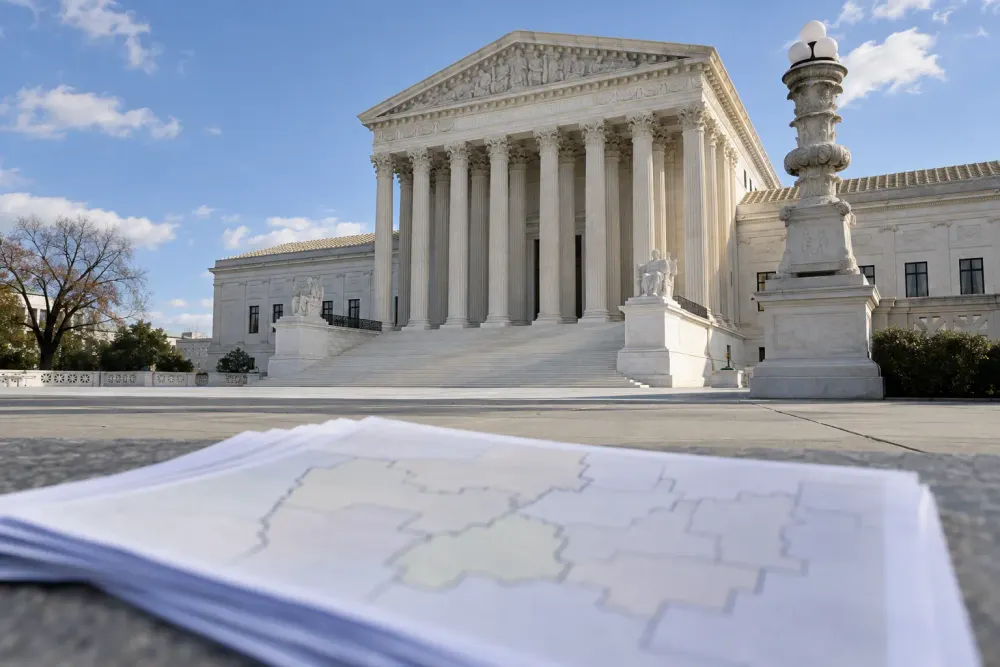
The U.S. Supreme Court on Thursday blocked a federal judge’s order that would have required Missouri to use a Republican-drawn 2025 congressional map, a decision that appears to restore the state’s older districts for the November midterm election and removes, for now, a plan designed to give the party a potential seventh seat in the state’s eight-member House delegation.
The justices granted an emergency application from the referendum campaign People Not Politicians. The Court’s official docket says the Sept. 8 order by U.S. District Judge Stephen Clark is stayed while the case proceeds through the U.S. Court of Appeals for the Eighth Circuit and, potentially, a later petition to the Supreme Court. The one-paragraph action was unsigned, offered no explanation and recorded no public dissent.
That procedural ruling is immediately consequential. Clark had ordered Secretary of State Denny Hoskins to use the 2025 map, creating a direct conflict with a Missouri Supreme Court decision that kept the map from taking effect before voters could decide a referendum challenging it. The U.S. Supreme Court’s stay suspends Clark’s order rather than finally resolving the underlying federal appeal. But with the Nov. 3 election approaching, Reuters and the AP reported that the practical result is likely to be use of the districts enacted in 2022.
What changed
Missouri’s Republican-led legislature approved the new lines in 2025 after President Donald Trump urged Republican-controlled states to redraw congressional districts between censuses. The plan reconfigured the Kansas City-area Fifth District represented by Democrat Emanuel Cleaver, dispersing Democratic-leaning voters among surrounding districts. Supporters sought to shift the delegation from its present 6-2 Republican advantage to a possible 7-1 split. Whether that seat would actually change parties would still depend on candidates and voters; the map created an electoral opportunity, not a guaranteed result.
Opponents gathered more than 305,000 signatures to suspend the law and place it before voters. The Missouri Supreme Court ruled that the petition was lawful, timely and sufficient, according to its opinion. That state ruling meant the 2025 map could not become effective until the referendum. A separate AP account said the measure was ordered onto the November ballot, setting up an unusual circumstance in which voters would choose representatives while also deciding whether to approve the boundaries intended for that election.
Clark intervened in federal court on Sept. 8. He concluded that the referendum process, applied at that late stage, violated the U.S. Constitution’s Elections Clause and ordered state officials to administer the election under the 2025 map. The ruling came after congressional primaries had already been held under the newer boundaries. A court report described his temporary restraining order as an effort to avoid changing district lines after candidates and election administrators had relied on them.
People Not Politicians immediately sought emergency relief. Justice Brett Kavanaugh first issued a short administrative stay while the full Court considered the application. Thursday’s order replaced that temporary pause with a stay tied to the appellate process. The Journal reported that the Court acted within roughly an hour of the final required filing. The speed reflected the compressed election calendar, not a merits opinion explaining which side has the stronger constitutional argument.
A second Supreme Court rebuff
Thursday marked the second time in three days that the U.S. Supreme Court declined to keep Missouri’s 2025 map in place. Earlier in the week, the Court turned away a separate emergency request after the state justices allowed the referendum to proceed. The latest dispute arrived through a different path: the challengers were asking the justices to stop a federal judge from overriding the state-court result. In each instance, the Court acted without a full written opinion.
The absence of an explanation limits what can be inferred. The stay does not amount to a final Supreme Court holding that the referendum is valid under federal law, nor does it establish a general rule against mid-decade redistricting. It does confirm that Clark’s Sept. 8 directive cannot govern while the appeal continues. The Guardian reported that election officials are now expected to return to the 2022 boundaries, which preserve two Democratic-leaning districts centered on Kansas City and St. Louis.
The Trump administration had urged the Court to leave the 2025 map in place. Solicitor General D. John Sauer filed an amicus brief Thursday, and Missouri officials and Republican members of Congress opposed the stay. Their filings argued that switching maps after the primary would disrupt the election and interfere with the state legislature’s constitutional authority. The Court’s order records those submissions but does not address the arguments.
The challengers, represented by attorney Abha Khanna, argued that Missouri’s constitution gives citizens a referendum power over laws enacted by the legislature and that the state Supreme Court had already determined the petition prevented the map from taking effect. Their emergency application also emphasized that election officials had administered past elections under the 2022 districts and could return to those lines. The justices granted relief on the timetable the challengers requested without adopting their full legal theory in writing.
Why one seat matters
The dispute concerns a single potential seat, but the national margin is narrow. Republicans hold a 219-214 House majority when including the independent who caucuses with them, according to the latest House count. A one-seat shift in Missouri could therefore matter to control of the chamber, especially as both parties contest districts redrawn elsewhere before the midterms.
Missouri’s fight is also part of a broader struggle over mid-decade redistricting. States normally revise congressional maps after the decennial census, but the Constitution does not categorically bar legislatures from drawing new lines between censuses. The legal questions in Missouri are narrower and more immediate: whether a voter referendum prevented the 2025 law from taking effect, whether a federal court could require use of that law despite the state ruling, and how courts should weigh legal claims against election-administration deadlines.
TAQ reported Wednesday that the state and federal rulings had left Missouri with competing commands. Thursday’s Supreme Court intervention breaks that deadlock for the moment. It gives the state high court’s practical conclusion effect during the appeal and removes the federal order that had told Hoskins to proceed under the disputed map.
What happens next
The Eighth Circuit remains responsible for reviewing Clark’s ruling. Under the Supreme Court’s order, the stay will continue through that appeal and through any timely request for Supreme Court review. If the justices deny review, the stay ends automatically; if they accept the case, it remains until the Court sends down its judgment.
Election officials must now implement the older map for the general election unless another court order changes the governing rules. That creates practical questions because candidates competed in August primaries under the 2025 boundaries. Courts have not yet provided a detailed public roadmap for reconciling those primary results with the districts expected to be used in November. State officials will need to issue instructions on ballots, candidate placement and voter assignments.
The referendum is still scheduled for the November ballot. Voters can reject or approve the 2025 redistricting law, but Thursday’s federal stay concerns which map governs this election while the appeal proceeds. The result of the referendum could shape later litigation and future elections, yet it will not by itself answer every federal constitutional question raised in Clark’s case.
For now, the confirmed change is clear: the federal order requiring Missouri’s Republican-drawn map has been suspended, the older districts are expected to govern the midterm election, and the attempt to create an additional Republican-leaning House seat has been halted at the Supreme Court less than eight weeks before Election Day.