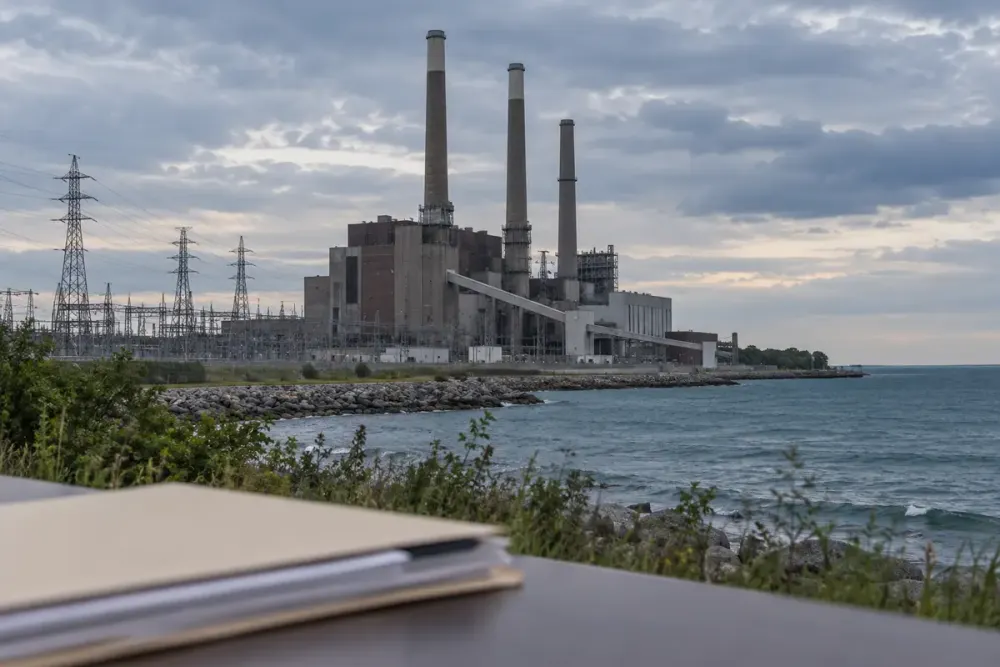
A unanimous federal appeals court invalidated the Energy Department’s original emergency order forcing a 1,420-megawatt Michigan coal plant to remain available after its planned retirement, sharply limiting an authority the administration has used to delay the closure of power stations in several states.
The U.S. Court of Appeals for the District of Columbia Circuit held Friday that the department had not identified an emergency within the meaning of Section 202(c) of the Federal Power Act when it directed the J.H. Campbell Generating Plant in West Olive, Michigan, to stay open in May 2025. Judge Cornelia Pillard wrote that the provision is a narrow, last-resort mechanism rather than a general tool for reversing scheduled plant retirements, according to the ruling described by AP and independently reported by Reuters.
The decision is immediately consequential even though it does not mean the plant will shut down Friday. Consumers Energy spokesperson Brian Wheeler told Reuters that the utility was reviewing the ruling and would continue complying with the department’s current 90-day directive. That latest order, issued August 14, runs from August 17 through November 14 and directs the Midcontinent Independent System Operator, or MISO, to keep Campbell available while using economic dispatch to minimize costs.
The court’s reasoning nevertheless places the legal foundation for that directive—and similar orders covering facilities in Indiana, Washington, Colorado, Florida and Pennsylvania—under substantial pressure. Friday’s ruling addressed the first Campbell order, but the department repeatedly relied on the same emergency provision to extend operation after the plant’s May 31, 2025 retirement date. Separate challenges to later orders remain pending. The decision therefore establishes a controlling interpretation for the D.C. Circuit, the court that reviews many federal energy actions, while leaving the immediate operational status of Campbell and the scope of relief in follow-on cases to further proceedings.
What the court decided
Section 202(c) authorizes temporary federal intervention during war or an emergency caused by a sudden increase in electricity demand, a shortage of power, generation or transmission facilities, fuel or water, or comparable causes. The statute lets the government order temporary generation, delivery, interchange or transmission measures that best meet the emergency and serve the public interest. It also contemplates orders lasting no more than 90 days when environmental requirements may conflict, although renewals are possible after additional consultation.
The administration argued that rising demand, planned generator retirements and the risk of future shortages justified keeping Campbell available. Its August directive said the plant had operated during periods of high demand and low intermittent generation, and cited a North American Electric Reliability Corporation assessment identifying elevated long-term shortfall risk in the MISO region. The department also said Campbell was scheduled to close 15 years before the end of its design life.
The court rejected the premise that those circumstances amounted to the kind of present emergency Congress specified. Pillard wrote that reversing the plant’s long-planned retirement was disruptive and that the record did not establish the statutory emergency required for the extraordinary order. The panel—Chief Judge Sri Srinivasan and Judges Pillard and Robert Wilkins—had heard arguments in May in the consolidated cases brought by Michigan, Illinois, Minnesota and environmental and consumer groups. The public docket identifies Consumers Energy and MISO as intervenors and shows the litigation consolidated under the Michigan petition.
The ruling does not decide whether coal generation is desirable, nor does it resolve the broader policy dispute over the pace of retirements. It decides a narrower legal question: whether the facts the department cited permitted it to invoke an emergency power that bypasses the usual planning and regulatory process. The panel’s answer was no for the May 2025 order.
A $259 million cost dispute
Campbell’s extended operation has become a regional ratepayer issue as well as a separation-of-powers case. CMS Energy, Consumers Energy’s parent, reported in a July filing that the net financial impact of complying with the emergency orders reached $259 million through June 30, after $239 million in MISO market revenue. The company said it intended to pursue cost recovery through proceedings before the Federal Energy Regulatory Commission.
Those costs do not all stay in Michigan. Consumers sought a tariff mechanism that would allocate compliance expenses across MISO’s North and Central regions, potentially spreading them among customers in multiple states. FERC granted the utility’s initial complaint in August 2025 but later rejected MISO’s first compliance filing; a revised filing was still pending when CMS submitted its second-quarter report. The eventual allocation remains unresolved, and Friday’s ruling does not itself determine who pays expenses already incurred.
The utility had planned to retire the 64-year-old plant as part of a generation transition approved through state processes. When the first federal order arrived days before closure, Michigan regulators and Consumers Energy said replacement resources had been arranged. Contemporary reporting noted that MISO expected adequate resources under normal summer conditions while warning that extreme scenarios could still strain the grid. The department reached a different judgment and treated the regional risk as an emergency requiring Campbell’s availability.
That factual disagreement is central. Long-term reliability assessments routinely identify future risks and the need for new generation, transmission, storage or demand management. The court’s ruling indicates that such planning concerns do not automatically become a Section 202(c) emergency. If the government wants to use the provision, it must tie its action to the temporary, concrete conditions described by Congress rather than invoke an indefinite mismatch between forecast demand and scheduled retirements.
National reach, limited immediate effect
The administration has used similar orders to keep a half-dozen aging facilities online. Challenges are already moving through administrative and judicial channels. In Indiana, groups are contesting orders covering units at the R.M. Schahfer and F.B. Culley stations. In Washington, the state and public-interest organizations are challenging the continued operation of the Centralia plant, which had been scheduled to stop burning coal under a long-standing state agreement. A Colorado order kept units at the Craig station available beyond planned retirement dates.
Those cases involve different grids, records and reliability claims, so Friday’s judgment does not automatically void every order. But the D.C. Circuit’s interpretation narrows the government’s room to defend them using generalized concerns. Petitioners can now point to a binding decision requiring a genuine statutory emergency, while the department can argue that other regions or time periods presented more acute conditions.
The Campbell litigation also exposes a practical tension in federal energy policy. Data centers, electrification and manufacturing are raising demand forecasts, while utilities are retiring older plants and adding gas, renewable generation, batteries and transmission at uneven speeds. Reliability authorities have warned that some regions face shrinking reserve margins. Yet keeping a specific uneconomic plant open transfers costs and operational risks, and it can conflict with state plans and environmental limits. Section 202(c) was designed for temporary intervention, not to settle that long-term portfolio debate.
Environmental and consumer groups that argued the case welcomed the decision. Before the ruling, they said Campbell’s repeated extensions were costing more than $600,000 a day and that MISO had added 5.6 gigawatts of capacity independent of the plant, more than half from solar generation. Their May statement reflects the petitioners’ position, not an independent court finding. The Energy Department had not issued a response to Friday’s ruling by the source cutoff.
What happens next
The parties must now determine how the judgment applies to the current August order and the pending challenges to the intervening directives. The department could seek rehearing by the panel or the full D.C. Circuit and could eventually petition the Supreme Court. It may also attempt to assemble a new factual record for later orders or rely on other statutory tools, but Friday’s decision makes clear that labeling a reliability concern an emergency is not enough by itself.
For Campbell, the near-term facts remain unchanged: the plant is still available under the August directive, and Consumers Energy says it will comply while reviewing the judgment. For Midwestern customers, the cost-allocation litigation at FERC remains unresolved. For the other plants kept open under federal orders, the ruling supplies a new and potentially decisive legal benchmark without ending their cases.
The most important confirmed change is therefore institutional rather than mechanical. A federal appellate court has imposed a boundary on emergency electricity authority at a moment when the administration is using that authority as a national strategy. Whether Campbell closes soon, and whether the same boundary invalidates other plant orders, will depend on the court’s mandate, additional filings and the government’s next move.