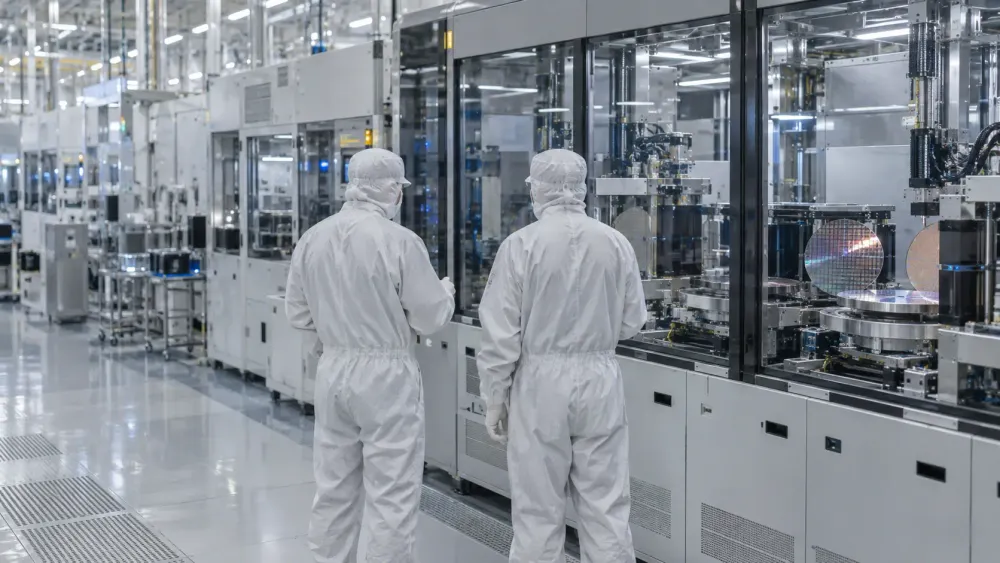
Chinese memory-chip maker CXMT says its fifth-generation manufacturing platform can produce at least 50% more gross DRAM dies per wafer than its previous process, a potentially important cost and capacity gain as China tries to build a larger domestic memory industry. The company also introduced two 24-gigabit LPDDR5X products made on the platform and said both are already in mass production, according to Reuters.
The announcement is significant because DRAM is the short-term working memory used by smartphones, computers and servers, and because the market remains concentrated among Samsung Electronics, SK hynix and Micron Technology. But CXMT's central claims have not yet been independently verified. Gross dies per wafer measure how many chips can theoretically be cut from a wafer before defective units are removed; they do not reveal the yield of chips that pass testing or the volume customers have qualified.
A denser process reaches production
CXMT said it reduced the spacing of key storage features to 11.95 nanometers by using quadruple patterning, which repeats manufacturing steps to create finer circuit patterns. Packing those features closer together can increase the amount of memory on a chip and the number of chips produced from a wafer. The company said simulations and joint work with Chinese equipment suppliers helped it develop the process.
The two new LPDDR5X products each hold 24 gigabits, 50% more data than CXMT's previous comparable 16-gigabit devices. That is a notable change from the company's public catalog, which lists LPDDR5X die capacities of 12 and 16 gigabits and speeds up to 10,667 megabits per second. LPDDR5X is designed for low-power devices, especially smartphones and other portable electronics, where greater capacity must be balanced against heat and battery use.
The yield question remains unanswered
The distinction between gross die count and usable output matters. A smaller die can raise the theoretical number of chips on a wafer, but manufacturing defects can erase part of that benefit. CXMT did not disclose production yield, shipment volume, customer qualifications or pricing for the new products. Those measures will determine whether the process can compete commercially, not only whether it can operate in a factory.
The company also said the new platform lowers cost and power use, but it did not publish independently audited comparisons. Its assertion that the process is on par with the most advanced mass-produced industry nodes should therefore be treated as a corporate claim. Mass production marks a manufacturing milestone, but it is not by itself evidence of parity in yield, reliability, scale or cost.
CXMT is broadening its mobile portfolio
The new LPDDR5X chips follow CXMT's September 7 announcement that its LPDDR6 memory had entered mass production in Xiaomi's 18 Fold smartphone. CXMT said that 16-gigabyte package could reach 12,800 megabits per second and use 20% less power than its LPDDR5X predecessor, while noting that the performance figures came from internal testing. The company also described more than 100 design-and-process optimizations.
Reuters previously reported that Xiaomi confirmed the LPDDR6 supply plan and that CXMT's first-half revenue had risen 874% from a year earlier to 150.3 billion yuan. The smartphone placement gives CXMT a visible commercial customer for its newest mobile-memory generation, though one device win does not establish broad market adoption.
A concentrated market faces a fourth supplier
Industry researcher TrendForce estimated that Samsung held 39.4% of global DRAM revenue in the second quarter of 2026, followed by SK hynix at 24.9% and Micron at 23.3%. Together, the three companies accounted for nearly 88% of the market. TrendForce said total industry revenue rose 59.5% from the prior quarter to about $154.73 billion as contract prices climbed and artificial-intelligence servers absorbed more advanced memory.
Within mobile DRAM, TrendForce's May analysis described Samsung, SK hynix, Micron and CXMT as an emerging “Big Four.” It said CXMT had used its strength in older LPDDR4X products to narrow the revenue-share gap with Micron in consumer mobile memory. Moving 24-gigabit LPDDR5X products into mass production would push CXMT further beyond those mature products and into a more demanding segment.
Why the milestone matters
CXMT's progress has strategic weight as U.S. export controls restrict China's access to some advanced chipmaking equipment and software. Quadruple patterning offers a route to finer features through repeated steps, but added process complexity can create its own cost and manufacturing challenges. The commercial test will be whether CXMT can sustain high yields and reliable shipments while qualifying the chips with major device makers.
For buyers, another credible supplier could eventually broaden sourcing and add competition in a market dominated by three companies. For incumbents, the announcement is an early warning that China's leading DRAM producer is advancing in both current-generation LPDDR5X and newer LPDDR6. The evidence so far supports calling the platform a meaningful production milestone, not proof that CXMT has matched the global leaders. Yield data, customer disclosures and shipment volumes will show how large the advance really is.