
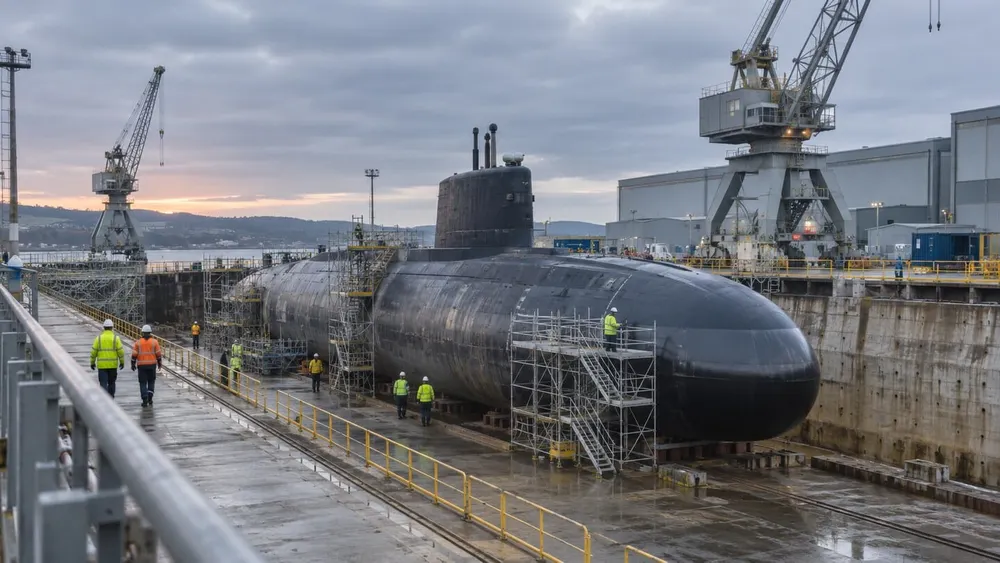
Britain awarded Babcock an £8.7 billion, five-year agreement on Thursday to maintain and support the Royal Navy’s nuclear submarines, the largest contract in the company’s history and a direct attempt to reduce maintenance delays that have strained fleet availability.
The agreement, which takes effect Dec. 1, combines submarine maintenance, engineering and naval-base services at Devonport and Clyde under a single framework. Britain’s Ministry of Defence described the award as roughly £8 billion, while Babcock’s £8.7 billion figure includes the five-year package it has booked and related framework value. The company said the arrangement could ultimately extend to 15 years under a separate memorandum.
The deal is consequential because it targets the industrial system that determines how quickly submarines return to service, rather than buying a new class of vessel. The government says it will support 8,500 existing jobs, create 3,000 additional positions and provide more than 2,500 apprenticeship and graduate opportunities. Those are commitments attached to the contract, not evidence that submarine availability has already improved.
A new performance framework
The Gateway Agreement replaces the Future Maritime Support Programme, whose latest extension ends Nov. 30. In a statement to Parliament, Defence Readiness Minister Luke Pollard said the new framework would put greater emphasis on outputs, productivity and accountability, with the ministry holding Babcock to its contractual commitments. The statement said the arrangement is intended to address historical maintenance backlogs and support the First Sea Lord’s maintenance recovery plan.
Government documents do not publicly specify a fleetwide availability target, a timetable for clearing the backlog or the detailed penalties that would apply if work runs late. That makes the performance framework important but not yet independently measurable. The public test will be whether refits become more predictable and operational availability improves without costs moving into adjacent infrastructure programs.
Readiness pressure behind the award
The contract follows sustained concern about the Royal Navy’s ability to keep enough submarines available. Reuters reported that maintenance constraints had contributed to longer-than-usual deployments and that the government framed the agreement as part of a broader readiness push. Babcock shares rose 6% after the announcement, reflecting the commercial scale of the award as well as expectations for additional long-term work.
Recent reporting illustrates the operational burden. The Guardian said HMS Vengeance completed a 217-day patrol this month, while the head of the Royal Navy had called for better submarine maintenance. Separately, a House of Commons Defence Committee report published last month cited evidence of low attack-submarine availability and asked the government for a plan to improve the readiness of frigates, destroyers and attack submarines before 2030.
Jobs and supply-chain capacity
The parliamentary statement breaks the 3,000 planned new jobs into 1,600 at Devonport, 900 at Clyde and 500 in Bristol and other locations. It also says £2.4 billion will flow through the wider British supply chain, including £1 billion targeted at small and medium-size businesses. The workforce expansion is meant to relieve a less visible constraint in nuclear ship support: the limited pool of cleared engineers, technicians and project managers able to work on regulated facilities.
The agreement sits beside, rather than replaces, a much larger naval infrastructure program. The ministry says Project Royal Oak will direct £26 billion over 10 years to modernize facilities and accommodation at Devonport, Clyde and Portsmouth. Keeping the service contract and capital construction program distinct matters because both are required for improvement: a larger workforce cannot eliminate a dry-dock bottleneck on its own, while new facilities cannot raise throughput without enough skilled personnel and disciplined scheduling.
What the agreement can and cannot prove
The contract creates incentives and capacity, but it does not by itself demonstrate better military readiness. Availability depends on the condition of individual boats, regulatory approvals, dock access, parts, workforce productivity and the interaction between current Vanguard and Astute fleets and future Dreadnought-class submarines. Many of those variables sit across multiple organizations, making responsibility harder to isolate when a schedule slips.
The government’s case is that consolidating services and tying compensation more closely to delivery will improve coordination. Babcock’s case is that a longer framework supports investment in people and infrastructure. Both positions are plausible, but both come from parties to the agreement. Independent assessment will require published evidence on turnaround times, milestones, costs and operational availability.
The first measures to watch
The most immediate milestone is the Dec. 1 transition from the existing support program to Gateway. Hiring and training will take longer, and the contract’s five-year term means its central promise should be judged over successive maintenance cycles rather than a single deployment.
Britain has therefore made a large and specific bet on maintenance capacity as the route to stronger submarine readiness. The award establishes money, commercial structure and workforce goals. It does not settle whether the Royal Navy can clear its backlog or consistently shorten refits, questions that will depend on transparent performance reporting after work begins.