Two Italian air-defense technicians were killed and two other people were injured Thursday after drones struck a Kuwaiti military installation, turning a regional exchange of long-range attacks into a lethal test of Kuwait’s ability to protect fixed defense sites. Kuwait and Italy attributed the drones to Iran, while Tehran denied conducting any military operation in the area and offered to join an investigation into who launched them.
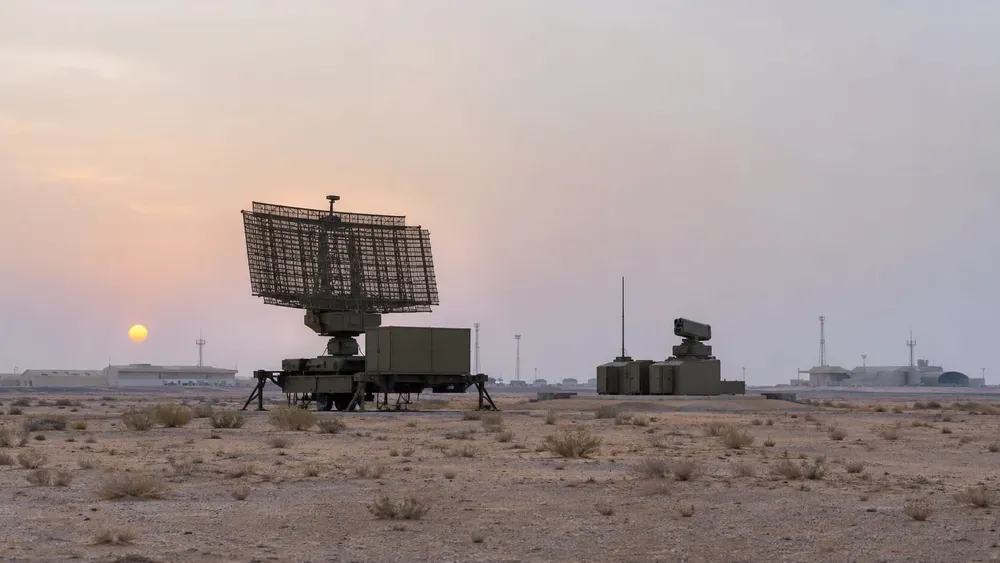
The victims worked for Rheinmetall Italia and were maintaining detection antennas for Kuwait’s Skyguard air-defense system, according to an official statement from Italy’s Foreign Ministry. Italian Foreign Minister Antonio Tajani told the Senate that the attack occurred around 2 p.m. local time and that the two other people injured were a Pakistani national and a Kuwaiti Army captain. Kuwait’s Defense Ministry said debris fell after its forces intercepted drones targeting what it called a vital facility.
Attribution remains contested
Kuwait described the incident as Iranian aggression, and Tajani told the Italian Senate record that drones of Iranian origin had targeted multiple Kuwaiti military installations. Neither government publicly identified the launch location, model, flight path or forensic evidence available when it made that attribution.
Iran’s senior armed-forces spokesman denied that Iranian forces had carried out offensive operations in the region. Foreign Minister Abbas Araqchi separately said Tehran was prepared to participate in a joint inquiry with Kuwait, Reuters reported. Tajani later said investigators had determined that the drone was manufactured in Iran but acknowledged that Iranian-made systems are also operated by proxy forces. That distinction is central: identifying a weapon’s origin is not the same as establishing who launched it or who authorized the attack.
A defensive success with deadly consequences
Kuwait said its forces intercepted the incoming drones, but the deaths illustrate a persistent weakness in counter-drone defense. Destroying an aircraft in flight can prevent a direct impact while still sending engines, warheads and structural fragments toward people or facilities below. Interception therefore does not by itself establish that a defended site was protected without loss.
Skyguard is intended for short-range protection of fixed positions. Rheinmetall describes the system as an inner layer for defending vital points and critical military infrastructure against small and fast aerial targets, according to its system overview. The technicians’ presence at the site underscores another operational reality: modern air defenses depend on civilian specialists, maintenance cycles, radar availability and command networks, not only interceptors. Personnel supporting those systems can become exposed when attacks are repeated or timed to exploit maintenance activity.
Kuwait’s role raises the stakes
Kuwait is not merely adjacent to the conflict. It is a major U.S. defense partner and logistics hub, with American forces located at several bases under a bilateral defense-cooperation framework. A State Department account describes cooperation spanning air and missile defense, maritime security, cybersecurity and counterterrorism. The Associated Press reported that Thursday’s incident was the second time this month Kuwait said it had been targeted.
That strategic position makes attribution especially consequential. A confirmed state-directed strike on a Kuwaiti military facility would carry different diplomatic and military implications from an attack launched independently by an aligned armed group. Until investigators disclose launch data, recovered components or command evidence, the responsible actor remains disputed even though the physical attack and casualties are confirmed by Kuwait and Italy.
Pressure is spreading across Gulf routes
The Kuwait attack occurred as maritime incidents continued around the Strait of Hormuz. A tanker about 50 nautical miles west of Dubai reported two nearby explosions on Wednesday, while another tanker was struck about 18 nautical miles east of Khasab, Oman. Crews were reported safe, and investigators had not publicly attributed the projectiles.
A November 26 UKMTO advisory counted 17 tankers struck in the Strait of Hormuz since November 1 and said visible commercial traffic remained far below its 2025 baseline. The monitor recorded only three cargo-carrying vessel transits above 1,000 deadweight tons from November 22 through 25, although U.S.-assisted transits averaged about 32 per day. Iran’s Revolutionary Guard said two tankers had hit mines after attempting to transit without authorization, but the Associated Press said that account could not be independently verified.
The investigation will determine the next risk
The immediate questions are technical rather than rhetorical: where the drones launched, whether they were remotely controlled or preprogrammed, what fragments survived, and whether radar or communications data can identify their route. A credible joint investigation would also need to separate manufacturer, operator and command responsibility.
For Kuwait, the incident shows that layered air defense must account for debris zones and the protection of technicians as well as successful intercepts. For Italy, it creates a direct casualty link to a conflict involving a defense contractor’s civilian employees. And for the wider Gulf, the combination of attacks on military sites and repeated incidents near shipping lanes increases the chance that a misattributed or poorly understood strike could trigger retaliation before the evidence is complete. What is established is that two civilians died at an air-defense site; who ordered the launch remains the critical unresolved fact.