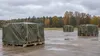
Poland reported Friday that Russian objects entered its airspace and fell on its territory during an overnight attack on Ukraine, prompting Warsaw to seek stronger allied support. Polish authorities said nobody in the country was injured and reported no damage to critical infrastructure.
The defense ministry identified a Kh-101 cruise missile at Nowy Lipowiec and described ongoing work at other locations. The incident brings the war’s risks onto the territory of a NATO member while leaving important questions about the other objects and the circumstances of their flight under investigation.
Officials distinguish confirmed and preliminary findings
Reuters reported Defense Minister Władysław Kosiniak-Kamysz’s assessment that the three objects were probably two missiles and a jet-powered drone. That formulation distinguishes the identification of one missile from less definitive descriptions of the other objects. Treating every initial assessment as equally conclusive would erase the uncertainty in the official account.
The ministry described activity at Nowy Lipowiec, Mołodycz and Rudnik nad Sanem. It said Polish and allied aircraft operated overnight, supported by surveillance and refueling assets. Those deployments establish a military response; they do not, by themselves, explain the trajectory or intended target of each object.
The absence of reported casualties is important but does not make the incursion inconsequential. Debris identification, flight data and operational records can help determine what occurred. A declaration that an event was a provocation is a political and military assessment that should be attributed to the officials making it.
Warsaw calls the incident deliberate
AFP reported that Prime Minister Donald Tusk called the incident intentional and linked it to European military exercises taking place in southeastern Poland. He said the objects had fallen near the area of the drills. The relationship between the timing and the exercises is Warsaw’s stated interpretation, rather than an independently established account of Russian intent.
AFP said the Kremlin had not commented at the time of its report. Without a substantive Russian explanation in that account, the publicly available evidence does not settle Moscow’s stated position on the specific incident. It also does not justify inventing a response or assuming that silence confirms another government’s interpretation.
The exercises were preparing forces for a potential postwar mission in Ukraine. Their continuation is distinct from a decision to deploy troops into Ukraine or conduct combat against Russia. An incursion near an exercise does not automatically change the exercise’s mandate, and the Polish minister said the planned training would proceed.
Support requests are not automatic treaty decisions
Kosiniak-Kamysz said he would seek additional support for NATO’s eastern-flank operations. AFP also reported that Tusk asked NATO Secretary General Mark Rutte for recommendations on strengthening the flank. Requests for support begin a political and military process; they do not establish that specific reinforcements have already been approved or arrived.
NATO explains that consultation is central to its decision-making and that alliance decisions are made by consensus. Article 4 provides for consultations when a member considers its territorial integrity, political independence or security threatened. Consultation should not be conflated with an automatic commitment to a particular military response.
The sources reviewed for this report do not establish a new formal treaty invocation resulting from Friday’s incident. An official confirmation would be required before reporting one. Statements condemning the incursion, requests for assistance and decisions about military measures remain separate developments even when they occur close together.
The consultation process allows allies to exchange information and discuss options before reaching agreement. NATO describes it as a means of reinforcing the alliance’s political role and preventive diplomacy. That is relevant to an incident with an evolving evidence base: allies can review what is known and consider additional protection without the reporting assuming a predetermined outcome. Any subsequent decision should be assessed on its own announced terms, including the forces involved, their location and the task they are assigned.
Information claims require their own scrutiny
Poland’s digital ministry said it intensified monitoring after the reports and identified misleading narratives, including claims of a Ukrainian provocation and AI-generated material impersonating officials. The announcement documents the government’s account of the information response, not a finding that every disputed online claim has the same origin.
That warning adds another verification task to the physical investigation. A circulating video, assertion about a missile’s route or purported official statement needs authentication before it can establish what happened. The ministry’s concerns about manipulated content do not replace the need to assess military evidence, but explain why immediate online explanations deserve care.
The confirmed public development is Poland’s report of an airspace violation, recovered missile debris and requests for allied support, with no reported injuries in Poland. Further official identification of the other objects and any announced alliance measures will clarify the response. Until then, the evidence supports a serious security incident without assuming that all questions of intent or escalation have been resolved.