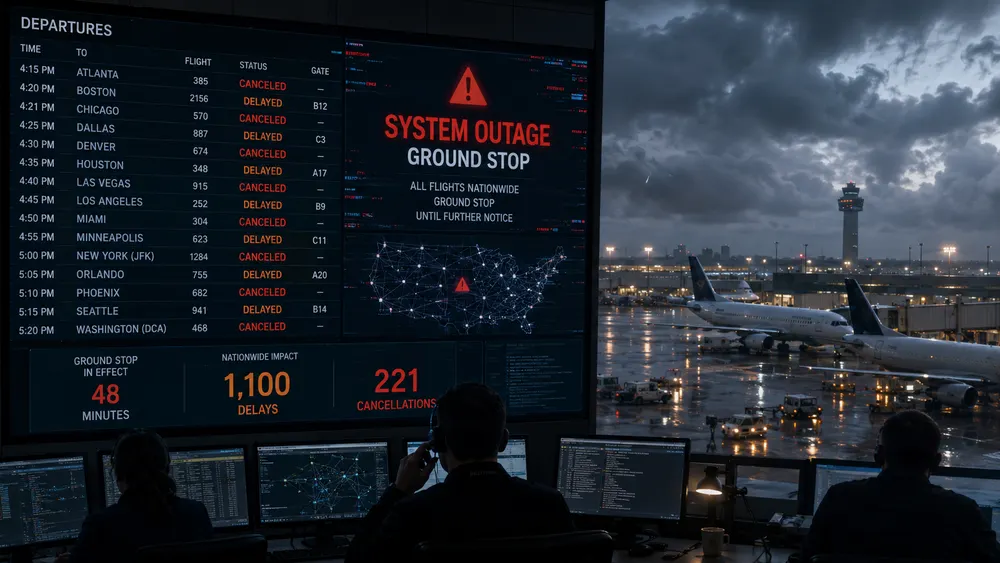
A technology failure at American Airlines on the evening of July 28 forced the FAA to issue a nationwide ground stop for the carrier at roughly 6:30 p.m. ET, the third such systemwide grounding for American in two years. The stop lasted about 48 minutes before systems came back online, but by day's end flight-tracking data showed roughly 1,100 American flights delayed and 221 canceled — about 30% and 6% of the carrier's schedule, respectively. The outage struck during an already turbulent night, as severe thunderstorms across the Northeast contributed to more than 2,500 flight cancellations nationwide. Flightradar24 counted 130 fewer aircraft airborne at the peak of the disruption than at the same hour a week earlier.
What Happened
Just before 6:30 p.m. ET on July 28, American Airlines requested that the FAA's Air Traffic Control System Command Center halt all of its departures nationwide after a "technology issue" disrupted connectivity for some of its internal systems. Aircraft already in the air were unaffected and continued to their destinations; the restriction applied only to departures that had not yet left the gate. Passengers reported trouble checking in and tracking flights, with DownDetectorlogging more than 1,400 complaints about the airline's app within the first 15 minutes. The FAA lifted the nationwide order at 7:18 p.m. ET, though a narrower, localized stop remained in effect longer at Charlotte Douglas International Airport, one of American's largest hubs. American has not disclosed which system or vendor failed, only that "connectivity" for unspecified operational systems was interrupted.
The Numbers Behind the Disruption
FlightAware's tallies put the scale of the fallout at roughly 1,100 delays and 221 cancellations attributable to American on July 28 — figures that reflect both the outage itself and the storm system moving through the region at the same time. Arrival delays at Charlotte, where the localized stop lingered, climbed from a 24-minute average to 49 minutes as the backlog built, with aviation-data trackers estimating a 30–60% chance the localized restriction would run past its initial window. Industry analysts noted the outage's operational fingerprint — a connectivity failure that appears to freeze multiple dependent systems such as dispatch, weight-and-balance, and crew scheduling simultaneously — matches the pattern of American's prior IT failures on Christmas Eve 2024 and in June 2025. The outage also landed atop an unusually stormy stretch: separate weather-driven ground stops hit Newark, LaGuardia and JFK the same evening, where more than 1,000 flights to and from the three airports were canceled independent of American's technology problem.
What Travelers Should Know
American said in a statement that connectivity had been fully restored and apologized for the inconvenience, but cautioned that recovery from a schedule disruption of this size typically extends well beyond the technical fix, since displaced aircraft and crews must be repositioned across the network. Passengers whose flights were affected are entitled under Department of Transportation rules to a rebooking on the next available flight or a full refund if they choose not to travel, and airlines generally cannot charge change fees for disruptions of their own making. Because the American outage was a self-inflicted technology failure rather than weather, it falls into a different regulatory category than storm-driven cancellations, which are typically exempt from compensation requirements. Travelers connecting through Charlotte, or flying American during the days following the incident, were advised to check flight status directly through the airline's app before heading to the airport, as residual delays from backlog clearing can persist for a day or more after systems are restored.
The Broader Pattern
The July 28 event arrived during what aviation trackers have described as one of the most disruption-heavy summers in recent memory. Independent of the American outage, the US Flight Disruption Index climbed through July as storm systems repeatedly overwhelmed East Coast and Midwest hubs — a separate event seven days earlier had already disrupted more than 5,600 flights in a single day. TSA has also been screening record volumes of travelers this summer, with a single-day peak of roughly 3.1 million people screened in June, meaning airline networks are absorbing technology failures with less operational slack than in past years. That the American incident marked the airline's third nationwide, self-caused ground stop in roughly two years has renewed scrutiny of aging airline IT architecture, though neither American nor federal regulators have identified a specific vendor, software system, or root cause as of this writing. The full extent of the July 28 disruption — including how many days of residual delays followed — remains to be tallied, underscoring how difficult it is to fully separate a single company's technology failure from the broader summer travel strain playing out across the industry.