Regulators in Texas have authorized a natural-gas plant built to power Amazon's newest artificial-intelligence data center to emit up to 33 million tons of carbon dioxide equivalent per year, according to permitting records filed with the Texas Commission on Environmental Quality. That ceiling, if the plant ever ran at its full permitted output, would make it the single largest source of climate pollution among power plants in the country, according to the Times.
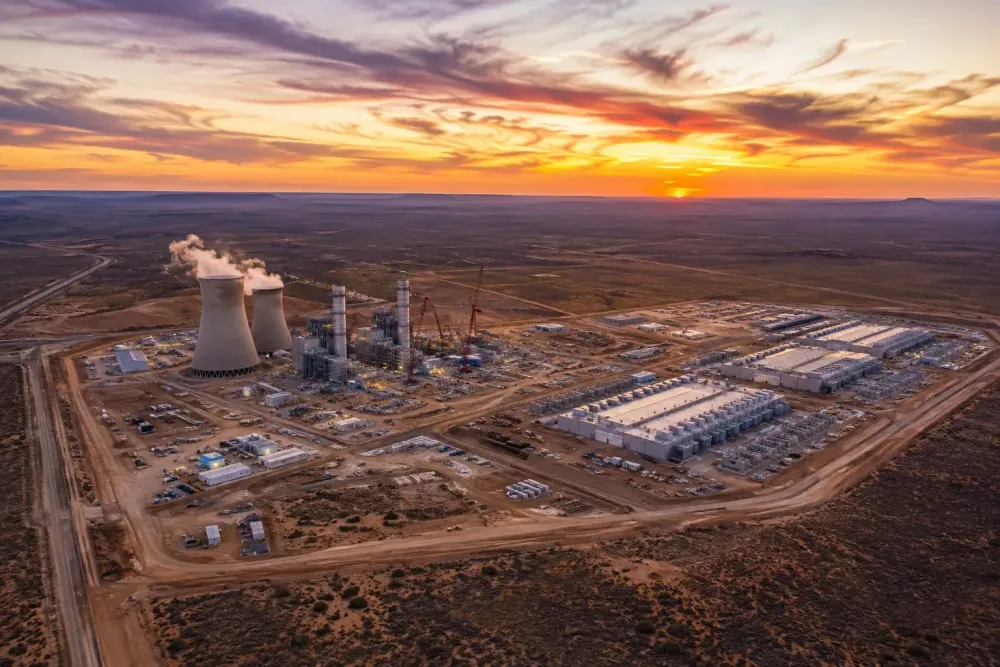
Amazon confirmed on August 7 that it is financing the facility, known as GW Ranch, on an 8,000-acre site in Pecos County in West Texas, roughly 17 miles north of Fort Stockton, according to the same TCEQ filing. The plant, developed by Pacifico Energy under the entity Pacifico GW LLC, will supply electricity directly to an adjoining Amazon data center campus rather than feeding the state's public grid. That arrangement lets the project skip the years-long queue new generators typically face before connecting to Texas grid operator ERCOT, an approach also used elsewhere by companies racing to power AI computing, according to Yahoo Finance.
What the permit authorizes
The TCEQ document lists the full slate of pollutants allowed annually: 837.99 tons of volatile organic compounds, 5,955.12 tons of carbon monoxide, 2,830.28 tons of nitrogen oxides, 397.70 tons of sulfur dioxide, 1,924.77 tons of ammonia, 998.82 tons of particulate matter, and 33,212,284.72 tons of carbon dioxide equivalent, according to the permit summary. That greenhouse-gas allowance alone equals nearly 5 percent of Canada's total annual emissions, according to the Observer, which first reported the permit's scale in January. Griffin Bird, a research analyst who tracks gas-plant permitting for the Environmental Integrity Project, told the outlet he would "be hard-pressed to think of a bigger emitter."
The facility centers on 35 simple-cycle gas turbines capable of producing up to 7.65 gigawatts, according to Pacifico's filings — more than any currently operating gas plant in the United States, according to Yahoo Finance. The site is also planned to include 1.8 gigawatts of battery storage and 750 megawatts of solar capacity, intended to reduce the frequency with which the turbines need to run.
It is worth clarifying what the 33-million-ton figure represents. A permit authorizes a legal ceiling assuming turbines run at full output for all 8,760 hours in a year — not a forecast of actual emissions. Facilities rarely emit at their permitted maximum, and Amazon says the added solar and storage should cut real-world reliance on gas, according to Yahoo Finance. Still, independent estimates suggest the real number could be large: if run near full capacity, GW Ranch could burn between 1 billion and 2 billion cubic feet of gas daily, equal to 4 to 7 percent of all gas produced in the Permian Basin in 2025, according to calculations by Rice University's Gabriel Collins cited by the Observer. Collins called that "a very material chunk" even for a basin the size of the Permian, while cautioning that megaprojects sometimes fall short of advertised scale or arrive gradually, "100 megawatts at a time."
Amazon's response and its climate pledge
Amazon spokeswoman Margaret Callahan said the campus is "powered by new on-site generation that won't raise electricity costs for Texas families" and is "designed to transition to grid-connected service as interconnection timelines allow," according to the Times. Amazon separately said it has enabled 40 carbon-free projects totaling nearly 10 gigawatts elsewhere in Texas and is examining further solar and storage additions at the GW Ranch site itself, according to Yahoo Finance.
The disclosure sits uneasily beside Amazon's existing climate pledge. The company co-founded the Climate Pledge in 2019, committing to net-zero operations by 2040. Callahan acknowledged the tension, telling the Times, "The world looks different now than when we co-founded the climate pledge," while adding, "our commitment hasn't changed." Amazon's own disclosures show emissions rising in each of the past several years, a trend the company has linked in part to growth in AI infrastructure. This strain is not unique to Amazon — other large cloud providers pursuing similar on-site power strategies, including gas, nuclear, and orbital solar arrangements, face comparable tension between near-term AI power needs and existing sustainability targets, an industry-wide structural pattern rather than any single company's choice.
Why gas, and why off-grid
The move toward dedicated, "behind-the-meter" generation reflects two converging pressures rather than a preference for fossil fuels specifically. Connecting a facility this large to the existing grid can take years, given interconnection backlogs, so building off-grid lets construction proceed immediately; land clearing at the site was already visible in satellite imagery by late July, according to Yahoo Finance. Separately, rising public frustration over electricity bills near new data centers has made utilities more cautious about approving new grid-connected demand, pushing companies toward self-supplied power instead.
GW Ranch is not isolated. Texas's pipeline of gas-fired power projects grew by nearly 58 gigawatts of planned capacity in 2025 alone, exceeding California's peak electricity demand, according to Global Energy Monitor data cited by the Observer. Roughly 40 gigawatts of that total is intended to power data centers directly. Comparable projects include Fermi America's 6-gigawatt Project Matador near Amarillo, permitted to emit up to 24 million tons annually, and a Chevron-backed plant of up to 5 gigawatts in West Texas — the oil major's first power plant. Only China has more gas-power capacity under development than Texas currently does, according to the same Global Energy Monitor analysis.
The financial backdrop
The Pecos County project arrives as Amazon repeatedly raises its own capital-spending targets for AI infrastructure. The company told investors in July it now expects to spend roughly $220 billion on capital expenditures in 2026, up from an earlier estimate of $200 billion, with the increase largely attributed to higher memory-chip costs, according to Reuters. Chief executive Andy Jassy told investors that demand for AI computing capacity continues to outstrip supply despite the higher spending, with data centers absorbing the bulk of that budget.
What remains unresolved
Several details are still unsettled. The TCEQ permit sets an emissions ceiling but does not commit Amazon or Pacifico to a firm construction timeline for all 35 turbines; operators must file within 180 days of construction start to specify exact turbine models and real emissions rates. Water use for cooling has not been detailed in public filings reviewed so far. And while Amazon calls the project "designed to transition to grid-connected service," no timetable for that transition, nor a figure for how much power the site might eventually draw from or contribute to ERCOT, has been disclosed. The gap between the permitted ceiling and the plant's actual footprint likely won't be clear until turbines begin operating, with first power targeted for early 2027.