
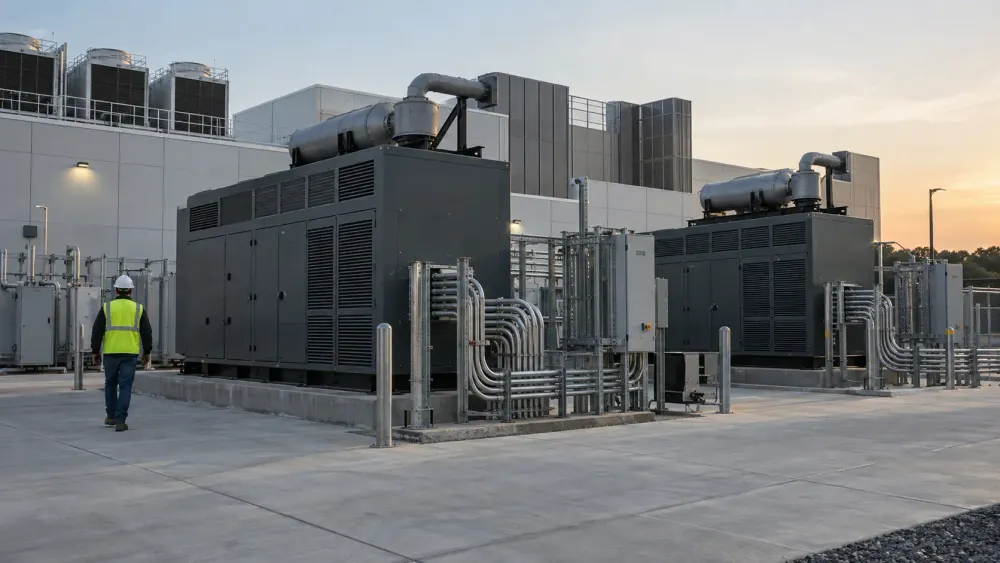
Amazon has committed $2.4 billion to buy large backup generators from Generac for delivery in 2027 and 2028, placing an unusually concrete price tag on one component of the data-center buildout supporting cloud computing and artificial intelligence. The companies’ long-term supply agreement, disclosed Wednesday, links a major buyer of computing infrastructure with a manufacturer that has been rapidly expanding beyond its familiar residential-generator business, according to Reuters.
The transaction is more than a conventional equipment order. Generac also granted an Amazon affiliate a warrant to buy as many as 1,693,745 Generac shares at $200.9266 each. A portion vested immediately, while the remainder is tied to Amazon’s payments for eligible generators. That structure gives Amazon potential equity participation if its purchases expand, and it gives Generac a large, visible customer commitment as it invests in production capacity.
The Warrant Ties Equity to Purchases
Generac’s filing says 307,954 warrant shares vested when the agreement was signed on Sept. 16. The rest vest as Amazon makes qualifying payments, on a schedule that extends to an $8 billion cumulative-payment threshold. The warrant is exercisable through Sept. 16, 2033, subject to its contractual terms.
That $8 billion figure should not be confused with a guaranteed order. The disclosed initial deliveries total about $2.4 billion across 2027 and 2028. The larger amount defines the upper end of the warrant’s vesting mechanism if additional purchases occur. For investors, the arrangement creates two opposing considerations: more Amazon spending could deepen Generac’s revenue opportunity, while exercise of the warrant could add shares and dilute existing holders. Generac shares rose sharply in after-hours trading after the agreement became public, Barron’s reported.
Data Centers Are Rewriting Generac’s Mix
The Amazon agreement arrives during a measurable shift in Generac’s business. In the second quarter, companywide sales rose 11% from a year earlier to $1.17 billion. Commercial and industrial sales increased 29% to $556 million, while residential sales declined 2% to $617 million. Generac attributed the industrial segment’s core growth mainly to rising data-center revenue, according to its earnings release filed with the Securities and Exchange Commission.
Management said in July that its data-center backlog had reached approximately $1.6 billion after about $1 billion of additional orders since the prior update. That total excluded committed volume from a second hyperscale customer whose product terms were still being negotiated. Generac separately said an earlier hyperscale agreement had already produced nearly $700 million of committed 2027 volume. The new Amazon order therefore strengthens a trend that was visible before this week: large computing campuses are becoming a central source of Generac’s growth rather than a side business.
Production Capacity Becomes the Test
A signed contract does not eliminate execution risk. Generac must manufacture, package and deliver large-megawatt systems on schedule while managing component availability, labor and customer-specific requirements. The company acquired Enercon and added a facility in Belvidere, Illinois, during the second quarter to expand large-generator packaging capacity. It also said it planned further investment as its opportunity pipeline developed.
Those investments matter because data-center customers generally require redundant backup systems and precise delivery coordination. Generac’s own disclosures identify raw-material availability, reliance on certain suppliers, manufacturing disruptions and contract terms involving cancellation rights or delivery obligations as risks. The Amazon agreement improves revenue visibility, but the profitability of that volume will depend on pricing, factory utilization, input costs and Generac’s ability to scale without eroding margins.
Reliability Has a Local Footprint
Backup generators are designed for outages and testing rather than continuous electricity production, but the number of units planned for very large campuses can make their local effects significant. In North Carolina, for example, Amazon-related permit applications covered hundreds of diesel generators for a proposed data-center complex, prompting a public review of air emissions, WRAL reported. That project is separate from the Generac contract, but it illustrates the scale at which backup-power decisions can reach local regulators and residents.
Federal requirements also apply to many stationary engines. The EPA regulates stationary reciprocating internal-combustion engines under rules addressing hazardous air pollutants and performance standards. Specific obligations depend on an engine’s design, fuel, size, age and operating conditions. As data-center construction accelerates, buyers and suppliers will face pressure to balance high reliability with emissions controls, testing limits, fuel logistics and community concerns.
What the Deal Proves—and What It Does Not
The agreement proves that at least one of the world’s largest data-center operators is willing to make a multiyear, multibillion-dollar commitment to backup-power hardware. It also shows how infrastructure suppliers can gain leverage from the AI investment cycle even when they do not make chips, train models or operate cloud software. Generac receives a significant forward order; Amazon obtains supply visibility and an equity-linked incentive tied to purchases.
It does not yet prove that Generac will receive $8 billion from Amazon, that every expected delivery will occur on time or that the contract will produce the margins investors anticipate. The most useful indicators will be backlog conversion, capital spending, production expansion, customer concentration and any revisions to 2027 and 2028 delivery expectations. For now, the $2.4 billion commitment is a consequential commercial validation of Generac’s data-center strategy—and a reminder that the AI economy depends as much on resilient physical power systems as on computing hardware.