
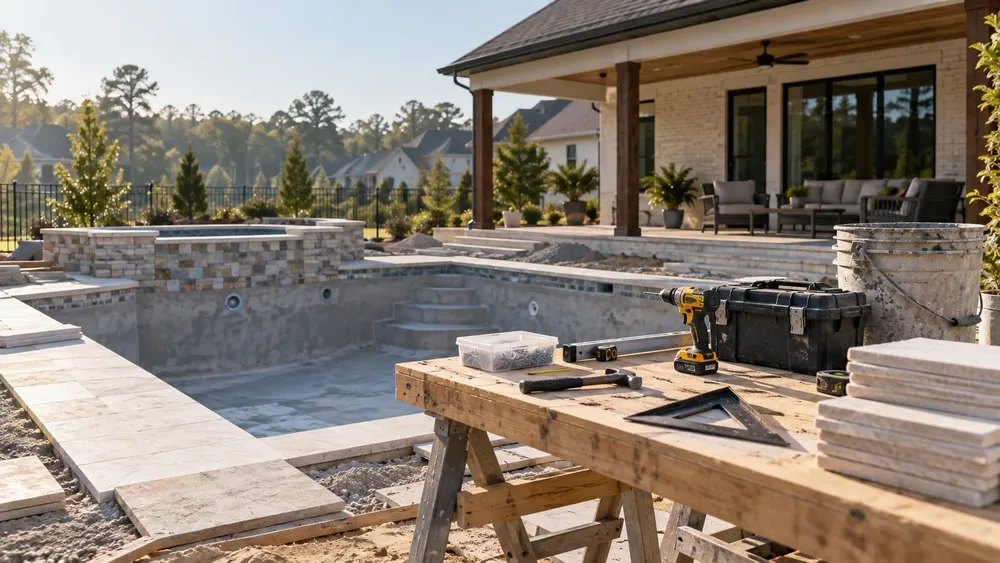
Alabama will broaden its exemptions from state general-contractor licensing on October 1, a change that directly affects residential pool builders and companies that perform recurring maintenance, cleaning and grounds work. The Alabama Licensing Board for General Contractors announced the change on September 10 and urged businesses to ask the board about borderline projects before bidding or starting work.
The new language comes from Act 2026-396, which amends Section 34-8-7 of the Alabama Code. It adds the construction or repair of a residential swimming pool to the same exemption that covers work on a residence or private dwelling. The law also removes the prior subsection that expressly kept swimming-pool contractors outside the statute’s general exemptions. Commercial pool projects are not named in the new residential exemption.
Beyond pools, the amended statute exempts several categories of routine or regular work. They include maintenance, repair, replacement, reinstallation or removal of equipment and specialized technological or facility systems; maintenance of existing security, lighting, plumbing, air-conditioning and electrical systems; routine cleaning and waste disposal; and ordinary landscape maintenance such as mowing, trimming, mulch placement and pressure washing. The Legislature’s October 1 version of Section 34-8-7 is the controlling text.
The broad-sounding list has an important limit. For the equipment and building-system categories, the statute leaves the board to determine whether work qualifies based on its scope, frequency and specialty. The law does not define “routine” or “regular.” The licensing board therefore says companies with questions about a particular job should contact it before committing to the work. A detailed industry analysis of the enacted language similarly cautions that full replacements or construction projects should not automatically be treated as maintenance.
The exemptions also do not erase other requirements. Local building permits and codes remain in place, and separately regulated electrical, plumbing or other trade work may still require credentials. Nor does the act change Alabama’s basic definition of a general contractor: under Section 34-8-1, nonresidential projects costing at least $100,000 generally fall within the licensing law unless an exemption applies.
For contractors, the practical dividing line is the start date and the job’s actual scope. Work performed before October 1 remains governed by the current statute, while work after that date may qualify for the new exemptions. Businesses that mix exempt maintenance with nonexempt construction will still need the appropriate license for the regulated portion. The board maintains a public license roster for customers and contractors checking a company’s status.
The change is substantial for residential pool companies because Alabama previously singled out their trade for stricter treatment. But the board’s warning means the law should not be read as a blanket deregulation of facilities work. Until the regulator publishes more detailed interpretations, firms near the boundary between maintenance and construction have a clear compliance step: obtain a project-specific answer before submitting a bid.