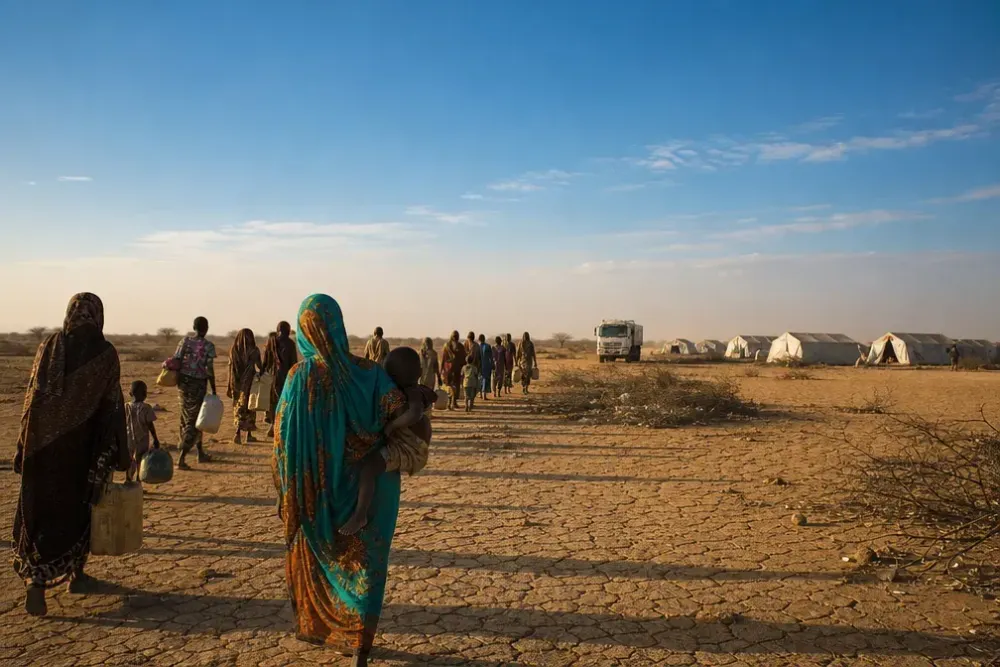
Six million people in Somalia are facing acute food insecurity while the World Food Program has only about one-tenth of the resources it had during the country's 2022 hunger emergency, when international assistance helped avert a formal famine declaration. Nearly 1.9 million children under five are expected to suffer acute malnutrition, including roughly half a million facing its most severe form, as drought, conflict, displacement and declining humanitarian funding converge again in one of the world's most chronically food-insecure countries. The AP reported the funding comparison Thursday after speaking with WFP leadership in Somalia.
The numbers resemble earlier Somali food emergencies, but the response capacity does not. The country's underlying vulnerability has accumulated through repeated droughts, decades of armed conflict and a population displaced from normal livelihoods. What has changed is the amount of international assistance available to interrupt that cycle before food insecurity progresses into mass mortality.
The current emergency therefore cannot be understood only as a shortage of rain. It is a shortage of food, income, security, accessible healthcare and humanitarian financing occurring simultaneously.
Drought becomes more dangerous when families have exhausted previous coping mechanisms
Somalia has experienced repeated failed rainy seasons and its lowest seasonal crop harvest in roughly three decades. The WFP currently estimates that 6.5 million people face crisis-level hunger or worse under the Integrated Food Security Phase Classification system, with about 2 million at emergency levels. The difference between that broader projection and the six million figure cited in the latest AP reporting reflects differing assessment periods and classifications rather than evidence that millions of people suddenly entered or exited hunger conditions.
Repeated drought creates cumulative damage.
A household that loses livestock during one dry season may survive by selling assets. If another drought arrives before those assets are rebuilt, there is less left to sell. Farmers who lose crops may borrow money or consume seed reserves intended for the following season. Displaced families may abandon land entirely and become dependent on informal work or humanitarian assistance.
That is why identical rainfall deficits can produce very different humanitarian outcomes depending on what happened in previous years.
Food insecurity is not merely a measure of how much food exists nationally. It measures whether households can reliably obtain enough of it.
Nearly 2 million malnourished children turn a food crisis into a health-system crisis
The consequences become most acute among young children. WFP projects about 1.84 million children will suffer acute malnutrition during 2026, including more than 480,000 expected to experience severe acute malnutrition, according to its latest nutrition update.
Severe malnutrition weakens immune function and makes illnesses that would otherwise be survivable considerably more dangerous. Diarrheal disease, respiratory infections and measles can become lethal when a child lacks sufficient nutrition.
Treatment therefore requires more than distributing staple food.
Children with severe acute malnutrition may require therapeutic foods, medical evaluation, antibiotics when clinically indicated and monitoring for complications. Pregnant and breastfeeding women also require targeted nutritional support because maternal malnutrition can affect both mother and infant.
The latest reporting describes individual treatment centers receiving hundreds of patients a day even as other nearby facilities have closed for lack of funding. That shifts patients toward the facilities still operating and forces aid organizations to prioritize the most severely ill.
WFP says it can currently reach only about one in ten people who need assistance, according to its emergency page.
Conflict raises hunger twice: first by displacing people, then by making aid more expensive to deliver
Somalia's continuing conflict with al-Shabab compounds the food emergency in ways that extend beyond the immediate violence.
People flee farms, businesses and livestock when areas become unsafe. Markets can close. Roads become dangerous. Agricultural activity declines. Families who once produced some of their own food become purchasers or aid recipients.
Conflict then makes helping those same people more expensive.
Humanitarian organizations may be unable to move trucks safely through contested territory. Some locations require air transport, security arrangements or indirect delivery systems. Each additional logistical barrier means a fixed amount of funding reaches fewer people.
That is particularly consequential during a funding shortage. An organization with ample resources can absorb higher transportation costs while preserving food assistance. An organization operating with a fraction of its previous budget must choose between geographic coverage, ration size and the number of recipients.
The result is a feedback loop: insecurity increases humanitarian need while simultaneously reducing the efficiency of the humanitarian response.
The Middle East conflict is reaching Somali families through food and fuel prices
Somalia also imports much of what it consumes, making international commodity and transportation costs unusually important.
WFP says the wider Middle East conflict has sharply increased fuel costs and disrupted humanitarian supply chains, according to its Somalia briefing. Higher fuel prices affect fishing boats, farm equipment, trucks carrying food from ports, generators powering hospitals and aircraft delivering relief.
Food prices can rise even where the physical crop failure occurred hundreds or thousands of miles away.
That makes Somalia's hunger crisis partially global. International conflict affects shipping and fuel. Donor governments redirect humanitarian funding toward new emergencies. Higher global commodity prices reduce how much food each aid dollar can purchase.
A contribution large enough to feed a particular number of families when grain and transport were cheaper may support fewer families after both prices rise.
A famine warning is not the same thing as a famine declaration
The distinction matters because famine has a specific technical meaning under the IPC system. It requires extraordinarily high levels of household food deprivation, acute malnutrition and mortality.
The United Nations warned earlier this year that some Somali populations faced a risk of famine if poor rains, rising prices and inadequate humanitarian assistance persisted, according to a joint UN warning.
That is not a declaration that Somalia as a whole is in famine.
Nor does the absence of a famine declaration mean conditions are acceptable. Millions can experience severe food insecurity and hundreds of thousands of children can require urgent nutritional treatment without the technical thresholds being met across a defined geographic population.
The 2022 experience demonstrates why the distinction matters. Large-scale humanitarian intervention helped prevent projected famine conditions from becoming a formal declaration in several areas. Avoiding famine did not mean the crisis was minor; it meant intervention altered the outcome.
That precedent makes today's funding shortfall more consequential.
Somalia has experienced drought before. It has experienced conflict before. It has experienced mass displacement before. The emerging difference is that the international system confronting those familiar risks is doing so with substantially fewer resources.
The current warning is therefore not that famine is inevitable.
It is that six million people are moving through another severe hunger emergency while the institution expected to help prevent the worst outcome says it has roughly one-tenth of the resources it had the last time.