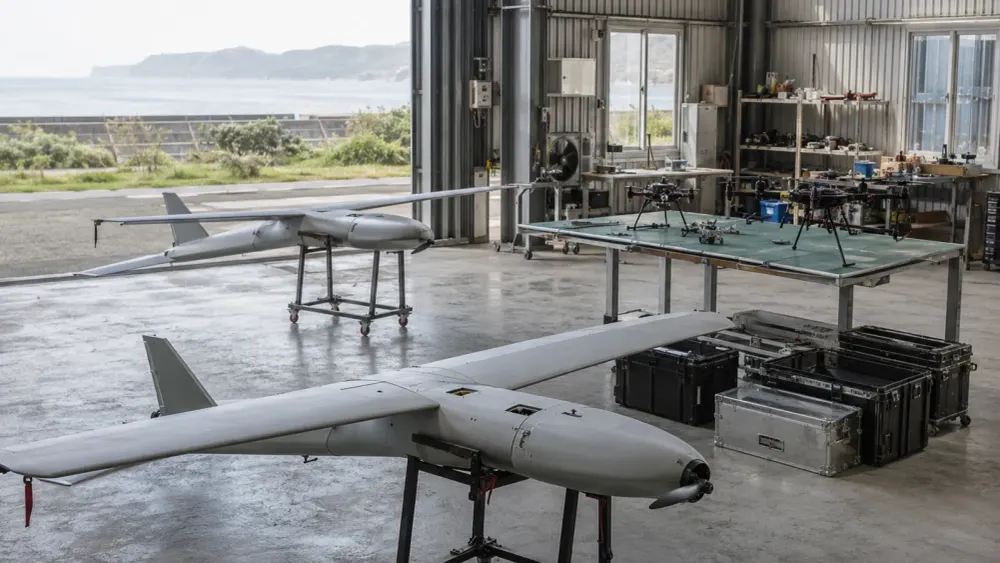
Taiwan’s cabinet proposed NT$145.7 billion, or about $4.6 billion, in additional 2026 defense spending Thursday, including more than 40,000 coastal attack drones, over 600 surveillance drones and the first batch of more than 100 small unmanned boats. The new package is a concrete attempt to move money toward locally produced systems after lawmakers approved only part of President Lai Ching-te’s larger special-defense request earlier this year.
The proposal combines two different approaches to deterrence. One is a relatively expensive medium-tier interceptor intended to engage tactical ballistic missiles. The other is mass: thousands of smaller uncrewed systems that could watch coastlines, complicate an amphibious assault and force an attacker to expend scarce munitions on numerous targets. Both matter, but neither is a fielded capability yet. The legislature must approve the money, manufacturers must deliver usable systems, and Taiwan’s armed forces must integrate them into units, communications networks and operating plans.
Filling a Budget Gap
The cabinet said the supplemental request would restore domestically produced items left out when the opposition-controlled Legislative Yuan approved roughly $25 billion in extra defense spending in May. That earlier action covered U.S.-sourced weapons but not the full mix Taipei sought. The new request therefore does not simply enlarge an existing shopping list; it changes its composition by putting local missiles and drones back into the 2026 funding stream.
That distinction also explains the urgency in the cabinet’s language. Officials said there could be no gap in national defense and that self-reliance could not wait. Yet the request arrives in a contested fiscal process. On August 27, lawmakers rejected a separate NT$210 billion government drone plan and passed a rival six-year framework totaling NT$240 billion, generally capped at NT$40 billion a year. The drone law offered more aggregate funding but imposed a slower annual rhythm and stronger legislative oversight.
The disagreement is therefore less about whether Taiwan needs unmanned systems than about how fast it should buy them and who controls the sequencing. Defense Minister Wellington Koo has argued that a NT$40 billion annual ceiling would be below the NT$42.1 billion his ministry planned for drones in 2027 alone. Opposition legislators say regular budgets produce better scrutiny. The supplemental request tests whether those positions can be reconciled without another delay.
A Layered Air-Defense Bet
The largest named conventional element is the medium-tier anti-tactical ballistic missile system known as Strong Bow. Taiwan’s defense ministry has described it as a domestically developed layer above the island’s Tien Kung III and U.S.-made Patriot PAC-3 systems. According to the ministry’s budget filing, the broader Strong Bow program is expected to cost NT$36 billion from 2026 through 2032, with the first Air Force deliveries scheduled for 2028.
Strong Bow is designed to intercept tactical ballistic missiles at altitudes up to about 70 kilometers. That does not make the island impermeable. Missile defense is a contest among sensor coverage, interceptor inventories, engagement doctrine and the volume and sophistication of an incoming attack. A higher layer can create another opportunity to intercept a threat, but it also requires reliable early warning, command links and enough rounds to withstand saturation. The number of systems and interceptors in the supplemental request has not been disclosed.
The cabinet’s choice reflects Taiwan’s effort to diversify beyond imported weapons. Lai has repeatedly paired foreign procurement with domestic production, describing asymmetric forces, drone defenses and joint development as linked priorities in presidential remarks. Local production can shorten some supply chains and make replenishment more responsive, but it cannot erase constraints in engines, sensors, communications components or explosives. A budget line is best read as industrial demand; its military value will depend on production quality, delivery schedules and operational testing.
Mass Without Illusions
The drone quantities are the clearest signal of a shift toward scale. More than 600 coastal surveillance and reconnaissance drones could extend observation around likely approaches. More than 40,000 coastal attack drones could distribute strike capacity among many small units. The first batch of at least 100 unmanned boats would add another layer near ports and landing areas. Together, they aim to make the waters and littoral around Taiwan harder to cross and easier to monitor.
Numbers alone can mislead. Small drones vary widely in range, endurance, resistance to electronic warfare, payload and autonomy. Systems that work in trials may fail when navigation is jammed, data links are disrupted or weather deteriorates. Taiwan must also train operators, stock batteries and spare parts, harden launch sites and connect sensors to commanders who can authorize engagements. The August legislation’s proposed 210,000-drone goal illustrated ambition, but the current supplemental request names a smaller near-term tranche rather than claiming that entire force exists.
The operating environment is not theoretical. Taiwan’s defense ministry publishes daily records of Chinese aircraft and vessels around the island; its latest MND tally recorded one People’s Liberation Army aircraft, five naval ships and three other official ships in a 24-hour period. Daily counts fluctuate, and one quiet interval does not define the trend. Persistent activity nevertheless requires Taiwan to distinguish routine patrols, coercive signaling and preparations that could precede a blockade or attack.
The Logic of Denial
Taiwan’s emphasis on mobile missiles and numerous unmanned systems follows a strategy of denial: survive an initial strike, preserve sensors and communications, and impose enough losses or uncertainty to prevent an attacker from achieving a rapid fait accompli. A detailed CNAS study describes how large numbers of relatively inexpensive autonomous systems could complicate an amphibious operation, especially when paired with mines, anti-ship missiles and resilient command networks.
That logic aligns with Washington’s stated emphasis on deterring China and increasing allied burden-sharing. The Pentagon’s 2026 strategy makes those goals explicit. But Taiwan’s program is not merely a response to U.S. pressure. The island faces a distinct geography: short warning times, limited strategic depth, exposed infrastructure and a coastline that makes early detection and dispersed defense unusually important.
Technology partnerships can help close specific gaps. Taiwan’s main military research institute previously signed a software pact with Auterion for drone software tested in Ukraine. Software, however, is only one layer. Effective swarms require secure updates, disciplined data governance and safeguards against compromised components. They also need doctrine that assigns missions among reconnaissance aircraft, one-way attack drones and unmanned boats without congesting radio spectrum or duplicating targets.
Approval Is the First Test
The supplemental request now meets the same political system that reshaped the earlier defense package. Lai’s Democratic Progressive Party does not control the legislature, and opposition parties can demand itemized costs, production milestones and audit rights. Those checks can improve a rushed program, but prolonged review can also destabilize suppliers that need predictable orders to expand factories and hire skilled workers. The practical question is whether scrutiny produces a better acquisition plan without turning annual timing into a capability gap.
Taiwan is simultaneously proposing a 2027 defense budget above NT$1 trillion for the first time. Lai’s remarks on Armed Forces Day argued that stronger deterrence protects regional peace, while Beijing accused his government of provoking confrontation and wasting public money. The rhetoric reflects incompatible political claims, but it does not resolve the procurement problem: Taiwan must translate spending into survivable forces faster than potential threats evolve.
The proposed mix is more consequential than its headline dollar value because it spans interception, sensing and distributed strike. It also exposes the limits of budgeting as a readiness measure. Contracts, delivered airframes, trained crews, tested networks and deployable units are different stages, and only the last produces operational capacity. Independent assessments of the cross-strait balance, including a CSIS review, show why Taiwan cannot assume that higher appropriations automatically close a widening capability gap.
If legislators approve the NT$145.7 billion request, the next evidence will come from award dates, unit prices, delivery rates and realistic exercises under electronic attack. Those measures will show whether the program is building a resilient defensive web or accumulating impressive quantities without the support system to use them. For now, Taiwan has defined the scale and direction of its answer: a higher missile shield, a much denser drone force and a renewed bet that domestic production can turn political urgency into military endurance.