The Wisconsin Supreme Court is weighing whether a property insurer may use an ordinance-or-law exclusion to deny payment for portions of a fire-damaged apartment building that a city later ordered demolished.
The justices heard arguments Wednesday in Distinguished Multiplying Buildings LLC v. Germantown Mutual Insurance Co., according to the archived court session. The dispute asks the court to separate damage caused directly by a covered fire from additional loss caused by enforcement of a municipal raze order. No decision has been issued.
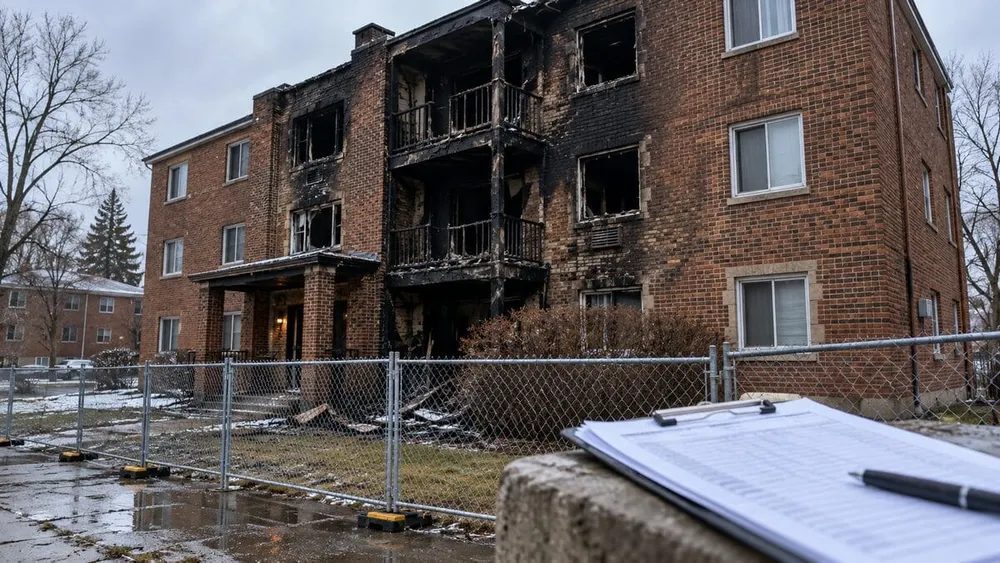
The case arose from a February 2020 fire at an Eau Claire apartment building owned by D.M.B. After an inspection, the city found the structure unsafe and unreasonable to repair because estimated repair costs exceeded the statutory threshold, then ordered it razed under Wisconsin law. D.M.B. sought payment for a total loss.
Germantown Mutual acknowledged coverage for the portions damaged by fire, smoke and water. It argued, however, that the policy excluded the cost tied to tearing down portions that the fire had not damaged. The policy language excluded loss caused directly or indirectly by enforcement of a law requiring property to be torn down.
A state court listing identifies the underlying April 22, 2025 Court of Appeals opinion as case 2023AP1717. The opinion upheld the insurer’s position. The appellate panel treated the fire and the later raze order as separate losses for coverage purposes and said the policy’s plain language controlled.
The panel also noted that D.M.B. did not challenge the raze order. Wisconsin law allows a person affected by such an order to seek circuit-court review, and the lower opinion said the record lacked evidence beyond the order itself that the building was irreparable. An appraisal later put covered repair costs for fire, smoke and water damage above $400,000; Germantown paid the balance due under that appraisal.
D.M.B.’s position is that the fire and raze order should be treated as one chain of loss because the municipal action reflected the building’s post-fire condition. Germantown’s position is that a raze order creates additional, excluded loss when it compels demolition of otherwise undamaged property. A legal analysis of the appellate ruling said the decision reinforced the effect of ordinance-or-law exclusions where demolition extends beyond directly damaged portions.
The Supreme Court’s eventual ruling could clarify how Wisconsin courts allocate losses when fire damage, building-code enforcement and demolition overlap. The practical stakes extend beyond this apartment building: owners and insurers may face different exposure depending on whether damage is attributed to the covered event itself or to a later government order.
Until the court rules, the Court of Appeals judgment remains the operative decision in this case. The justices’ review does not by itself change the policy language or determine that either party will prevail.