Missouri has awarded $10 million in public-safety grants to 350 local governments and one school district through the state’s Blue Shield Program, a statewide expansion that will put new equipment into agencies across 95 counties.
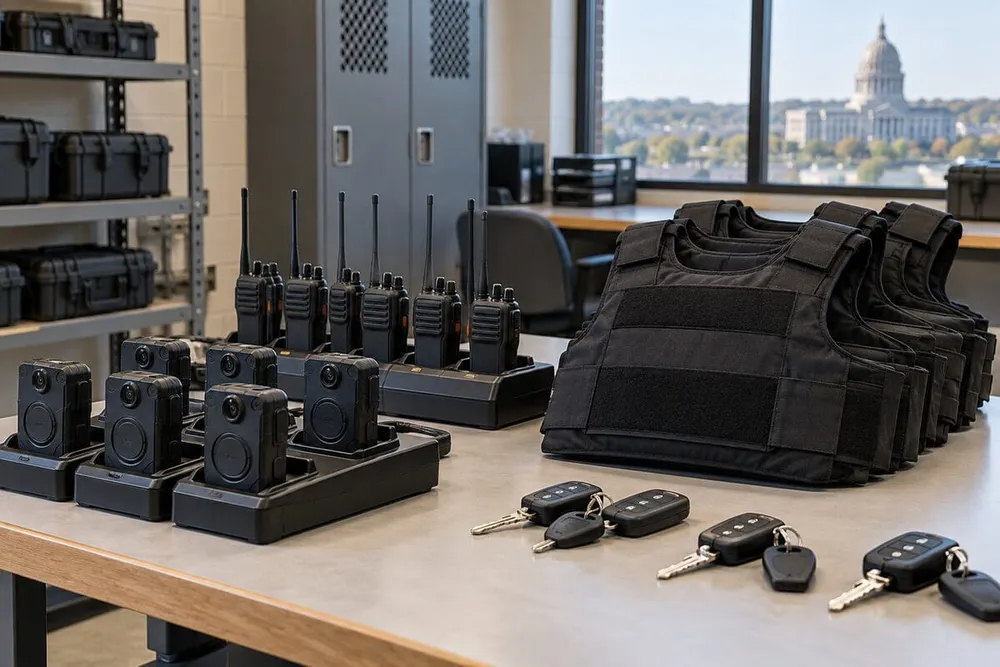
Each participating jurisdiction was eligible to apply for up to $29,070, according to the governor’s award notice. The grants will support 351 mobile data terminals, 232 body cameras, 313 ballistic vests, 170 interoperable radios, 81 vehicles and 23 utility-terrain vehicles, among other purchases.
The recipients include 252 cities, 95 counties, two towns and one school district. Participation increased from 201 communities in the program’s first year to 350 this year, a 74% rise. The official recipient roster, maintained by the Missouri Department of Public Safety, shows awards spread from large urban counties to small rural municipalities.
The Blue Shield Program was created under Gov. Mike Kehoe’s January 2025 executive order establishing the Safer Missouri initiative. It recognizes local governments that meet state criteria intended to demonstrate support for law enforcement and cooperation with statewide crime-reduction efforts.
To qualify, communities had to adopt a resolution supporting law enforcement, maintain public-safety investment, use community-policing practices and show efforts involving officer recruitment and retention, crime reduction or regional task forces. They also had to remain compliant with state reporting requirements. The Department of Public Safety’s program summary describes the designation as both recognition and a route to competitive state resources.
The scale is statewide but the award amounts remain locally bounded. Dividing the appropriation evenly sets a ceiling of $29,070 per recipient, while the final equipment mix reflects agency requests rather than a single mandated purchase. The governor’s award notice says grants were available after communities completed the Blue Shield application and identified eligible needs.
What the grants change
The relatively small individual awards are designed for discrete purchases rather than major construction or staffing expansions. For a local department, however, a grant can replace aging radios, add body-worn cameras or equip officers with protective gear without shifting the entire cost to municipal or county budgets.
The equipment list also shows that the state is funding communications and mobility alongside personal protection. Mobile data terminals allow officers to receive dispatch information and access records in vehicles, while interoperable radios can improve coordination among agencies during pursuits, disasters or multi-jurisdictional investigations.
Missouri launched Safer Missouri with six executive orders covering immigration enforcement, state law-enforcement recruitment, crime-data reporting and assistance to local agencies. The launch package placed the Blue Shield designation within that broader policy agenda.
The grant announcement does not establish that receiving communities have achieved lower crime rates. It confirms that they met the program’s eligibility standards and received funding for specified public-safety purchases. The practical test will be how quickly agencies acquire the approved equipment and how those tools are used, maintained and incorporated into local policies.