
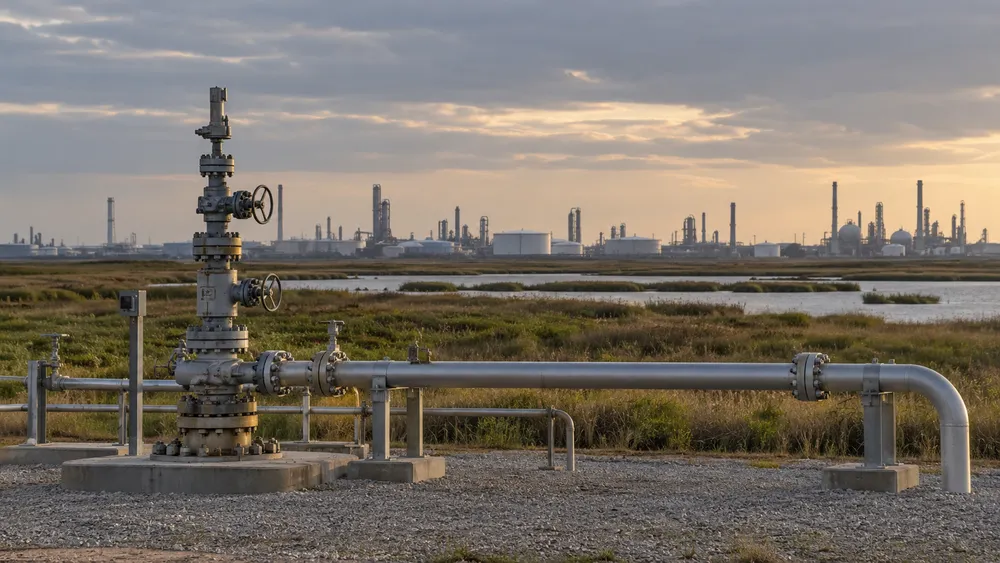
The Railroad Commission of Texas approved ExxonMobil’s Rose Carbon Capture and Storage permit on Tuesday in a 2–1 vote, advancing a large Jefferson County project over objections from one commissioner about long-term safety and public cost. The vote was disclosed in a September 15 commission statement from Commissioner Wayne Christian, who voted no.
The permit covers three proposed Class VI injection wells about 15 miles southwest of Beaumont. According to the commission’s Rose project summary and permit record, ExxonMobil plans to inject about 4 million metric tons of carbon dioxide annually for 13 years, or 53 million metric tons in total. The carbon dioxide would come from large nearby industrial emitters and be compressed before injection into the Fleming and Upper Frio formations at depths ranging from roughly 3,400 to 7,525 feet.
The approval is consequential for the Gulf Coast’s emerging carbon-management industry, but it is not permission to begin injecting immediately. The commission’s Class VI process requires additional drilling authorization, well construction and completion reports, an inspection, and a separate permit to operate before injection can start. The Rose record also calls for monitoring during the proposed 13-year injection period and for 50 years afterward, unless regulators approve an earlier demonstration that underground drinking-water sources are no longer endangered.
The decision arrives after Texas assumed primary enforcement authority for Class VI wells in December 2025. That shift moved the lead permitting role from the Environmental Protection Agency to the state commission, provided Texas maintains standards at least as stringent as federal requirements. Class VI rules require operators to characterize the storage formation, model the carbon plume and pressure front, address possible migration pathways, demonstrate financial responsibility, and maintain emergency and post-injection plans.
Christian said the administrative record did not adequately establish the project’s long-term safety. In prepared remarks, he focused on the proposed groundwater-monitoring network, the composition of confining layers, and the possibility of small faults that might create migration pathways. Those are the dissenting commissioner’s conclusions; the commission majority nevertheless approved the permit.
The vote also has broader commercial implications. The Financial Times reported that the Rose approval is tied to ExxonMobil’s wider Gulf Coast carbon-capture plans, which contemplate a regional pipeline network and multibillion-dollar investment. Even so, a regulatory permit does not by itself guarantee construction, customer contracts, financing, or a final investment decision.
What happens next
For Jefferson County residents, the next meaningful milestones are the final permit’s effective date, any further legal challenge, drilling applications, construction notices, and the commission’s eventual operating decision. The commission says an approved project must still satisfy its permit conditions and pass inspection before operation. That makes Tuesday’s vote a major regulatory step—but not the end of state oversight or the start of carbon injection.