
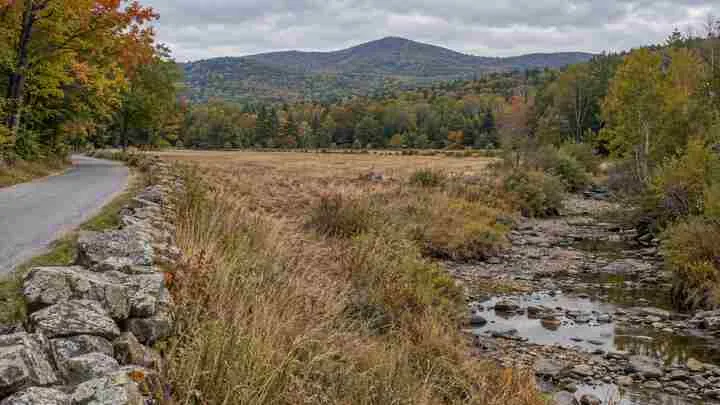
New Hampshire entered the second half of September with drought still covering a broad central and eastern corridor, while state officials reported outdoor-water restrictions at 88 public systems and two municipalities. The U.S. Drought Monitor map released September 17, based on conditions through September 15, continued to show moderate drought and abnormal dryness across most of the state.
The practical effects are already visible beyond the map. New Hampshire Bulletin reported that about 250 dry wells have been reported to the Department of Environmental Services during the past year. State officials also said the hardest-hit areas are carrying a precipitation deficit of roughly 10 inches, a gap that becomes more difficult to close once frost limits infiltration into the ground.
The latest federal update is less severe than the conditions New Hampshire faced a year ago, when extreme drought expanded across much of the state. But it leaves residents who depend on private wells with little margin if autumn precipitation falls short. State Climatologist Mary Stampone told the Bulletin that groundwater in southern New Hampshire reflects a longer-term deficit, not only this season’s rainfall. The state has not been completely drought-free since summer 2025.
Emergency well money is already committed
The Department of Environmental Services reopened the Emergency Drought Assistance Program in 2025 to help eligible low-income households restore drinking water through measures such as deepening or replacing wells. An April funding notice said the agency would continue reviewing applications already received, but warned that available money was expected to be fully committed.
By this week, the department had approved 60 emergency projects, with about half completed, and expected the current $1.8 million allocation to be exhausted. Additional applications remain pending without enough funding to complete them, according to the agency information provided to the Bulletin. Officials said the program is unlikely to reopen for new applications under current funding.
That makes local conservation rules the most immediate tool. Customers of a restricted public water system should follow that utility’s instructions, which may be stricter than conditions in a neighboring town. Private-well users are not automatically covered by public-system restrictions, but limiting lawn irrigation and other nonessential outdoor use can reduce pressure on shared aquifers.
Rain is possible, recovery is not guaranteed
The national outlook accompanying the September 17 map favored above-normal precipitation along the Eastern Seaboard in the September 22-26 period. That forecast offers a chance for short-term improvement, but it is not a guarantee of groundwater recovery. Drought classifications combine precipitation with streamflow, reservoirs, soil moisture and groundwater, so a single wet week may not erase months of deficit.
Fall foliage prospects are also uneven. Researchers said the North Country and mountains have smaller precipitation deficits than central and southeastern New Hampshire, leaving room for a typical display there. For households and water managers, however, the more consequential date is the first sustained freeze: meaningful rainfall before then has a better chance of replenishing groundwater before winter.