
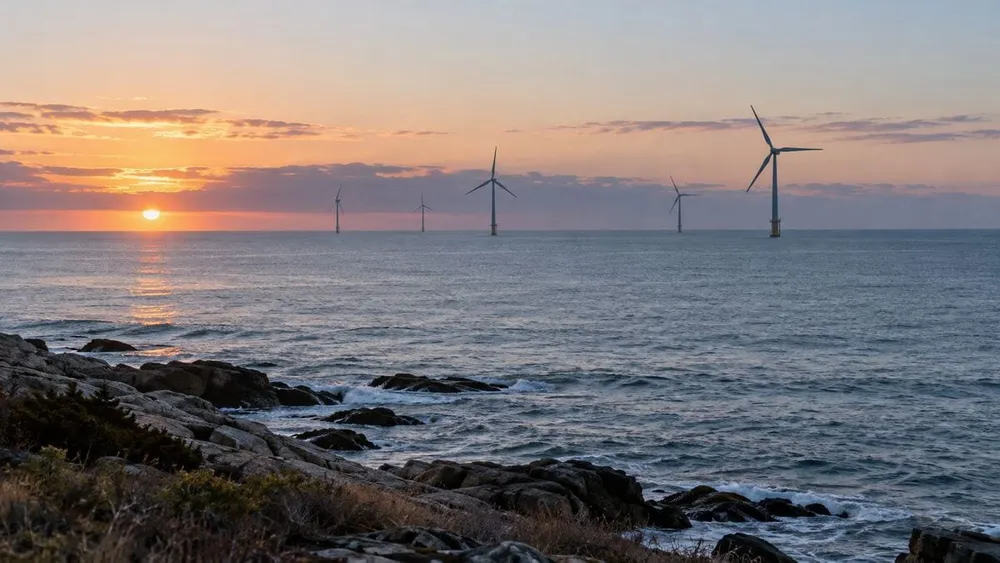
Revolution Wind has installed the last of its 65 offshore wind turbines, completing the project’s major at-sea construction milestone off Rhode Island, Gov. Dan McKee announced Friday. The milestone does not by itself mean the entire project has entered commercial operation: the wind farm began sending some electricity to the New England grid in March, while its developer said at the time that full operations would follow later.
The federal Bureau of Ocean Energy Management describes Revolution Wind as a 704-megawatt project with up to 65 turbines and two offshore substations. Its lease area sits roughly 15 nautical miles southeast of Point Judith, with export cables making landfall at Quonset Point in North Kingstown, according to the agency’s project record. That scale makes Friday’s announcement a concrete construction marker for one of southern New England’s largest new power projects.
Revolution Wind has contracted to sell power under 20-year, fixed-price agreements to utilities in Rhode Island and Connecticut. Developer Ørsted said when the project produced first power on March 14 that it is designed to serve the equivalent of more than 350,000 homes and businesses across the two states. Its first-power announcement also said more than 2,000 workers had supported the project, including more than 1,000 local union workers who logged over 2 million hours.
For Rhode Island residents, the immediate significance is progress toward a large new regional supply source rather than an overnight change in bills or service. The turbines still must complete commissioning and testing before the project reaches full commercial operation. Once that happens, its electricity will enter the regional system operated by ISO New England; customers will not receive power through a separate Revolution Wind connection to individual homes.
The distinction between turbine installation and commercial completion matters because offshore wind projects advance through several stages. Foundations and turbines can be in place while electrical equipment, cables, controls and grid connections undergo final testing. Ørsted’s March statement confirmed that the project had already begun delivering initial power, but it did not set a specific commercial-operation date. Friday’s gubernatorial statement likewise celebrated all 65 turbines standing without announcing that final operating milestone.
The project has also passed through federal regulatory and construction interruptions. BOEM’s public record shows that federal officials approved the construction and operations plan in November 2023 and later issued stop-work directions before allowing activity to resume. Those events make the completion of turbine installation notable, but the state’s next practical checkpoint remains completion of commissioning and sustained delivery at the project’s intended scale.
Rhode Island’s role extends beyond purchasing part of the output. The export cable reaches shore at Quonset Point, and the state has framed the project as both an energy-supply investment and an offshore-wind workforce project. McKee called Friday’s installation milestone evidence that the state could build major clean-energy infrastructure. The measurable test now shifts from construction progress to how quickly the developer completes commissioning and brings the full 704 megawatts into regular operation.