
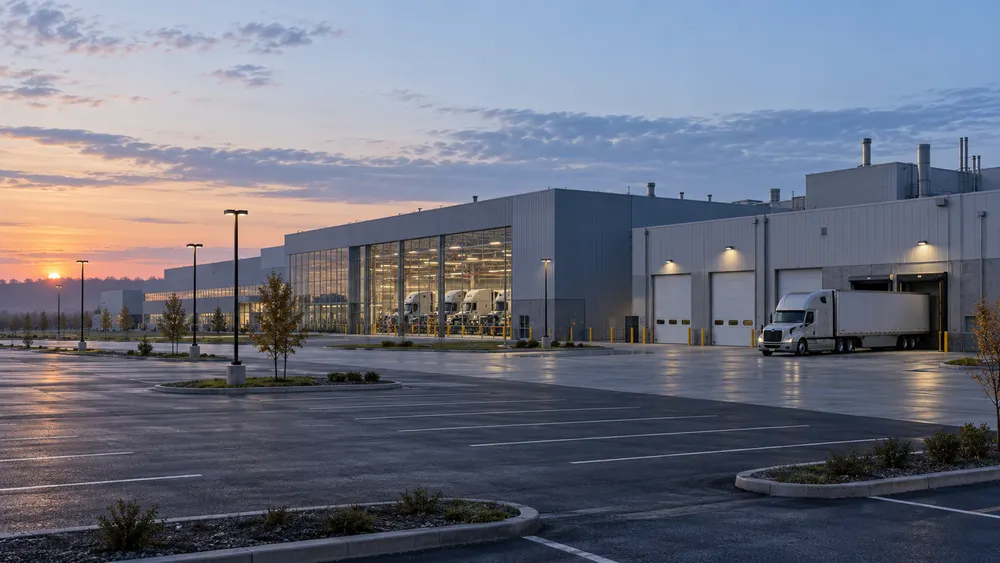
Nearly 1,400 workers at the former International Motors truck plant in Springfield, Ohio, were laid off this week as ownership shifts to Canadian armored-vehicle manufacturer Roshel, creating an abrupt employment gap at one of Clark County’s largest industrial sites. Workers told The Associated Press that they expect Roshel to rehire in phases, but the anticipated six-to-12-month timeline has not been guaranteed.
The disruption follows a sale process announced in March. International Motors said it had agreed to sell its Springfield manufacturing and warehouse facilities to Roshel, with closing subject to customary conditions. International also said its existing collective-bargaining agreement and contract at the plant would expire Sept. 30, 2026, establishing the date around which the operating transition would occur.
The layoff’s immediate scale is significant for southwest Ohio. The AP reported that losing almost 1,400 positions at once was large enough to erase roughly a year of job growth in the broader Dayton region. For affected households, the practical questions are more direct: when hiring will resume, which skills and classifications Roshel will need, and whether pay, benefits and seniority will carry into the new operation.
The Springfield plant sits within a region that has spent decades adjusting to factory closures and changing production patterns. The AP’s account describes workers cutting household expenses after the layoff and places the plant transition against a local history of manufacturing losses. That context makes the interval between International’s departure and Roshel’s ramp-up economically consequential even if the buyer ultimately reaches its expansion target.
Roshel has publicly framed the purchase as an expansion rather than a permanent shutdown. In International’s sale announcement, Roshel chief executive Roman Shimonov said the company intended to combine the plant’s workforce expertise with its armored-vehicle technology and expand its U.S. manufacturing footprint. The AP separately reported that Roshel says it aims to protect the existing workforce and more than double employment over time, though the company described that growth as a phased process.
The buyer’s production strategy also has an international industrial partner. In June, Daimler Truck and Roshel announced a memorandum of understanding covering joint development, production, marketing and support of protected and armored vehicles. That agreement helps explain why a heavy-vehicle plant with an experienced workforce could be useful to Roshel, but it does not itself set a Springfield hiring schedule or guarantee a specific number of local jobs.
The central distinction for Ohio officials and workers is therefore between a long-term investment plan and current payroll reality. The plant has a new industrial mission and a buyer publicly committed to growth, while nearly 1,400 people are presently without those jobs. Until Roshel publishes firm production dates, job postings and employment terms, the pace and breadth of the promised rebound will remain the key measure of the sale’s impact on Springfield.