
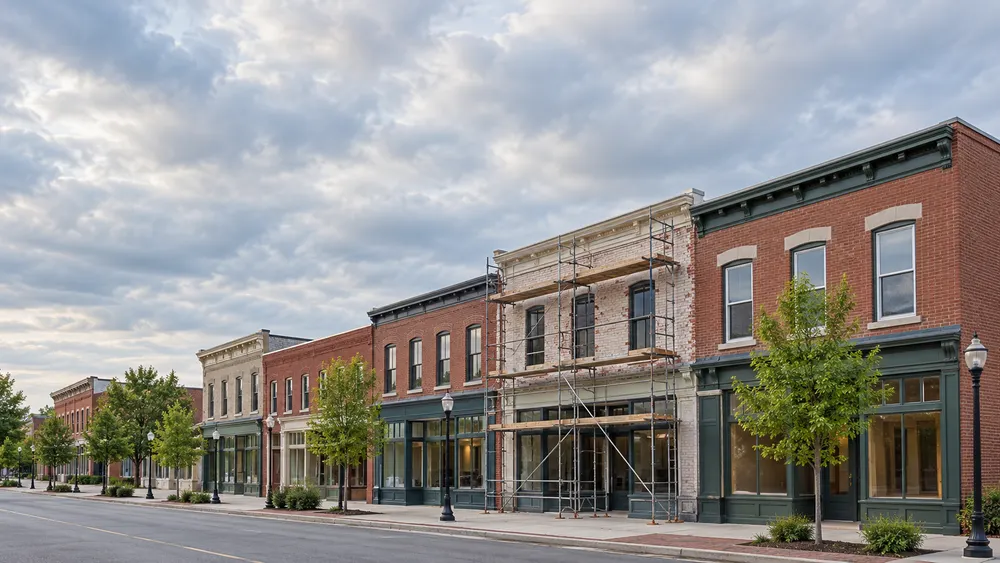
Delaware has designated Claymont, Newport and Millsboro as its three newest Downtown Development Districts, filling all 15 slots permitted under state law. Gov. Matt Meyer made the announcement Thursday after the Cabinet Committee on State Planning Issues unanimously recommended the communities following a competitive application round.
The designation makes qualifying residential, commercial, industrial and mixed-use projects inside the final district boundaries eligible for state and local development incentives. The main state benefit is a rebate that can offset up to 20% of eligible capital construction costs. It is intended to draw private money toward rehabilitation, expansion and new construction in downtown areas.
The three selections extend the program into different parts of the state. Claymont, an unincorporated community in New Castle County, becomes the first district of that kind in the program. Newport adds a second new designation in New Castle County, while Millsboro expands the map in Sussex County. Five communities applied for the three available designations.
A mature incentive program
Delaware created the program in 2014 to stimulate investment, jobs, housing and commercial activity. The state says 495 projects have since been completed, supported by $47.4 million in public investment that leveraged about $693 million in private investment. Claymont, Newport and Millsboro join 12 earlier districts, including Wilmington, Dover, Seaford, Georgetown and Middletown.
The Delaware Code authorizes grants of up to 20% of qualified real-property investment above a minimum threshold. Eligible costs can include interior and exterior improvements, structural, mechanical and electrical work, excavation, paving, landscaping and demolition. The law also makes awards subject to legislative appropriations and allows the Delaware State Housing Authority to set caps and other conditions.
That means a district designation is not a blank check. Housing Delaware’s current program page says projects must be within an approved boundary, conform to the local district plan, clear a minimum investment threshold and meet site-control requirements. The agency has allocated $3 million for small-project rebates in the fiscal 2027 cycle, with applications accepted on a rolling basis through May 30, 2027, while funds remain. Large-project reservations are not currently open.
What happens next
The new districts are not fully operational simply because the names were announced. Each community must work with the Office of State Planning Coordination to finalize boundaries and incentive packages, name an administrator and complete other designation requirements. Those choices will determine which parcels qualify and how state rebates combine with local incentives.
Under the state’s program rules, district designations last 10 years and may be considered for up to two five-year extensions. The Cabinet Committee reviews applications and makes recommendations, but the governor has final designation authority.
Millsboro officials have identified the 1930s-era Millstone Theater as a potential anchor for arts access and mixed-use development. Newport officials described the award as a first step in downtown redevelopment. In Claymont, county leaders linked the designation to a longer revitalization effort involving community partners.
For residents and property owners, the immediate task is to watch for the finalized maps and local incentive details. Only investments within approved boundaries and consistent with district plans can qualify. The larger measure of the three designations will come later: whether public rebates prompt durable housing, occupied storefronts and private construction that would not otherwise have moved forward.