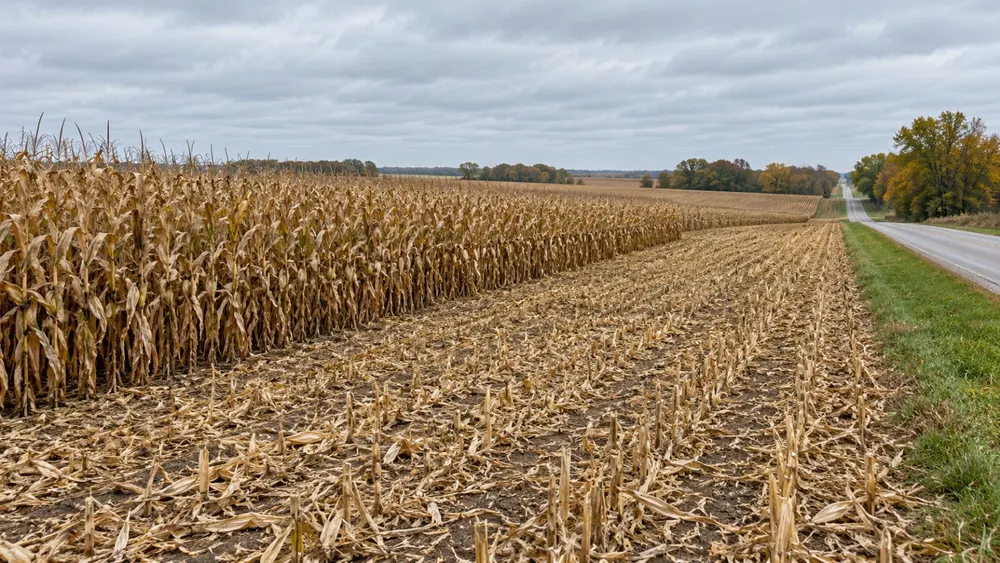
Iowa’s corn harvest remained less than one-third complete entering this week, intensifying the scheduling pressure behind state officials’ appeal for farmers to plan their votes. The October 19 crop report put corn harvesting at 26% and soybean harvesting at 57%, both well behind their five-year averages.
Secretary of Agriculture Mike Naig joined Secretary of State Paul Pate on October 19 to encourage farmers to use early-voting options while delayed fieldwork competes for their time, Capital Dispatch reported. As of October 20, the deadline to request a mailed absentee ballot has passed, but voting in person before Election Day remains available under the secretary of state’s published schedule.
Harvest progress is not crop maturity
The agriculture department’s weekly report, covering October 12–18, recorded 4.6 days suitable for fieldwork. Corn harvesting was 24 percentage points behind its five-year average; soybean harvesting was 17 points behind. The same report said 98% of corn had reached maturity, matching the average. Those measures distinguish crop development from the work of getting it out of the field.
Moisture remained a constraint: 24% of topsoil and 21% of subsoil were rated surplus. State climatologist Justin Glisan’s accompanying weather summary recorded the season’s first widespread frost and freeze. Naig described farmers as roughly two weeks behind and said warmer, mostly dry forecast conditions could help them advance where fields permit, according to the state release.
Voting options after the mail-request deadline
Pate’s election-specific announcement set 5 p.m. October 19 as the deadline for county auditors to receive applications for mailed ballots. That was a request deadline, not the deadline for returning a ballot already received. Marked absentee ballots must reach the county auditor by 8 p.m. November 3, when polls close.
In-person absentee voting at county auditors’ offices continues through November 2. The September announcement and October reporting agree on that remaining option. Farmers do not need to wait for Election Day to vote simply because they missed the mail-request cutoff; they should check their own county’s office hours and available locations.
The secretary of state’s absentee guide explains that an in-person absentee ballot must be marked and left at the voting location, rather than taken home. County auditors can also identify satellite sites. For voters already holding a mailed ballot, the guide distinguishes returning it to the auditor from bringing it to an Election Day polling place: a voted absentee ballot cannot be delivered there. It describes surrendering the ballot to vote regularly, or provisional voting if it cannot be surrendered.
The state guide also links to ballot tracking and county-auditor contacts. Those tools let voters check a mailed ballot’s status and resolve questions with the responsible local election office, rather than assume mailing and receipt are the same step.