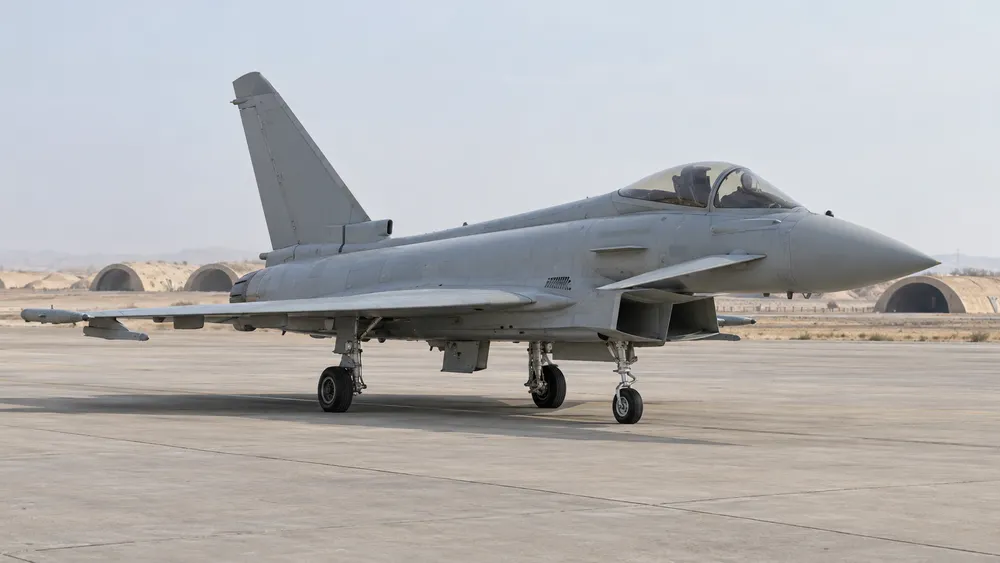
Britain approved Royal Air Force Typhoon fighter patrols over Saudi Arabia on October 20 to help intercept Houthi missiles and drones, expanding its military role as attacks threaten Saudi cities and infrastructure. The Defence Ministry said the aircraft would undertake defensive counter-air missions, not offensive strikes against the Houthis in Yemen. The announcement authorizes a new mission; it does not establish that British fighters have already intercepted an attack.
The decision moves British support beyond equipment, advisers and aerial refuelling to include fighter patrols themselves. Reuters reported that the additional assistance followed a Saudi government request. Defence Secretary Wes Streeting cited attacks on Riyadh’s airport in explaining the decision, while the government maintained that its purpose was protection rather than a wider offensive campaign.
Fighter patrols join a broader support package
The package also includes an Atlas A400M military transport aircraft and British military advisers. The transport aircraft will help move defence equipment inside Saudi Arabia, while advisers will assist Saudi staff officers. ITV News reported that King Khalid International Airport in Riyadh had been repeatedly targeted this month, placing civilian aviation alongside cities and infrastructure among the concerns behind the expanded mission.
The existing RAF Voyager refuelling deployment will be extended for another 90 days, according to Streeting’s parliamentary statement as reported by Sky News. That extension is separate from the addition of Typhoons. Together, the measures broaden the forms of British assistance without announcing a British fighter campaign against targets on the ground.
The defensive label has an important limit
The restriction on Typhoon strikes does not mean the entire British support package is confined to intercepting incoming weapons. Tuesday’s ministry statement says extended refuelling support covers Saudi defensive air operations, including operations to degrade Houthi military targets in Yemen. Those are the government’s descriptions of the mission; they should not be confused with a claim that British fighters have been authorized to bomb those targets.
Britain had already agreed on September 22 to provide a Voyager tanker following a Saudi request. Its earlier announcement also described air-defence equipment and British personnel already helping protect the kingdom against missile and drone attacks. Tuesday’s consequential change is therefore the addition of fighter patrols and further transport and advisory support, not the beginning of all British involvement.
A conflict with consequences beyond Saudi Arabia
The Associated Press reported that Saudi Arabia had sought air-defence assistance from several allies and that Washington, which conducted strikes against the Houthis under Presidents Joe Biden and Donald Trump, had declined to repeat that response in the current confrontation. Britain’s decision is an allied military expansion, not an announcement of a new American operation. It comes within a regional crisis that already engages U.S. security interests.
London also framed its response in economic terms. The September ministry announcement warned that Gulf instability could disrupt energy supplies and increase costs for households and businesses; ITV reported those concerns again Tuesday. Streeting’s statement, quoted by Sky, also emphasized threats to international shipping in the Red Sea and Bab al-Mandab Strait. These concerns explain the mission’s wider significance, but the announcement does not demonstrate that patrols have restored shipping security or prevented further attacks.
Deployment details and diplomacy remain unresolved
The operational update did not specify the number of Typhoons, their operating bases or a first-patrol date. Those omissions limit what can be concluded about the mission’s immediate reach. Authorization, deployment and successful interception are distinct developments, and the public announcement establishes the first of those rather than a record of operational results.
Downing Street rejected the suggestion that Britain was being drawn into Yemen’s civil war, describing the assistance as proportionate, ITV reported. Streeting separately told Parliament that a U.N.-led political process remained the best route to lasting peace, according to the Associated Press. The next tests are whether the patrols begin, how their defensive limits are applied and whether the wider conflict moves toward negotiations rather than further military expansion.