
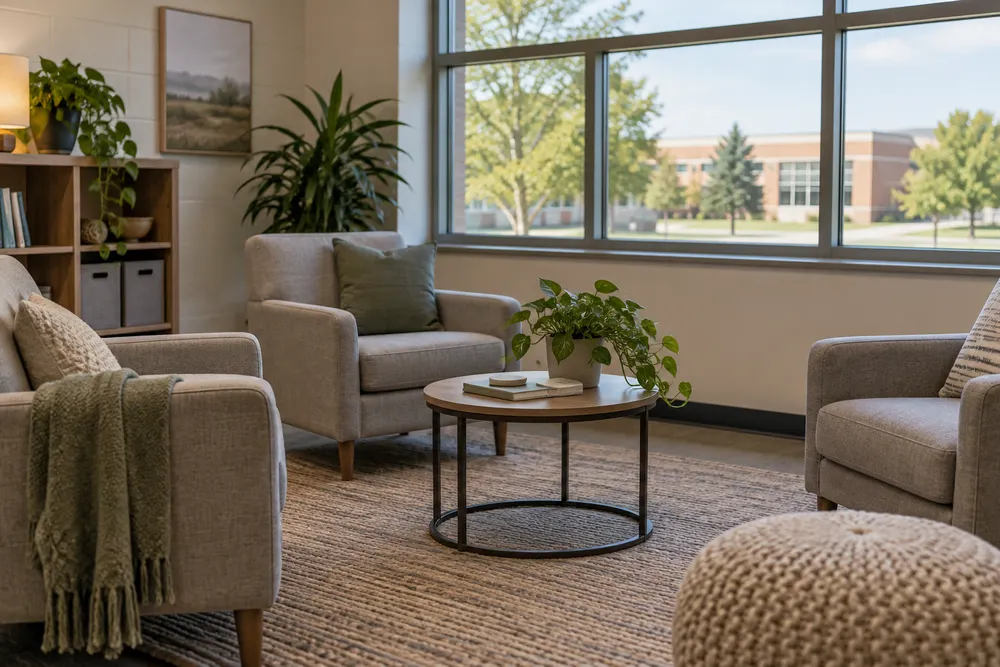
Nearly 20 Iowa schools are now using designated “brain health retreat rooms,” a model that gives students a brief, supervised break when stress or strong emotions make it difficult to stay in class. The latest expansion came this month in Ankeny, where Northview and Southview middle schools opened rooms with support from the nonprofit Brain Health Now, according to new reporting.
The Ankeny rooms can accommodate up to five students at a time. Students may spend about 10 minutes there, with school social workers present, before returning to class or receiving additional help. Brain Health Now supplied each school with a $2,500 stipend as well as furniture and signs, Axios reported. The Iowa Department of Education said in February that nearly 20 schools statewide had adopted the rooms.
The concept is deliberately narrower than a counseling office or clinical service. Brain Health Now describes the rooms as a place where students and staff can pause without judgment and practice self-regulation. Typical features include quiet seating, breathing prompts and grounding activities. The organization’s published guidance stresses that the space is intended to help people reset; it is not a referral service and does not replace professional mental-health care.
Iowa districts have been testing the approach for several years. Dubuque Senior and Hempstead high schools opened rooms in 2022. Ottumwa High School later added one, and Evans Middle School followed in fall 2025 to provide continuity for students moving through the district. Ottumwa’s special-programs director told KYOU that the room is used when thoughts or feelings are distracting students and that a counselor is available to help them calm and regulate.
Early operating data show demand, but not yet a definitive verdict on long-term results. Ottumwa High recorded roughly 1,000 visits during the first half of the 2025-26 school year, according to an Axios newsletter. District officials also reported that use declined over time and attendance improved, patterns they view as encouraging. Those observations are local and do not establish that the rooms alone caused either change.
That distinction matters as the model spreads. A short, supervised reset may help some students return to instruction, but schools still need clear rules on access, staff coverage, privacy, documentation and escalation when a student shows signs of a more serious crisis. The retreat-room model is best understood as one tier of support inside a broader school mental-health system, not a substitute for counselors, psychologists, family engagement or emergency protocols.
For Iowa policymakers and districts, the next step is measurement. Comparable data on repeat visits, time out of class, attendance, disciplinary referrals and referrals to clinical care would show whether the rooms are improving outcomes or simply relocating distress. With adoption nearing 20 schools, Iowa now has enough experience to evaluate the model statewide while preserving the local supervision that gives the rooms their practical value.