
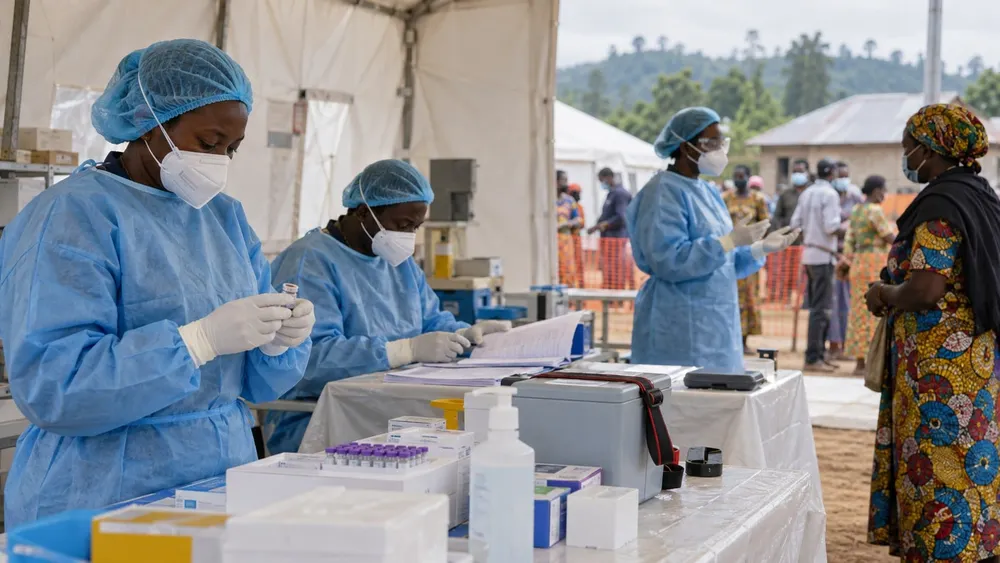
A clinical trial launched in eastern Democratic Republic of Congo this week to answer an urgent question in the world's largest recorded outbreak of Bundibugyo virus disease: can an existing Ebola vaccine protect people from a different species of the virus? The first participants were enrolled in Bunia on October 23 as the outbreak continued to spread across Congo and produced imported cases in Kenya and Nigeria.
The trial begins amid a severe epidemic. As of October 20, Congo had reported 9,704 confirmed cases and 4,687 deaths across 66 health zones in eight provinces, according to the World Health Organization's latest outbreak update. That 48.3% crude case-fatality ratio reflects confirmed cases and recorded deaths, not an immutable biological rate. Earlier detection and faster supportive care can improve survival, while delayed diagnosis and deaths outside treatment centers can worsen outcomes.
The immediate U.S. risk remains low. The Centers for Disease Control and Prevention says no case linked to this outbreak has been confirmed in the United States and assesses the chance of domestic spread as very low. That distinction matters: the international emergency is grave, but the CDC assessment does not support panic among people without relevant travel or exposure.
A vaccine trial during an active emergency
The new TUMAINI study is using Ervebo, the licensed vaccine that is highly effective against Ebola virus disease caused by the Zaire species. The current outbreak is caused by Bundibugyo virus, a separate species for which no vaccine has been licensed. Animal data suggest Ervebo may provide some cross-protection, but researchers do not yet know whether that protection exists in humans or how strong it might be.
WHO's vaccine guidance therefore recommends that Ervebo be used against Bundibugyo disease within a research protocol. The preferred design is a ring-vaccination randomized trial: when a case is confirmed, investigators identify that person's contacts and contacts of contacts, creating a “ring” of people at elevated risk. Participants are then vaccinated under a protocol designed to measure whether the shot reduces disease while maintaining informed consent and safety monitoring.
That design allows researchers to learn during the response rather than waiting for the outbreak to end. It also avoids presenting Ervebo as proven for a use that remains experimental. WHO has said that observational vaccine-effectiveness studies may be appropriate where randomized ring vaccination is impractical, provided authorities preserve reliable records and predefined rules for modifying or stopping the program.
The trial is one part of a broader vaccine strategy. WHO experts have also prioritized candidates designed specifically for Bundibugyo virus, including a ChAdOx1 vaccine developed with the University of Oxford and Serum Institute of India and an mRNA candidate from Moderna. In its candidate review, WHO cautioned that those products require clinical evidence before routine use. The urgency of the outbreak cannot substitute for evidence about safety, dose and protection.
Why the outbreak remains difficult to contain
Transmission has remained high in Congo despite months of response work. WHO reported 67 new confirmed cases in the most recent 24-hour period covered by its October 23 update, concentrated in Ituri and North Kivu. Fifty of 66 affected health zones had reported a case during the preceding 21 days. The agency also recorded 307 of the 482 deaths added since its previous update as occurring in communities rather than treatment centers, a warning sign for delayed detection, barriers to care and the possibility of unrecognized exposure.
Ebola does not spread through the air in ordinary social contact. It is transmitted through direct contact with blood or other body fluids of a person who is sick or has died, or through contaminated materials. People are not contagious before symptoms begin. Those facts make rapid identification, isolation, protective equipment, safe burials and careful contact tracing effective tools, but each depends on trust and functioning local health systems.
Conflict, displacement and movement across borders complicate all of those measures in eastern Congo. Africa CDC said in a ministerial coordination statement that spread across Central, Eastern and Western Africa requires stronger cross-border surveillance and renewed political commitment. Its public Bundibugyo guidance emphasizes early care, avoidance of direct contact with bodily fluids and prompt reporting of suspected illness.
Imported cases test regional defenses
Kenya's first confirmed patient traveled from Congo through Uganda and arrived in Nairobi on October 3. Authorities quarantined contacts, and the additional cases were identified among people linked to that patient. Kenya's Health Ministry said its response included passenger tracing, laboratory testing and infection-control measures. By October 22, WHO reported that Kenya had screened more than 709,000 travelers and tested 461 samples in five laboratories.
On Friday, Kenya reported a second death among its nine confirmed cases, according to Reuters. The patient was a close relative of the first case and had developed symptoms while already in quarantine. Seven patients remained in care, and officials said they had found no evidence of community transmission. Quarantine does not prevent an exposed person from becoming ill; its purpose is to ensure symptoms are detected quickly and to limit onward exposure.
Nigeria confirmed an imported case in Abuja on October 20 in a patient who had traveled from Uganda. WHO said investigators were reconstructing the person's travel and exposure history while contact tracing proceeded. The European Centre for Disease Prevention and Control's October 23 risk update listed 44 contacts identified in Nigeria and assessed the likelihood of infection for the general European population as very low.
Those imported cases are serious because they test detection and infection-control systems far from the outbreak's center. They do not, by themselves, mean sustained transmission is occurring in Kenya or Nigeria. An Associated Press review described the outbreak as the most geographically widespread Ebola emergency recorded in Africa, while also noting that Uganda had ended its outbreak after completing the required period without a new case.
What travelers and clinicians should know
For Americans, risk depends heavily on travel and close exposure. The CDC advises against all travel to the most affected parts of Ituri and North Kivu and recommends different levels of precaution for other areas. It tells returning travelers to monitor for symptoms and seek medical guidance if they become ill, especially after contact with a sick person, healthcare setting, funeral or contaminated materials in an affected area.
The State Department's October 19 Kenya advisory raised the country to Level 3, “Reconsider travel,” citing health alongside crime, kidnapping, terrorism, unrest and traffic risks. That broad advisory is more restrictive than the CDC's Ebola-specific notice for Kenya, which calls for usual precautions. Travelers should read the agencies' full explanations rather than treating either level as a prediction that infection is likely.
Clinicians should ask about travel and exposure when evaluating compatible illness. Ebola's early symptoms, including fever, fatigue, muscle pain, headache and sore throat, can resemble more common infections. Vomiting, diarrhea, rash and bleeding may occur later, but visible bleeding is not required. Infection-control precautions and rapid consultation with public-health authorities are essential when exposure history makes Ebola plausible.
The vaccine trial offers a path toward better protection, but it will not replace the fundamentals of outbreak control. Contact tracing, safe care, laboratory capacity, protective equipment and community trust remain the immediate defenses. The most responsible reading of the current evidence holds two realities at once: Congo and regional responders face an extraordinary emergency, while the risk to the general U.S. public remains very low.