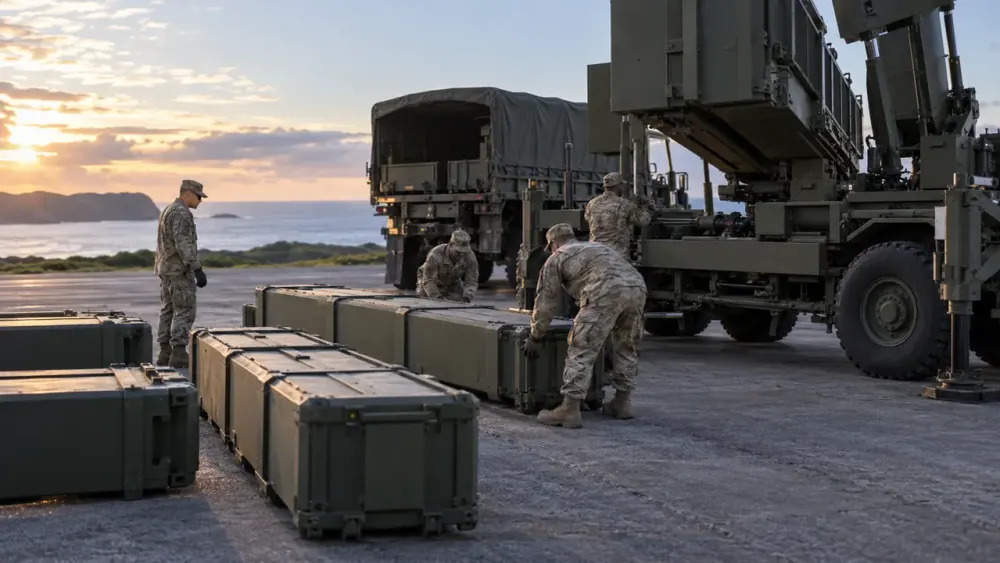
The Pentagon is moving toward a more dispersed approach to deterring China in the western Pacific, pairing advanced missiles with weapons that can be produced in larger quantities and launched from harder-to-target positions.
A newly released implementation update to Congress says U.S. force development is increasingly focused on the conventional capabilities needed for “deterrence by denial” along the First Island Chain. That arc runs from Japan through Taiwan and the Philippines toward Borneo and frames the maritime approaches to China.
The concept is straightforward but demanding: convince Beijing that an attack could not achieve its objectives quickly enough to succeed. The update emphasizes mobile ground-launched missiles, forces positioned inside contested areas, naval mines, survivable aircraft, hardened command networks and logistics capable of operating while under attack. It also says the military needs both highly capable weapons and less costly munitions that industry can manufacture rapidly at scale.
USNI News, which reported on the document Friday, described the plan as a forward-deployed anti-access network intended to threaten hostile ships and aircraft across strategic waterways. The shift is important because it places less weight on a small number of large platforms and more on a resilient web of launchers, sensors, ammunition stocks and allied access.
A strategy built around denial
The new update implements the January defense strategy, which made deterring China in the Indo-Pacific one of the department’s central priorities. The administration describes the approach as strength without confrontation: forces should be capable enough to make aggression appear infeasible, while avoiding steps that would make conflict inevitable.
That logic has already shaped exercises and force posture. In May, U.S. Indo-Pacific Command said its regional approach combined allied partnerships, distributed operations and faster decision-making. Its account of the Shangri-La Dialogue stressed that denial could not rest on American weapons alone; access, interoperability and partner capacity are part of the military architecture.
Distributed forces complicate an adversary’s targeting problem. A fixed airfield or major ship can be tracked and attacked. Smaller mobile units can move among islands, conceal launchers, disperse supplies and create overlapping zones of risk. But dispersion also creates its own burden: fuel, replacement parts, secure communications and missiles must reach numerous locations across great distances, potentially while ports and airfields are under attack.
That is why the implementation update gives unusual prominence to hardened command-and-control systems, contested logistics and “magazine depth”—the number of weapons available before launchers run out. The plan is not simply to acquire a better missile. It is to sustain repeated operations after the first exchange.
The production test
The most visible evidence of the production push arrived this week. The Navy awarded Raytheon a multiyear agreement worth up to $24.4 billion for more than 1,900 Standard Missile-6 interceptors. Reuters reported that the five-year contract includes two additional option years and is meant to create a steadier supply of a weapon used for air defense, missile defense and strikes against surface targets.
The award illustrates both the ambition and the uncertainty. A long-term contract can give suppliers confidence to hire workers, expand facilities and order components. Congress, however, has not appropriated all of the money contemplated by the agreement. A ceiling value is therefore not the same as cash already committed, and the eventual production rate will depend on annual funding, suppliers and testing.
Independent federal findings also show why strategy cannot be measured by contract announcements alone. In July, the Government Accountability Office found that the Navy’s effort to place Conventional Prompt Strike hypersonic missiles on Zumwalt-class destroyers was 24 months behind schedule. GAO said production remained well below the goal of 12 rounds a year and concluded that the Pentagon lacked a comprehensive investment strategy spanning related Army and Navy programs.
Those findings do not directly evaluate the newer Pacific implementation update, but they document the industrial and management risks facing the same broader objective: fielding long-range weapons in sufficient numbers and on a reliable schedule. Advanced weapons that arrive late or only in small quantities cannot provide the endurance the denial strategy requires.
What remains unanswered
The public update establishes direction, not a complete operational plan. It does not disclose required inventories, deployment locations, readiness levels or timelines for creating the network. Those omissions are understandable in an unclassified document, but they make it difficult for Congress and the public to measure progress.
The approach also depends on political access. Mobile U.S. forces cannot disperse across the First Island Chain without agreements from allies and partners, and governments may place limits on missions launched from their territory. Logistics infrastructure must be built before a crisis, while ammunition production requires sustained funding over many years.
The Pentagon’s latest update nevertheless clarifies what it believes will deter a Pacific conflict: not one decisive platform, but a layered network able to survive an opening attack and continue firing. The central test now moves from strategy to execution—whether the United States and its partners can build the access, stockpiles and industrial capacity that the plan assumes.