
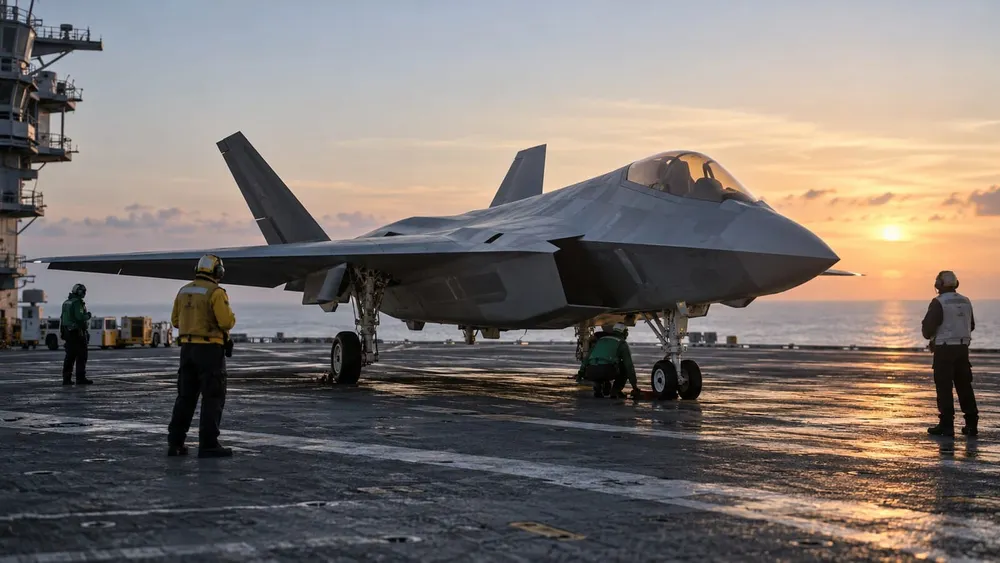
The Navy has awarded Boeing more than $20 billion to develop the F/A-XX, advancing a long-delayed sixth-generation carrier fighter that is expected to shape American naval aviation well into the 2030s.
The full-scale development contract covers the aircraft’s design, engineering and construction of multiple test jets, according to the Defense Department’s official release. It does not buy an operational fleet. Instead, the award begins the demanding phase in which the Navy and Boeing must turn classified requirements into aircraft that can survive carrier operations, integrate weapons and sensors, and complete airworthiness testing.
The selection gives Boeing both of the Pentagon’s announced sixth-generation fighter programs after the company won the Air Force’s F-47 competition last year. It also raises a central execution question: whether one contractor and its supplier network can develop two highly complex combat aircraft on overlapping schedules while meeting cost and production targets.
What the Navy bought
The contract calls for several test aircraft to support ground testing, flight certification, systems evaluation and weapons integration. The Navy describes F/A-XX as the future centerpiece of its carrier air wing, designed to operate with both crewed aircraft and uncrewed Collaborative Combat Aircraft. Detailed performance requirements remain classified, a limit that makes independent assessment of the program’s technical ambition difficult.
The new fighter is intended eventually to replace both the F/A-18E/F Super Hornet and the EA-18G Growler beginning in the 2030s while operating alongside the F-35C. Defense News reported that the development award exceeds $20 billion and includes multiple test aircraft, confirming that the immediate objective is proving the design rather than fielding combat squadrons.
That distinction matters. A successful prototype campaign would still have to be followed by production contracts, carrier qualification, training, maintenance planning and weapons integration. Each stage can add time and cost, especially for an aircraft expected to connect with other platforms across a distributed naval force.
A carrier-air-wing reset
The program arrives as the Navy weighs how to preserve combat reach while its current fleet ages. A CRS primer says the service operates nine carrier air wings, each with more than 60 aircraft, and identifies range, payload and networking capacity as central considerations for the next generation. Those requirements reflect the difficulty of operating against long-range missiles and sophisticated air defenses in the Indo-Pacific.
F/A-XX is therefore more than a one-for-one Super Hornet replacement. The Navy’s concept pairs a crewed fighter with uncrewed aircraft that could extend sensing, electronic warfare or weapons capacity. The approach could increase the reach of a carrier air wing without placing a pilot in every aircraft, but it also creates dependencies on secure communications, autonomous systems and coordinated testing across multiple programs.
The transition will be gradual. Reuters reported that initial production is expected in the 2030s, while Super Hornets are likely to remain in service into the 2040s. That overlap gives the Navy operational flexibility but requires it to fund legacy readiness, F-35C procurement and the new fighter at the same time.
Boeing gains a second sixth-generation program
Boeing defeated Northrop Grumman for the Navy award after Lockheed Martin was eliminated earlier in the competition, Reuters reported. The result strengthens Boeing’s combat-aircraft business and gives its St. Louis operation a longer production horizon. In its company release, Boeing said it has invested in a secure advanced manufacturing facility in St. Louis as well as new technology and workforce capacity.
Those investments make Missouri a meaningful part of the program’s industrial story. They do not eliminate execution risk. Developing the Navy fighter while advancing the Air Force’s F-47 could strain specialized engineering talent, software teams and lower-tier suppliers. The overlap may also offer efficiencies in digital engineering and manufacturing, but the classified nature of both programs leaves the extent of any shared technology unclear.
The award also changes the competitive landscape. With Boeing leading both sixth-generation fighter efforts, the Pentagon will need to preserve competition among engine, sensor, weapons and autonomous-aircraft suppliers even as the prime contractor base narrows.
Cost and schedule remain the tests
The development award is only the opening financial commitment. Reuters said the program could be worth hundreds of billions of dollars over its lifetime if it proceeds through large-scale production and decades of sustainment. That projection is inherently uncertain because the Navy has not publicly disclosed a final fleet size, production rate or complete acquisition baseline.
Congress has already played a decisive role. Lawmakers provided $750 million for the program in a 2025 spending law and added $1.4 billion for fiscal 2026, according to Reuters, after the Pentagon had considered slowing the effort. The Financial Times similarly described the award as a major expansion of Boeing’s position in advanced military aviation while noting the fiscal pressure surrounding the Navy’s modernization plans.
Oversight will now turn from whether F/A-XX survives to whether it performs. The most useful public measures will be stable requirements, progress through test milestones, credible cost estimates and evidence that the industrial base can support two advanced fighter programs without cascading delays. Because many technical details will remain classified, Congress will have to balance necessary secrecy with enough disclosure to judge schedule and affordability.
The Navy has made its strategic choice: a new crewed fighter, linked to uncrewed partners, will anchor the future carrier air wing. The $20 billion award gives that plan momentum. It does not yet prove that the service can deliver the aircraft on time or afford the broader force needed to make it effective.