Last updated: August 16, 2026
Quick Answer
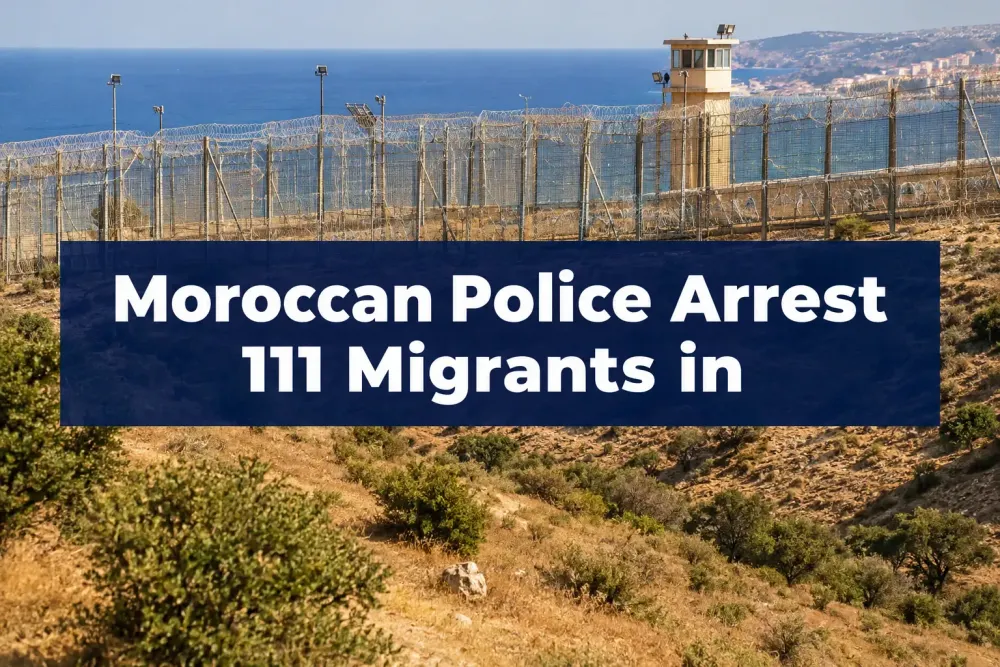
Moroccan police arrested at least 111 people on Saturday, 15 August 2026, as they tried to reach the Spanish enclave of Ceuta from hills near the town of Fnideq, according to Reuters reporting relayed by CBC and other outlets [1][6]. The group included 109 migrants from sub-Saharan Africa and two Moroccan citizens [2][10]. Officers fired tear gas to break up crowds gathered roughly three kilometres (about 1.8 miles) from the border after social media posts called for a coordinated mass crossing [1][7]. Spanish and Moroccan media have reported higher totals, from 148 to 294 detentions, reflecting different counting periods [5][10].
Key Takeaways
- 111 arrests were confirmed by Reuters on 15 August 2026 near Fnideq (Castillejos), the Moroccan town closest to Ceuta's land border [1][6].
- The detainees were 109 sub-Saharan African migrants and 2 Moroccan nationals [2][10].
- Police used tear gas on groups massed about 3 km from the Ceuta perimeter [1][7].
- The attempt was organised through social media calls for a mass crossing, echoing viral mobilisations in earlier years [2][3].
- Arrest figures diverge: Anadolu reported 148 detained across Ceuta and Melilla; Spain's Economía Digital reported 294, including 46 Moroccans [5][10].
- Morocco deployed drones, riot police, intervention vehicles and water trucks around Fnideq and other border points [3][5][8].
- Ceuta is one of only two land borders between Africa and the European Union, alongside Melilla.
- Sub-Saharan migrants detained inside Morocco are typically bused to the country's interior, not formally deported to their home states.
What is Ceuta, and why do migrants try to cross there?
Ceuta is an 18.5-square-kilometre Spanish city on the North African coast, bordered entirely by Morocco and the Mediterranean. Crossing its fence means standing on European Union soil without a boat, a visa, or a smuggler's dinghy, which is why it draws people from across West and Central Africa.
The enclave sits about eight kilometres of fenced frontier away from Moroccan territory. Spain has built a multi-layer perimeter with sensors, cameras and Guardia Civil patrols, backed on the Moroccan side by the Auxiliary Forces. Migrants attempt three main routes: climbing the fence in large groups, swimming around the breakwaters at Benzú or Tarajal, or hiding in vehicles at the Tarajal checkpoint.
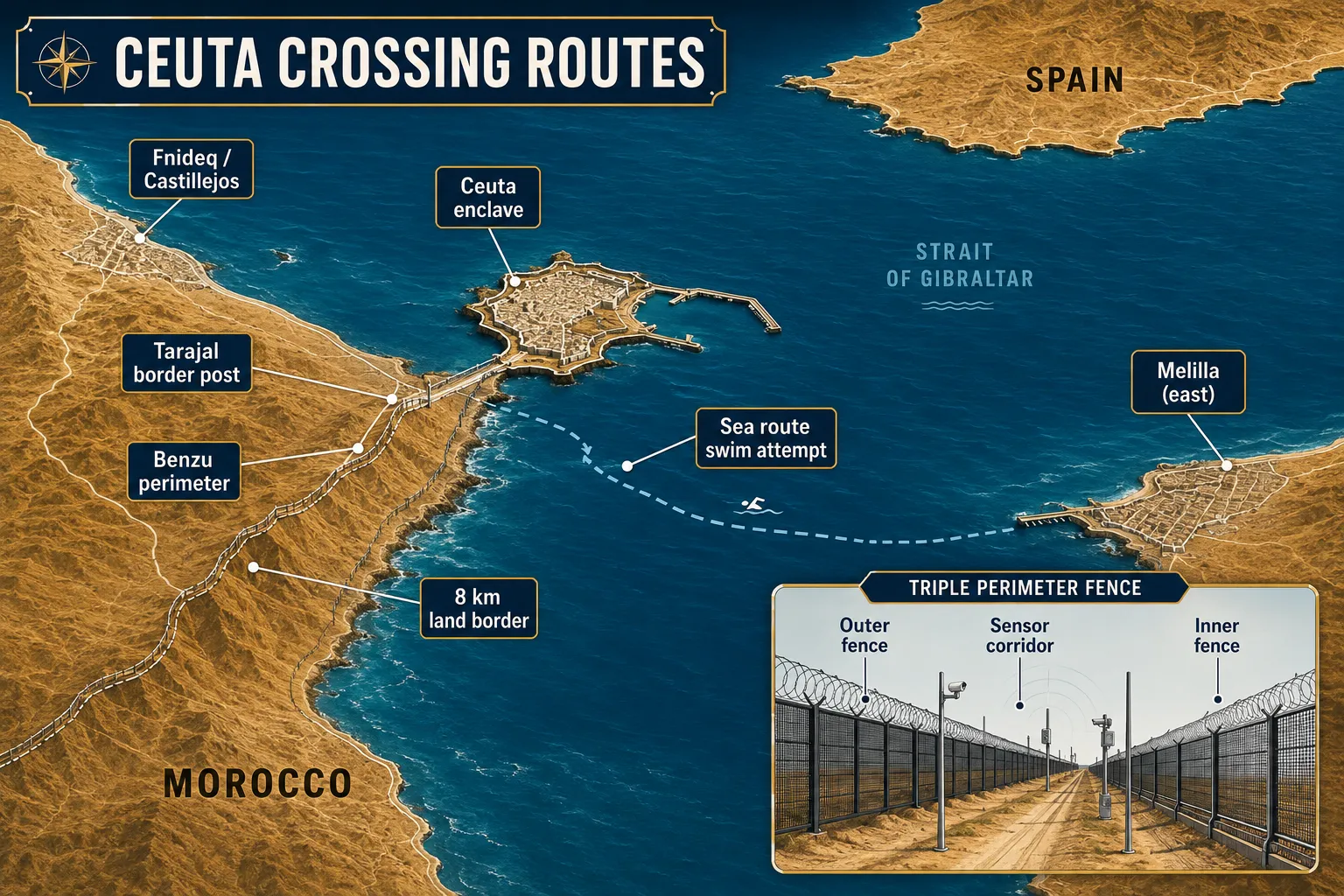
Decision point for organisers: mass attempts almost always target moments when Moroccan policing thins, public holidays, shift changes, or in this case a date circulated online. Saturday's calls drew crowds into the hills above Fnideq, where police intercepted them before they reached the fence [1][3].
How did Moroccan police arrest 111 migrants in this Ceuta mass crossing attempt?
Moroccan security forces intercepted the group in and around Fnideq, roughly three kilometres from the border, before any large-scale breach of the Ceuta perimeter occurred [1][2][7]. Tear gas was used to disperse those gathered on the surrounding hillsides.
Authorities had advance warning. Posts circulating on social platforms urged people to converge on Fnideq for a coordinated push into the enclave, prompting reinforcements ahead of the date [2][3]. Moroccan officials moved in surveillance drones, intervention vehicles, water trucks and riot units, a posture designed to stop movement well short of the fence and limit face-to-face clashes at the barrier itself [3][5][8].
The arrest tallies do not match across outlets:
| Source | Reported detentions | Breakdown |
|---|---|---|
| Reuters (via CBC, Al Jazeera) | 111 | 109 sub-Saharan Africans, 2 Moroccans [1][2][10] |
| Anadolu Agency | 148 | Across Ceuta and Melilla attempts [5] |
| Economía Digital (Spain) | 294 | 248 sub-Saharan Africans, 46 Moroccans [2][10] |
The gap between 111 and 294 is most plausibly a counting question, a single Saturday operation versus cumulative sweeps across multiple days and both enclaves [2][5][10].
How many migrants attempt the Morocco, Ceuta crossing, and how dangerous is it?
Attempts run continuously in small groups and spike during organised mass pushes, when hundreds or thousands move at once. The physical risk is serious: the crossing kills and injures people every year.
The main hazards are concrete:
- Fence injuries. The perimeter's height and razor components cause falls, fractures and deep lacerations.
- Drowning. Swimmers attempting to round the breakwaters face strong currents; children have died on this route in past episodes.
- Crowd crush. Mass attempts funnel large numbers into narrow gaps, with trampling risk on both sides of the line.
- Tear gas and baton charges. Dispersal operations in confined hill terrain produce panic and stampedes [1][7].
- Pre-border conditions. Many wait weeks in informal camps in the hills near Fnideq without shelter, clean water or medical care.
Edge case worth knowing: unaccompanied minors are a recurring feature of Ceuta attempts. Spanish law obliges authorities to take them into child protection care rather than return them summarily, which is why teenagers make up a visible share of those who reach the enclave.
Where are these migrants from, and what are they fleeing?
The overwhelming majority of those arrested on 15 August were sub-Saharan Africans, alongside two Moroccan citizens [2][10]. Ceuta's arrivals typically come from Sudan, Guinea, Mali, Senegal, Côte d'Ivoire, Cameroon and Nigeria, plus Moroccan nationals from the northern Rif and interior towns.
Their reasons split into three broad drivers:
- Conflict and persecution, war in Sudan, insurgency across the Sahel, and instability in Mali and Burkina Faso.
- Economic collapse and climate stress, failed harvests, drought and youth unemployment in West Africa and in Morocco's own interior regions.
- Conditions inside Morocco, migrants who arrive intending to work often face limited legal status, restricted employment, racialised policing and periodic relocation away from border provinces. For many, Ceuta becomes the only visible exit.
Moroccan participants are a distinct group. The 46 Moroccan nationals in the higher Spanish tally, and the two in the Reuters count, reflect domestic frustration in Fnideq itself, a town whose economy was hollowed out when Spain closed the informal cross-border trade that once employed thousands [2][10].
What are the consequences for migrants arrested in Ceuta, and can they appeal?
Consequences depend entirely on which side of the fence a person is detained. Arrest on Moroccan soil, as happened on 15 August, generally means administrative detention and internal transfer rather than deportation abroad [1].
- Arrested in Morocco: sub-Saharan nationals are typically bused hundreds of kilometres south to cities such as Marrakech, Agadir or Beni Mellal. Moroccan citizens involved in crossing attempts can face criminal charges under laws on illegal exit and unlawful assembly.
- Reaching Ceuta: Spain processes arrivals in the enclave, often at the CETI reception centre. Adults may be issued removal orders; minors enter regional child protection.
- Appeal rights: anyone facing removal from Spanish territory can challenge the order before the Spanish administrative courts and may claim asylum, which suspends removal while the claim is examined. Access to a lawyer and an interpreter is a legal requirement. In practice, appeals hinge on whether the person was formally processed, summary pushbacks at the fence leave no paper trail to appeal, which is the core of long-running litigation over Spanish border practice.
- Appeals in Morocco: administrative relocations inside Morocco are rarely accompanied by a documented decision, leaving little to contest.
Practical rule: an appeal is only realistic once a named removal decision exists. Without documentation, the legal route closes before it opens.
Why is there a migration standoff between Morocco and Spain?
The Morocco, Spain migration relationship is a bargain: Madrid and Brussels fund and reward Moroccan border enforcement, and Rabat controls the flow. When diplomatic relations sour, enforcement pressure eases and arrival numbers climb.
That mechanism was visible in May 2021, when thousands of people, including many minors, crossed into Ceuta over roughly 48 hours during a diplomatic rupture over Western Sahara. Spain later shifted its position on the territory, relations were restored, and cooperation resumed. Both governments have since described the arrangement as a joint security partnership, and the August 2026 operation fits that pattern, Moroccan forces intercepting crowds well before the Spanish fence, with drones and reinforced units in place [3][5][8].
Ceuta and Melilla also carry a policy weight out of proportion to their size. Because they are EU territory in Africa, every crossing becomes a test of Spain's border law and of the EU's external partnership approach at once.
What is the difference between Ceuta and Melilla, and what does Spain's policy mean for them?
Both are Spanish autonomous cities on Morocco's coast and both sit outside the Schengen free-movement area, but they differ in geography and scale.
| Ceuta | Melilla | |
|---|---|---|
| Location | Western Morocco, facing Gibraltar | Eastern Morocco, Rif coast |
| Approx. area | 18.5 km² | 12.3 km² |
| Nearest Moroccan town | Fnideq / Castillejos | Nador |
| Route mix | Fence climbs and sea swims | Predominantly fence climbs |
Spain applies a special regime in both: residents of neighbouring Moroccan provinces long enjoyed visa-free local entry, while onward travel to mainland Spain requires additional documentation even for people already inside the enclaves. That single feature explains much of Ceuta's dynamic, reaching the city is legally decisive but geographically a dead end, so arrivals accumulate locally, straining reception capacity and pushing Madrid to arrange transfers to the peninsula.
Reinforcement now runs on both sides of the line. Anadolu reported extra personnel and drones deployed against attempts at Ceuta and Melilla in the same period [5].
Which humanitarian organisations help migrants in Ceuta?
Aid in and around Ceuta is delivered by a mix of Spanish public services, the Red Cross and international NGOs, with distinct roles on each side of the border.
- Spanish Red Cross, first aid, hydration and triage for people arriving by fence or sea.
- CETI (Centro de Estancia Temporal de Inmigrantes), the state-run temporary stay centre providing beds, meals and case processing.
- UNHCR and IOM, asylum referral, protection monitoring and voluntary return programmes.
- Save the Children and Spanish child protection services, care and legal guardianship for unaccompanied minors.
- Moroccan and Spanish rights groups, including AMDH and Caminando Fronteras, which document injuries, deaths and border incidents.
Common mistake: assuming NGO presence in the hills near Fnideq matches that inside Ceuta. It does not. Aid access on the Moroccan side is far more limited, which is why people intercepted before the fence often receive no medical assessment at all.
Conclusion: what to watch next
The arrest of 111 people near Fnideq on 15 August 2026 ended without a mass breach of the Ceuta fence, but it confirmed that online mobilisation can still assemble hundreds of people at Europe's African land border within days [1][2][3]. Three indicators will show where this goes.
- Reconciliation of the numbers. Whether official Spanish and Moroccan figures converge on 111, 148 or 294 will reveal how many separate operations took place [1][5][10].
- Treatment of those detained. Watch for confirmation of internal transfers, charges against the Moroccan nationals, and any documented removal orders that create appeal rights.
- Enforcement posture. Sustained drone and riot-unit deployment around Fnideq would signal that Rabat expects repeat attempts [3][5][8].
For readers tracking this story, follow the Guardia Civil's arrival statistics, Spanish Interior Ministry releases, and NGO incident logs from Caminando Fronteras, those three sources, read together, catch discrepancies faster than any single wire report.
References
[1] cbc.ca - https://www.cbc.ca/lite/story/9.7308697 [2] Morocco Arrests 111 Migrants Near Ceuta After Online Calls For Mass Border Cross - https://newscord.org/article/morocco-arrests-111-migrants-near-ceuta-after-online-calls-for-mass-border-cross--Story_20260815_Moroccanpoliceinterc5f01b493 [3] World Ceuta Migrants - https://www.rte.ie/news/world/2026/0815/1588027-world-ceuta-migrants/ [4] 2026 Morocco, Spain Border Incident - https://en.wikipedia.org/wiki/2026_Morocco%E2%80%93Spain_border_incident [5] aa.com.tr - https://www.aa.com.tr/en/world/morocco-detains-111-migrants-after-attempted-mass-crossing-into-spains-ceuta/4028352 [6] facebook - https://www.facebook.com/startelegram/posts/ceuta-spain-aug-14-reuters-moroccan-police-arrested-at-least-111-people-on-satur/1500130058817932/ [7] BBC News - https://www.bbc.com/news/articles/ckg44x2ey1ro [8] 2026 Ceuta Migrant Crisis - https://en.wikipedia.org/wiki/2026_Ceuta_migrant_crisis [9] facebook - https://www.facebook.com/100072019954167/posts/111-arrested-after-attempted-mass-migrant-crossing-to-ceutaby-nokwanda-mambasdn-/1068846092192713/ [10] Moroccan Police Arrest Over 100 Migrants Trying To Reach Spanish Enclave - https://www.aljazeera.com/news/2026/8/15/moroccan-police-arrest-over-100-migrants-trying-to-reach-spanish-enclave
Tags: Ceuta, Morocco Spain border, migration, 111 migrants arrested, Fnideq, Melilla, EU border policy, sub-Saharan migrants, asylum in Spain, Guardia Civil, mass crossing attempt, North Africa