
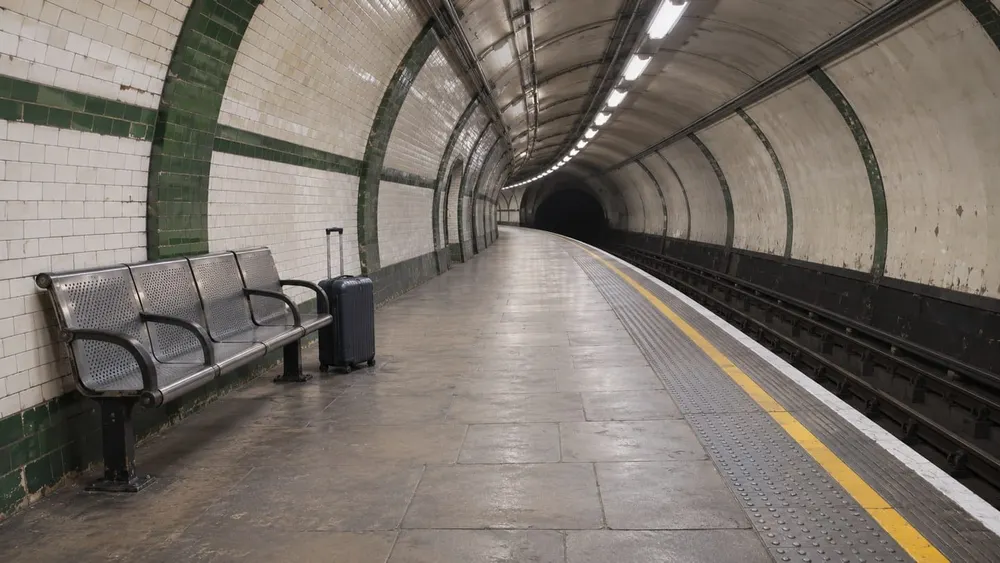
A 24-hour London Underground drivers’ strike that began at noon Thursday, November 26, is disrupting journeys into Friday, with travelers facing a gradual recovery rather than an immediate return to normal when the walkout ends. The action is the first of eight planned winter stoppages and affects a network that also carries passengers to Heathrow Airport.
Reuters reported the start of the strike Thursday and warned of effects through Friday evening. For American visitors arriving after Thanksgiving, the immediate issue is the connection between an airport, a hotel and the wider city: a flight operating normally does not ensure that the usual Underground route will be available.
Thursday also demonstrated the limits of advance service forecasts. Some trains ran where closures had been expected, while other routes remained suspended or reduced. Travelers need to distinguish the published strike window, the expected recovery timetable and the actual status of their individual route before setting out.
Thursday service exceeded some advance warnings
Transport for London initially expected no Piccadilly or Circle line service Thursday and no Waterloo & City service after midday. In practice, the Piccadilly line operated for part of the day. The Standard reported that it continued into the evening before services were suspended at about 6 p.m., with TfL saying more drivers had reported for work than anticipated.
That improved availability did not amount to normal operation. The same report described widespread disruption, a suspended Circle line and closures on parts of other lines. London Underground customer operations director Nick Dent acknowledged the disruption while saying the network had delivered better service than expected. The distinction matters for airport passengers: a line running for some hours Thursday is not evidence that a particular train or terminal connection will run Friday.
Friday recovery extends beyond the strike’s end
TfL’s published plan sets the walkout from noon Thursday to 11:59 a.m. Friday, London time. It anticipates a later start Friday, from about 7 a.m., with disruption continuing through the afternoon and normal service expected around 6 p.m. Those are operating expectations, not guarantees for every station or journey.
The authority says the Elizabeth line, London Overground, Docklands Light Railway, buses and trams are outside the action and expected to operate, although they may be busier as passengers switch routes. Its advice is to consult current information through TfL Go or its website and allow additional journey time. For a traveler with a fixed check-in deadline, a route requiring several connections offers more opportunities for disruption than the airport train alone would suggest.
That is why planning only around the strike’s formal finish can be misleading. A noon appointment or departure does not become straightforward simply because industrial action ends minutes earlier. TfL’s recovery forecast itself extends several hours beyond that point, and the relevant question is whether the complete journey is operating when the passenger needs to leave.
Heathrow retains alternatives to the Piccadilly line
The Elizabeth line and Heathrow Express provide alternatives when the Piccadilly line is unavailable, according to Time Out. Heathrow Express links the airport with Paddington. That still leaves the connection to or from Paddington to arrange, particularly where a traveler would ordinarily use an affected Underground line.
Heathrow’s guidance confirms that the Elizabeth line serves the airport’s three rail stations: Terminals 2 and 3 share a station, while Terminals 4 and 5 have their own. Passengers should check the destination of the train rather than assume that every Heathrow service reaches their terminal. The airport cautions that train times and fares can change and directs passengers to confirm information before traveling.
The effects extend to other London airports even where their principal rail services are outside the walkout. Time Out notes that Gatwick and Stansted passengers may need alternative transport to reach their departure stations, while the DLR remains an option for London City Airport. The practical bottleneck can therefore be the first or last part of the journey. Reaching an operating airport railway remains a separate task from boarding it.
A working-pattern dispute reaches the winter travel calendar
The RMT union says the dispute concerns proposed changes that would worsen working conditions, including longer duties, increased driving time and less predictable shifts. It argues that protections would be lost whether drivers choose a four-day or five-day week. Those are the union’s claims about the proposal, rather than independently established findings about its effects.
TfL describes the arrangements as voluntary and says it has added a five-day option that guarantees drivers can remain at their existing depot. It says the other drivers’ union, Aslef, has accepted the proposal. The disagreement is therefore about the terms attached to the working pattern as well as the number of days worked.
RMT lists the next stoppages for December 17 and 19, followed by January 4 and 6 and February 17, 23 and 25. Those remain planned actions, subject to developments in the dispute. For Friday’s travelers, the evidence supports a more immediate conclusion: London retains transport alternatives, but Thursday’s partial service does not remove the need to verify Friday’s route and allow for recovery through the evening.