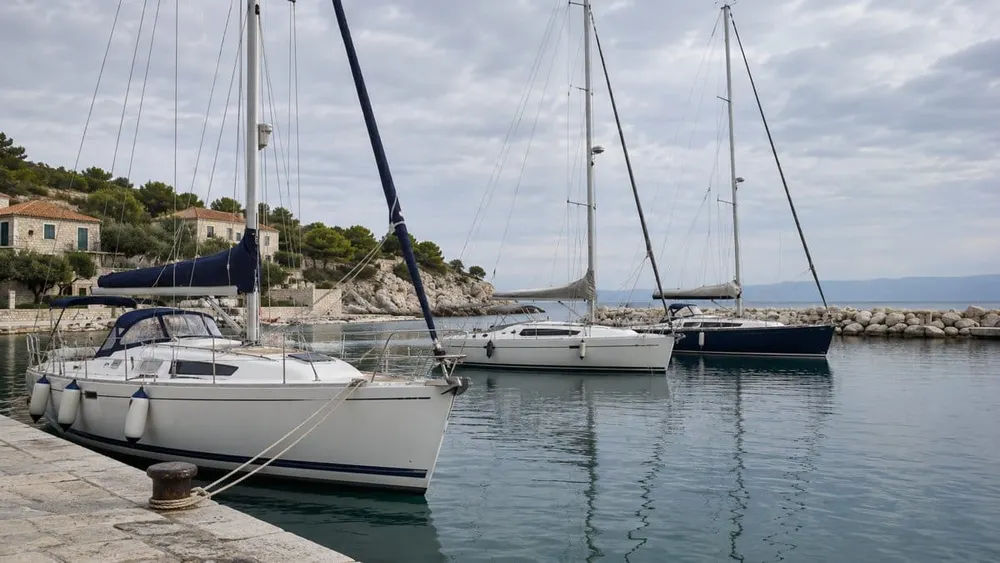
The crew of the sailing yacht Bayesian lacked information about a critical vulnerability to extreme winds before the vessel sank off Sicily, killing seven people, Britain’s Marine Accident Investigation Branch said in its final report Thursday. Investigators found that the yacht could be knocked onto its side with no sails set, a risk not identified in the approved stability information available to the crew.
The findings concern the Aug. 19, 2024 accident, rather than a new sinking. Bayesian was anchored near Porticello when a violent downburst knocked it onto its starboard side. It could not recover and flooded. Six guests and one crew member died, while 15 people survived. The report’s significance for marine travel lies in the information, design and preparation needed before an emergency develops.
The danger was not limited to sailing
Yachting World reported that the stability booklet contained information for operating under sail but not the relevant vulnerability at anchor or under engine power with sails down. The investigation examined the effects of the vessel’s loading, wind angle and retractable centreboard position. Those conditions matter because the same vessel can behave differently in different operating configurations.
The trade publication also described a complication with the centreboard: lowering it at anchor could increase the vessel’s movement from side to side around the anchor, worsening snatching on the cable and the risk of dragging. It was therefore rarely lowered while anchored. That detail illustrates why the investigation addresses usable operating information rather than assuming one simple action would resolve every competing hazard.
The findings are specific to this vessel and its configuration. They do not establish that every sailing yacht has the same vulnerability, or that a single wind threshold can be applied across different designs. The wider issue is whether owners and crews have stability information covering the conditions in which they actually operate.
Conditions deteriorated within minutes
Chief Inspector of Marine Accidents Rob Loder said in the branch’s statement that calm conditions changed to winds of at least 68 knots within 14 minutes. The yacht then went onto its side in less than 15 seconds. He said its susceptibility had not been recognized because it had never been assessed at anchor with sails down.
The agency found that the forecast was predominantly correct but did not convey the risk of downbursts from the predicted thunderstorms. The distinction is important: a broadly accurate forecast may still omit a rare, severe event that matters to a particular vessel. The investigation therefore examines how weather information supports decisions, rather than treating the event simply as a failure to consult a forecast.
The recommendations extend to the Met Office and UK Hydrographic Office. Investigators want consideration of how low-likelihood, high-impact weather hazards are represented and better published guidance on extreme-weather risks. Those are recommendations arising from a completed investigation, not evidence that every relevant forecasting service or maritime publication has already changed.
Survival depended on manual action
The branch’s account says the yacht sank in 50 meters of water. None of its liferafts automatically released or inflated, requiring crew members to deploy a raft manually. The crew gathered survivors in the water and helped them aboard before a nearby vessel rescued them. These findings identify a separate part of the accident sequence from the initial loss of stability.
Loder said the survivors reached a liferaft launched by a crew member. His statement emphasizes how quickly the emergency developed and calls on regulators, training providers and weather services to examine the findings. The recommendations include changes to yacht-master training to address downbursts and severe gusts, as well as further study of the vulnerabilities identified in the report.
A safety investigation has a defined purpose
Reuters reported that the investigation was not designed to determine liability. The branch’s own explanation of its work says its role is to establish causes and circumstances so that future accidents can be prevented. It does not prosecute, enforce laws or assign blame.
The branch investigates accidents involving UK vessels worldwide, as well as vessels in UK territorial waters. Its involvement in an accident abroad follows that safety remit. Its published explanation makes prevention the objective of the investigation, allowing recommendations to address systems beyond the actions of one person.
That distinction limits how the report should be used in interpreting competing legal accounts of the sinking. Identifying a previously unrecognized vulnerability is a safety finding; it is not a court judgment settling responsibility among designers, owners or crew. The next practical question is how the organizations receiving recommendations respond.
The report asks the Red Ensign Group to study the vulnerabilities and amend its yacht code and guidance in light of the findings. Thursday’s publication provides a more complete account of the loss and a set of proposed safeguards. Whether those safeguards become revised standards, training or clearer weather information will determine the investigation’s longer-term effect on marine travel safety.