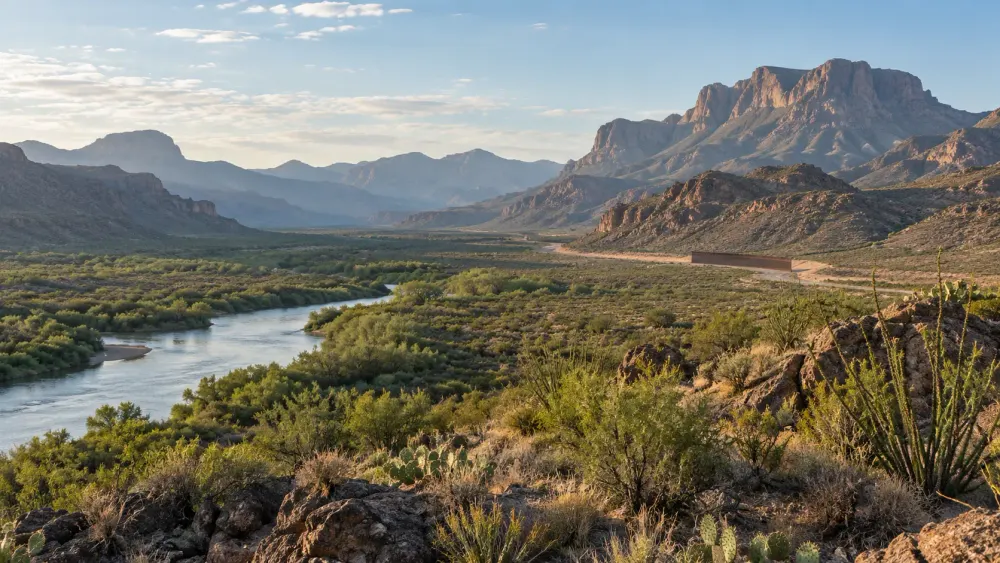
A federal judge has temporarily stopped border-barrier construction and related ground disturbance across Texas’ Big Bend sector, turning a local fight over desert roads, vehicle barriers and surveillance infrastructure into a broader test of how far the executive branch may go when it waives laws to accelerate border projects.
U.S. District Judge Kathleen Cardone granted a preliminary injunction Friday in Friends of the Ruidosa Church v. Mullin. The order bars the federal government from building border barriers or related infrastructure, or conducting ground-disturbing work in the sector, unless it complies with the laws at issue while the case proceeds. Reuters reported that the restraint covers the Big Bend sector, while The Associated Press said it reaches the national park and surrounding areas, including private land affected by planned construction.
The ruling is not a final judgment that the entire project is unlawful. A preliminary injunction instead preserves conditions while the court resolves the merits. Cardone found that the plaintiffs were likely to succeed on at least one claim, faced a likelihood of serious and irreparable harm, and had the balance of equities and public interest on their side. The case docket identifies the dispute as Friends of the Ruidosa Church v. Mullin, No. 3:26-cv-01099, filed in the Western District of Texas.
What the court stopped
The challenged program is broader than a continuous steel wall. Federal descriptions and news accounts include access roads, vehicle barriers, lighting, cameras, sensors, drainage work and other supporting infrastructure. A June 9 Department of Homeland Security notice in the Federal Register said the project would use barriers and roads to deter illegal crossings and waived a long list of federal, state and local requirements to speed construction.
DHS cited Section 102 of the Illegal Immigration Reform and Immigrant Responsibility Act, as amended, as its authority. In the notice, the department said Border Patrol recorded more than 89,000 apprehensions between ports of entry in the Big Bend sector during fiscal years 2021 through 2025. That figure is the government’s own administrative justification for the waiver; it does not, by itself, decide whether every planned segment is necessary or whether the waiver was exercised constitutionally.
The plaintiffs—the Center for Biological Diversity, Friends of the Ruidosa Church and Big Bend-area river guide and landowner Danny William Miller Jr.—contend that the government’s waivers and construction plans exceed statutory and constitutional limits. The Texas Tribune and Big Bend Sentinel reported that Cardone viewed the constitutional claims as likely to succeed, after hearing testimony about environmental, historic-preservation and property harms.
The government has defended the work as a border-security measure and argued that rugged terrain should not be treated as a permanent substitute for infrastructure. Customs and Border Protection Commissioner Rodney Scott had already paused work inside the national park for a personal review and consultations. The injunction matters because it makes that pause judicially enforceable and extends protection beyond an agency’s discretionary timetable.
A dispute over process as much as policy
Big Bend National Park shares 118 miles of international border with Mexico, according to the National Park Service. Its river corridor, desert habitat, historic sites and remote communities make the region unusually sensitive to grading, new roads, lighting and permanent barriers. Those same features also complicate enforcement, giving the administration a policy argument that the sector should not remain outside a broader border-security network.
The court’s intervention does not choose between open borders and enforcement. It addresses who decides, under what authority, and with which safeguards. Congress has given the executive branch unusually broad waiver power for border construction. The plaintiffs argue that the administration used that power in a way that intrudes on Congress’ own role and strips away legal protections too comprehensively. The government says the statute authorizes expedited action where the secretary determines barriers are necessary.
That distinction will shape the next phase. If the injunction survives an appeal and the plaintiffs ultimately prevail, the government may have to narrow the project, conduct reviews under laws it sought to waive, or return to Congress for clearer authority. If the administration wins, the ruling could be dissolved and construction could resume under the existing waiver framework.
The Big Bend decision also arrives against a mixed legal landscape. A separate federal case concerning border work farther southeast recently denied a preliminary injunction, underscoring that outcomes depend on the claims, record and property at issue rather than on a single nationwide rule. Cardone’s order is therefore consequential but geographically and procedurally limited.
What happens next
The Justice Department can ask Cardone to clarify or stay the injunction and can seek review from the U.S. Court of Appeals for the Fifth Circuit. Meanwhile, the district court will consider the underlying statutory and constitutional claims on a fuller record. Any later ruling could redefine the injunction’s scope or replace it with a final judgment.
For now, the practical result is clear: the administration cannot restart ground-disturbing border work in the Big Bend sector on its own terms. The larger policy question remains open—whether a statute designed to speed border construction permits the executive branch to bypass so many other legal constraints in a region where public land, private property, historic resources and national security policy converge.