
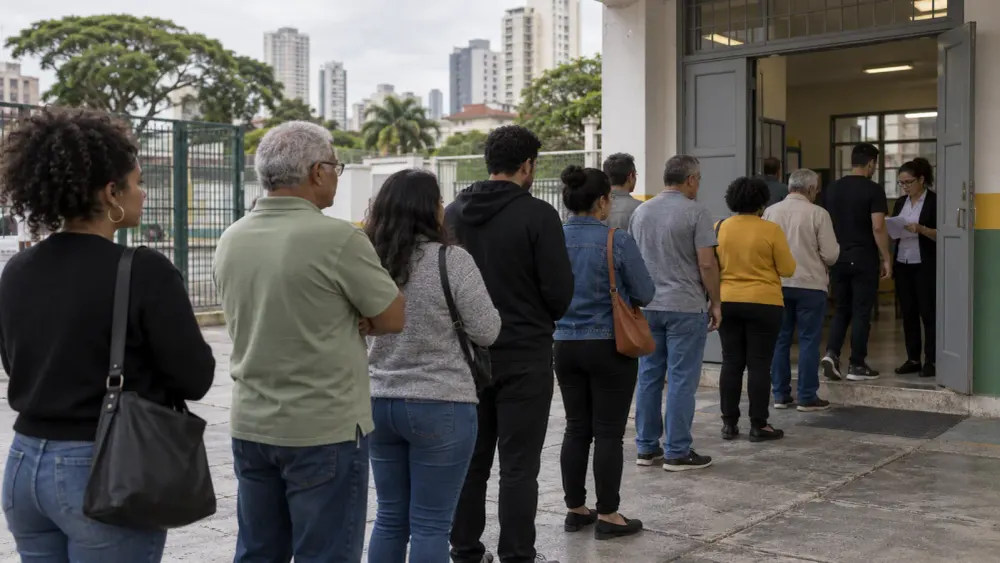
Brazil entered presidential election day with President Luiz Inácio Lula da Silva holding a narrow lead in several final polls but falling short of the support needed to win outright. The late surveys point toward a runoff against Sen. Flávio Bolsonaro, while also showing that the second-round contest would begin essentially even.
A Reuters review of polls released Saturday found Lula ahead across multiple surveys before Sunday’s first round. Yet none placed him above 50% of valid votes, the threshold for avoiding a second round. Brazil’s official election calendar schedules a runoff for October 25 if no presidential candidate clears that mark.
Final polls show a lead, not a verdict
Two of the newest surveys underscored how little separation exists. Datafolha put Lula at 45% of projected valid votes and Bolsonaro at 42%, while Quaest measured 46% to 45%. Both polls had margins of error of two percentage points, meaning the candidates were statistically tied. The published methodology and registration details show that Datafolha interviewed 4,006 voters Saturday and Quaest interviewed 3,702 voters on Friday and Saturday.
A separate CNT/MDA survey, conducted from September 30 through October 2, gave Lula 47.8% of projected valid votes and Bolsonaro 42.1%. Its first-round margin was wider, but its runoff test narrowed to 47.3% for Lula and 43.1% for Bolsonaro. Taken together, the surveys support two limited conclusions: Lula led heading into voting, and a second round was more likely than an immediate victory. They do not predict the exact order or size of the final result.
Polls are snapshots built from samples, turnout assumptions and decisions about how to treat undecided voters. That is especially important in Brazil, where valid-vote estimates exclude blank and null ballots and some pollsters model who is likely to participate. Small differences among the final surveys may therefore reflect methodology as well as last-minute movement. The official count, not the polling average, will determine whether the contest ends or continues.
The majority rule creates a clear dividing line. A candidate who receives more than half of valid presidential votes wins in the first round. If no one does, only the two leading candidates advance, and the second round becomes a direct choice between them. Because the smaller candidates collectively registered several percentage points in every major poll, even a modest gap between Lula and Bolsonaro would not necessarily be enough to end the race Sunday.
158.7 million voters, six choices
The scale of Sunday’s vote extends well beyond the presidency. The Superior Electoral Court, known as the TSE, says 158.7 million people are eligible to participate. Voters will also choose governors, two senators per state, federal deputies and state or district deputies. Nearly 919,000 eligible Brazilians live abroad.
Lula, 80, is seeking another term after a political career that has spanned decades. Bolsonaro, 45, is the son of former President Jair Bolsonaro and is trying to extend the conservative movement associated with his father. An Associated Press election guide described a field of 12 presidential candidates but identified Lula and Bolsonaro as the only contenders with a realistic path to the runoff.
The contest presents voters with sharply different political coalitions. Lula has emphasized social programs, environmental protection and continuity with his current government. Bolsonaro has campaigned on public security, a harder response to organized crime and closer alignment with conservative governments abroad. Those contrasts matter not only for Brazil, Latin America’s largest economy, but also for regional diplomacy, Amazon policy and the country’s relationship with the United States.
Congressional and state races will shape how much room the next president has to govern. Brazil’s fragmented party system often requires presidents to assemble broad legislative coalitions, making the composition of the Senate and Chamber of Deputies consequential for budgets, social policy and regulatory priorities. Governors also exercise substantial authority over policing, infrastructure and public services. Sunday’s result is therefore a national power map, not merely a presidential preference test.
Security is elevated, but voting remains the central test
Authorities prepared a nationwide security operation for election day. Brazil’s Federal Police said it would work with electoral officials and other agencies to prevent and investigate election crimes. The effort covers traditional offenses such as vote buying as well as cyber incidents and threats that could disrupt voting.
The security posture follows a tense campaign and heightened international attention. The United States and Australia temporarily suspended some diplomatic services after Brazilian police investigated suspected threats involving U.S. facilities. Those inquiries are separate from the administration of the vote, and no official evidence has established that the election system itself is compromised.
Brazil’s electronic voting system is designed to produce results quickly, and the TSE has created a public channel for the official count. Early totals may shift as returns arrive from different regions, so the nationally certified tally remains the meaningful measure.
The final polls frame the choice but cannot resolve it. Lula begins election day with a numerical advantage; Bolsonaro remains close enough to force a competitive second round. With neither candidate polling at a first-round majority, Brazil’s 158.7 million eligible voters—not the surveys—will decide whether the race continues for three more weeks.