
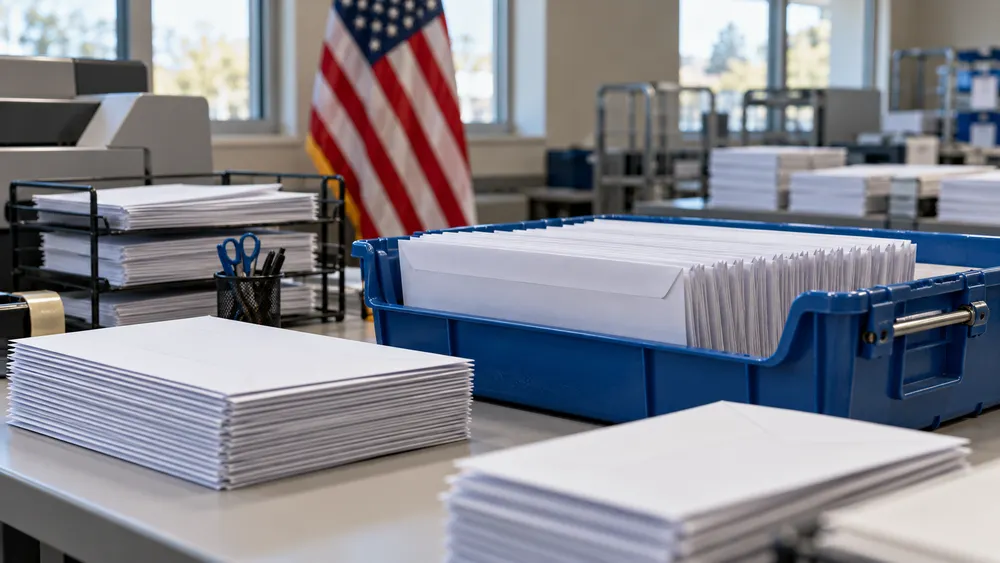
President Donald Trump is now urging Republican voters to use mail ballots if that is the most practical way to participate in the Nov. 3 midterm elections, a tactical shift from his long campaign against voting by mail. In a weekend message, Trump told supporters to vote early, by mail or in person. Asked about the change before leaving the White House on Monday, he said he still preferred in-person voting but that supporters “can vote by mail if they want,” according to a transcript of his remarks and Reuters.
The new instruction does not amount to a full change in Trump’s stated view of the system. During the same exchange, he repeated his allegation that mail voting involves widespread cheating after a reporter challenged the lack of supporting evidence. The political adjustment is therefore narrower: Republicans should use a voting method Trump continues to criticize because failing to do so could leave votes uncast in a close election.
A turnout message meets an established voting method
Mail voting is governed primarily by state law, and the rules vary. The U.S. Election Assistance Commission says some states require voters to provide a reason to request a mail ballot, others allow any eligible voter to request one, and still others automatically mail ballots to voters. The agency directs voters to confirm deadlines and procedures with their state election office rather than relying on national political messaging.
The method is neither new nor confined to one party. The National Conference of State Legislatures reports that all states provide some form of absentee or mail voting and that 37 states either permit no-excuse mail voting or send ballots to all active voters. Eight states and the District of Columbia conduct elections primarily by mail, according to NCSL’s state-by-state review. Those differences matter because a campaign’s nationwide call to vote by mail still has to fit distinct state requirements.
Trump’s appeal comes as Republicans try to maximize turnout in congressional contests that will determine control of the House and Senate. Reuters reported that some Republican officials have worried the president’s repeated attacks on mail voting could deter supporters who live far from polling places or find Election Day voting difficult. Encouraging every lawful option can reduce that risk, especially with early voting already underway in parts of the country.
The legal backdrop changed before the campaign message
The shift also follows a major legal defeat for the administration. On Sept. 14, the Supreme Court declined to let the U.S. Postal Service enforce new ballot-mail requirements before the midterms. The proposed rule would have required specialized envelopes and barcodes and allowed the Postal Service to reject noncompliant ballot mail. In its brief order, the Court said the government was unlikely to prevail in its challenge to a lower-court injunction; Justices Samuel Alito and Clarence Thomas dissented. The Supreme Court’s order, along with reporting from The Associated Press, confirms that states can continue their existing systems for this election while the litigation proceeds.
The administration had defended the Postal Service rule as an election-integrity measure. States and voting-rights groups argued that changing the system after voting preparations had begun could cause lawful ballots to be delayed or rejected. The Court’s decision did not resolve every long-term question about federal authority over ballot mail, but it removed the proposed requirements from the immediate midterm calendar.
Election officials continue to use multiple checks for mail ballots. The Election Assistance Commission’s election-security guidance describes a decentralized system in which state and local administrators apply safeguards to voter registration, ballot issuance, return, verification, counting and certification. Specific procedures differ, but the agency emphasizes that mail ballots are part of the same layered election system as early and Election Day voting.
What the reversal means—and what it does not
For Republican campaigns, Trump’s message resolves a practical tension: they can ask voters to use every legal channel without contradicting the party’s immediate goal of maximizing participation. It does not erase years of rhetoric that may have reduced confidence in mail voting among some conservative voters, and it leaves candidates to explain why a method described as vulnerable is also being promoted as necessary.
For voters, the operational takeaway is simpler than the political contradiction. Eligibility, request deadlines, return rules and ballot-tracking options come from state and local election authorities. The EAC advises voters to consult official state information and to act early enough to meet applicable deadlines. Political campaigns can recommend a voting method, but they do not set the legal requirements.
Trump’s change is best understood as a turnout strategy under pressure rather than an endorsement of the mail-voting system. He continues to question the method while acknowledging that Republicans may need it. With the midterms less than a month away, that distinction will matter less to campaigns than whether supporters follow the new instruction and submit valid ballots on time.