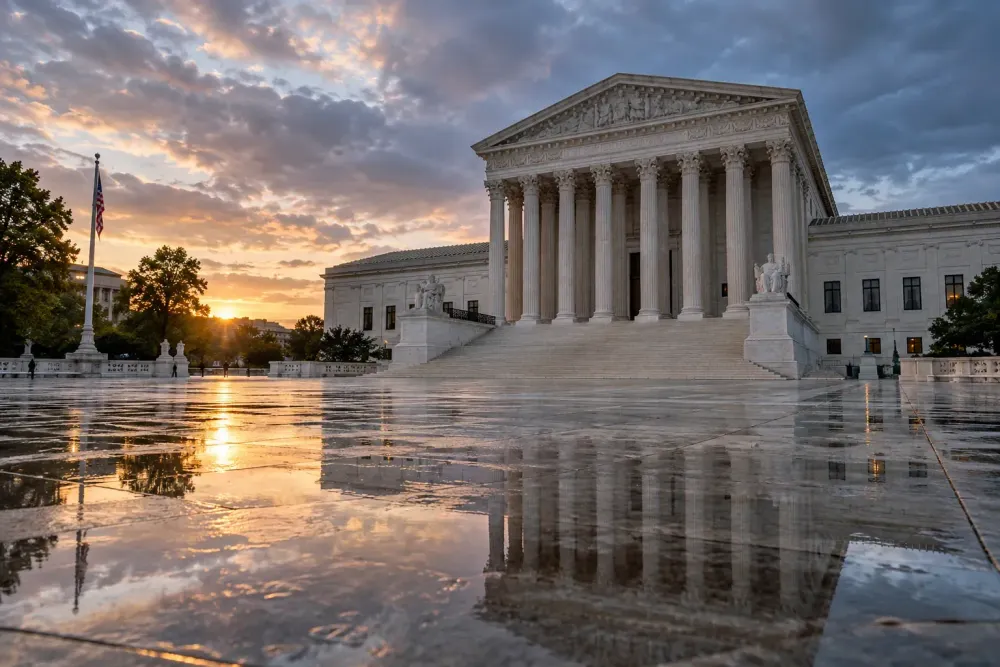
Nearly 60 state and local governments have filed climate-liability suits against fossil-fuel companies, and the U.S. Supreme Court will hear a case Monday that could determine whether many of them can proceed. The October 5 argument in Suncor Energy v. Boulder County opens the court’s new term and asks whether federal law blocks Colorado common-law claims seeking money for local climate harms, according to the court’s official docket and a Reuters report.
The justices are not deciding whether ExxonMobil and Suncor Energy caused a particular wildfire or how much they might owe. They are reviewing a preliminary ruling that allowed Boulder’s lawsuit to continue, making the immediate dispute one of federalism, preemption and jurisdiction rather than final liability. The distinction matters because, as the Associated Press explained, a ruling for the companies could cut off a national wave of cases before evidence is tested at trial.
The dispute turns on federal preemption
Boulder’s city and county governments sued in 2018, alleging that fossil-fuel production, promotion and sales contributed to climate change while the companies misled the public about the risks. They seek damages for local costs, including infrastructure, emergency response, environmental loss and public-health effects. The governments say they are pursuing traditional state-law remedies for injuries inside Colorado, not asking a judge to set an emissions limit or stop oil and gas sales.
Exxon and Suncor frame the same claims as regulation by another name. Their brief argues that liability tied to worldwide fossil-fuel activity would let one state impose costs on conduct occurring far beyond its borders. The companies contend that the Constitution reserves inherently interstate disputes for federal law and that the Clean Air Act assigns decisions about stationary-source emissions primarily to the Environmental Protection Agency and the states where those sources operate.
The federal government backs the companies
The Trump administration supports dismissal. In its filing, the Justice Department argues that Colorado cannot use tort law to impose liability for effects attributed to emissions released across the country and abroad. It says a patchwork of state rules would conflict with the national framework Congress established through the Clean Air Act and interfere with the federal government’s responsibility for foreign affairs.
Boulder answers that its case targets alleged deception and upstream business conduct, not the emissions of a particular power plant or factory. Its response says the requested remedy is money damages, not an injunction or emissions control, and argues that courts have long applied state tort law when out-of-state conduct produces in-state injury. The Colorado Supreme Court accepted that distinction in allowing the common-law claims to move forward, though two justices dissented.
Jurisdiction offers the court a narrower exit
Before reaching climate policy, the justices must decide whether they have authority to hear the appeal now. The Supreme Court ordinarily reviews final judgments from a state’s highest court, but Boulder’s underlying case has not reached trial. When the court granted review, it specifically directed the parties to address whether the Colorado ruling is sufficiently final and whether Article III’s jurisdictional requirements are met.
The companies and the federal government say the Colorado Supreme Court completed a separate, self-contained proceeding when it rejected the preemption defense. Boulder argues that the ruling was interlocutory because the trial court must still consider causation, damages and other defenses. If a majority agrees with Boulder on jurisdiction, the justices could dismiss the appeal without deciding whether federal law preempts the climate claims.
The policy stakes extend beyond Colorado
Local governments view these cases as a way to recover some costs of adapting infrastructure and emergency systems to a changing climate. The defendants counter that allowing dozens of state courts to assign responsibility for a global problem would produce inconsistent standards and use damages awards to reshape national energy policy. Both positions contain a genuine institutional question: whether ordinary state tort remedies remain available when the alleged harm is local but the causal chain is global.
A victory for Exxon and Suncor could provide a basis for dismissing many similar cases before discovery or trial. A victory for Boulder would not establish that the companies are liable; it would allow the litigation to continue under state law, where plaintiffs would still have to prove misconduct, causation and compensable injury. A jurisdictional dismissal would be narrower still, leaving the Colorado ruling intact without resolving the national preemption issue.
Eight justices will hear the argument
Justice Samuel Alito has recused himself, leaving eight justices and creating the possibility of an evenly divided court. A 4-4 split would leave the Colorado decision in place without establishing a nationwide Supreme Court precedent. The argument will therefore be closely watched for whether the justices concentrate on jurisdiction, the boundary between damages and regulation, or the practical reach of state law beyond Colorado.
A decision is expected by the end of June 2027. The court’s reasoning will matter at least as much as the result: a broad preemption ruling could close state courthouses to much of the climate-liability campaign, while a narrow jurisdictional decision would postpone the central policy dispute. Monday’s hearing will show whether the court is prepared to settle that boundary now or allow the cases to develop further in state courts.