
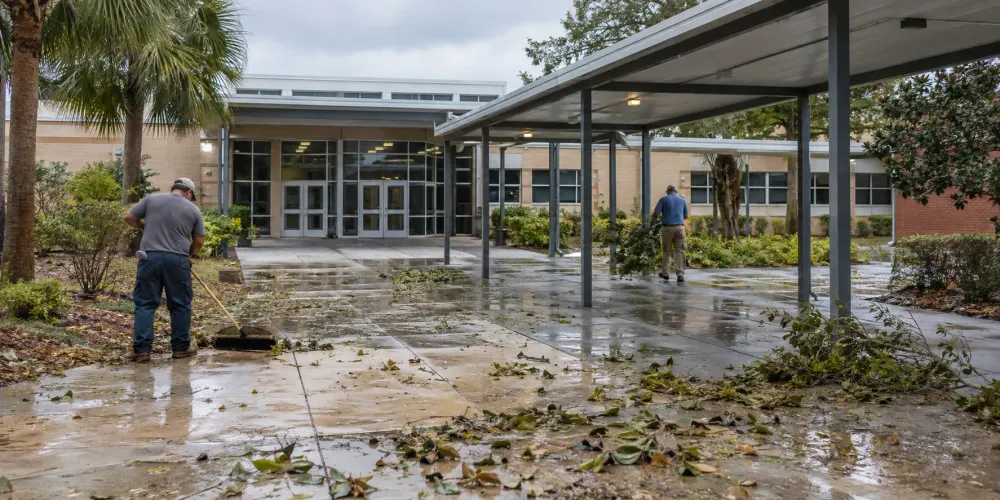
Nineteen K–12 districts or lab-school campuses, six Florida College System institutions and three state universities appeared on Florida’s statewide storm tracker Saturday with closure, reopening or post-storm scheduling notices after Hurricane Isaias. The state tracker shows a regional recovery moving on several clocks: some schools plan to reopen Monday, others will remain closed, and several districts will not bring students back until Tuesday because of previously scheduled breaks or teacher-planning days.
Isaias made landfall near Destin at about 8:30 p.m. Central time Friday with maximum sustained winds of 105 mph, according to a federal update. A Saturday state briefing said the Category 2 hurricane produced gusts of 116 mph near Santa Rosa Sound and pushed water at Panama City Beach roughly 5.6 feet above the average high-tide level. Those conditions made reopening decisions dependent not only on whether a campus building survived, but also on roads, electricity, transportation routes and the availability of staff and families.
A Patchwork Return Across the Panhandle
Florida’s Education Department listed Franklin, Jackson, Liberty and Taylor county schools as reopening Monday. Calhoun, Gulf and Washington county systems were described as open after the storm but observing previously scheduled breaks Monday, with Calhoun, Gulf and Washington also out Tuesday. Gadsden, Jefferson, Leon and Wakulla were likewise open following the storm but had Monday breaks already on their calendars. The result is not a single regional reopening date, even where the state no longer lists a storm closure.
Local notices show why the statewide list remains only a starting point. Jackson County said its Monday reopening was contingent on weather impacts, road conditions, utility restoration and safety assessments. That language leaves room for a schedule change if inspections uncover hazards after buses begin testing routes or facilities staff gain full access to campuses.
Elsewhere, the next student day was already later. Santa Rosa reminded families Saturday that Monday remains a teacher-planning day and students are expected back Tuesday. Wakulla County also scheduled students to return Tuesday following its planning day. These calendar distinctions matter for families arranging child care and transportation: a district may be operational after the hurricane while classrooms remain closed to students for reasons unrelated to new storm damage.
Colleges Recover on Different Timelines
Higher education is following the same uneven pattern. The Education Department said the University of West Florida intended to resume normal operations Monday unless conditions changed. Florida State University’s Panama City campus and Pensacola medical campus had closed Thursday and Friday, while its Tallahassee campuses shifted to remote classes Friday morning before suspending normal operations at noon.
FSU began restoring selected services during the weekend. Its campus alerts said libraries, dining locations, the student union and campus stores reopened Saturday, while postal operations were set to resume Monday. The university also kept some outdoor facilities closed and asked staff to report damage, illustrating that an institution can restart core services before every part of campus returns to routine use.
Pensacola State College was the clearest exception on the state list: it was scheduled to remain closed through Monday. The tracker also listed Friday closures at Chipola College, Gulf Coast State College, Northwest Florida State College and Tallahassee State College, with North Florida College closing at midday. For students in compressed or career programs, even a brief interruption can affect laboratory work, clinical preparation, testing and course sequencing, making institution-specific notices more reliable than any assumption that the region is reopening together.
The Operational Test Comes Before Instruction
The first post-storm decisions are primarily about safe access. Jackson County’s reopening conditions identify the essential chain: passable roads allow buses and employees to reach schools; restored utilities support lighting, refrigeration, communications and building systems; and facility checks determine whether students can occupy classrooms. Florida State’s weekend notice added another layer by identifying flood-prone parking areas and adjusting transportation and recreation schedules before normal Monday operations.
Communication is part of that recovery system. Districts are directing families to official websites, text alerts, email and mobile applications because conditions can change faster than printed calendars. The state tracker itself advises families to contact charter and nonpublic schools directly rather than assume they follow the public district’s schedule. For educators, that means reopening is not a single announcement but a sequence of facility, transportation, staffing and family-access decisions.
The Educator's Takeaway
For school and college leaders, Monday’s status should be treated as institution-specific rather than regional. The most useful distinction is between a campus that is physically cleared, a district that is administratively open and a school that is actually receiving students. Jackson County’s conditional reopening, Santa Rosa’s planning day and Pensacola State’s continued closure show how those categories can diverge. Faculty and staff should rely on their employer’s official channel for reporting times, remote-work instructions and course adjustments, while families should verify both the district schedule and their individual school’s notice. The evidence available Saturday establishes broad operational recovery across Northwest Florida, but it does not establish uniform readiness. Road access, power restoration and final building inspections remain the practical variables most likely to change a local schedule.