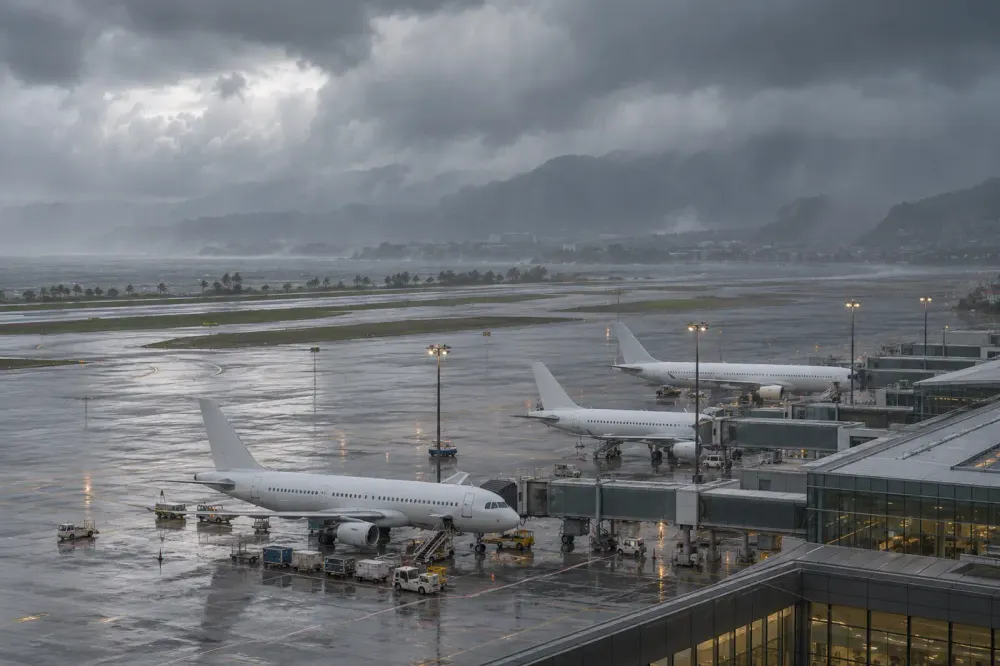
Hurricane Simon was battering Mexico’s Pacific coast Sunday with sustained winds near 150 mph, forcing Puerto Vallarta International Airport to remain closed until Monday morning and sending tourists and residents into shelters and hotel safe zones. The Category 4 storm’s eye was tracking close to the coast near Cabo Corrientes, creating an unusually uncertain threat: remaining offshore could allow Simon to preserve its strength while still driving catastrophic wind, storm surge and rain into one of Mexico’s busiest resort regions, according to the latest reports from AP and Reuters.
For travelers, the immediate consequences extend beyond a canceled weekend flight. The airport closure interrupts a major international gateway serving Puerto Vallarta and the Riviera Nayarit, while dangerous roads, flooding and landslide risks could complicate movement even after runways are cleared. Authorities have told visitors to remain in protected areas and follow local emergency instructions rather than attempting to travel through the storm.
Puerto Vallarta airport stays closed through Monday
Puerto Vallarta airport closed at 6 p.m. Saturday under an official aviation notice and is scheduled to reopen at 8 a.m. Monday, local time. The operator, Grupo Aeroportuario del Pacífico, said the timing remains tied to the storm and safety assessments. Its airport notice also reported that Manzanillo’s airport closed Saturday evening through Sunday morning, placing the two principal air gateways nearest Simon’s path under restrictions.
A scheduled reopening is not a guarantee that normal service will resume immediately. Airlines must reposition aircraft and crews, confirm destination conditions and work through passengers displaced by cancellations. Roads connecting resorts, smaller communities and airports may also remain unsafe after winds subside, particularly where flash floods or mudslides block access.
The storm’s track keeps the danger high
At daybreak Sunday, Simon’s center was about 110 miles south-southeast of Cabo Corrientes and moving north-northwest at roughly 6 mph. The slow, nearly parallel movement along the coast made the exact landfall point difficult to predict. A current NHC advisory kept Simon at Category 4 strength and warned that the core could pass close enough to produce destructive conditions even if the center did not immediately cross the coastline.
Forecasters said Simon could deliver 10 to 20 inches of rain across parts of southwestern Mexico, with isolated totals approaching 30 inches in Michoacán, Colima and Jalisco. The Sierra Madre’s steep terrain amplifies the risk because intense rainfall can run rapidly into valleys and destabilize slopes. Along the shore, storm surge and large waves can flood roads and damage waterfront infrastructure before the eye arrives.
Tourists are sheltering with coastal communities
Jalisco suspended classes in 22 coastal municipalities and began evacuating people from vulnerable areas. Hotels and tourism businesses were asked to account for workers and visitors and move them into shelters or designated safe zones. The federal government also suspended nonessential activity across Jalisco, Colima, Michoacán and Nayarit, according to the Mexican presidency.
Those measures reflect a broader vulnerability than the resort district alone. Puerto Vallarta has large hotels and reinforced structures, but many workers and residents live in hillside or inland communities where housing and roads may be less resistant to extreme wind and water. Visitors sheltering in hotels therefore share the same regional constraints on power, communications, medical access and transportation as the surrounding population.
Airlines offer flexibility, but options remain limited
Delta issued a weather waiver for travel through Puerto Vallarta and Guadalajara on October 10 and 11. The airline’s waiver allows eligible passengers to rebook through October 14 without an extra change cost when its conditions are met, or cancel and retain an electronic credit. Travelers on other carriers must check their airline’s rules because waiver dates, eligible airports and refund options can differ.
Passengers should avoid heading to a closed airport unless their airline and the airport confirm operations have resumed. A flight displayed as scheduled can still be delayed or canceled as conditions change, and the airport operator’s reopening time may be revised after inspections. Travelers already in the region should prioritize local shelter directions over an attempt to reach an airport or cross flooded roads.
Reopening will depend on more than the runway
Once Simon moves away, aviation teams will need to inspect runways, lighting, navigation equipment, terminals and access roads. Airlines will then rebuild schedules around available aircraft and crews. Even if Puerto Vallarta reopens Monday morning, a backlog could produce uneven service through the day, especially if inbound aircraft were diverted or kept outside the region.
The central uncertainty is how long Simon remains close to the coast at major-hurricane strength. The storm’s slow movement raises the possibility of prolonged wind and rainfall, while a small shift could materially change which communities receive the worst conditions. The verified facts are already sufficient for travelers to act: Puerto Vallarta’s airport is closed through at least Monday morning, airline schedules are disrupted, and movement in the affected coastal corridor should wait for explicit clearance from aviation and emergency authorities.