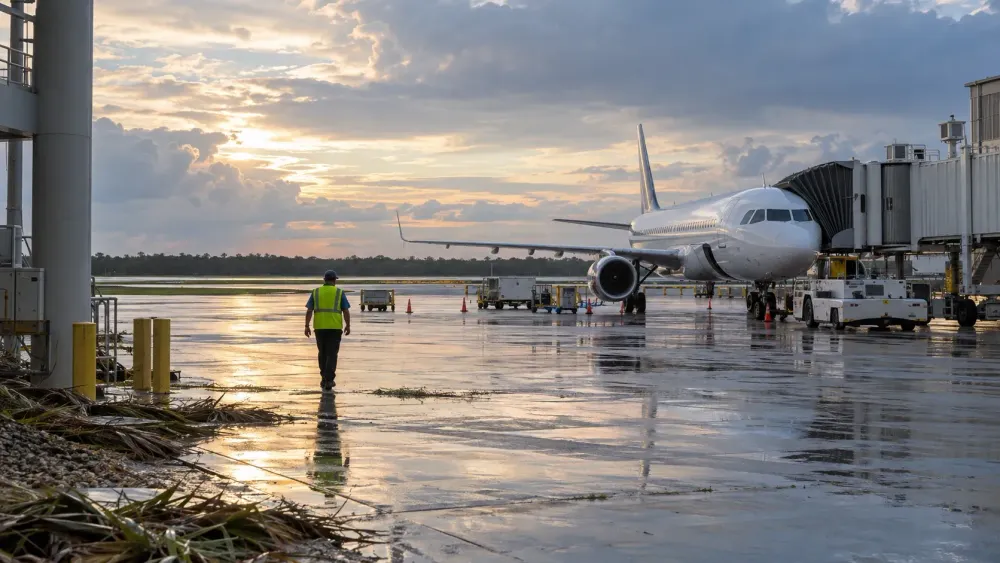
Pensacola International Airport remained closed to commercial flights Saturday, one day after Hurricane Isaias forced 74 cancellations there and disrupted every major passenger airport near its Florida Panhandle landfall. The airport said recovery work was underway but had not announced a reopening time, leaving Sunday travelers without certainty as the region began restoring roads, power and air service.
The closure is the sharpest remaining aviation constraint along the western Panhandle. Northwest Florida Beaches International Airport near Panama City reopened Saturday, while Destin-Fort Walton Beach Airport and Pensacola were still closed in the afternoon, according to WLRN. That uneven recovery means an open alternate airport does not necessarily provide a practical replacement for passengers whose roads, hotels or local utilities remain affected.
Isaias made landfall near Destin late Friday as a Category 2 hurricane with maximum sustained winds of 105 mph, then weakened as it moved inland. The Associated Press reported widespread structural damage and nearly 900,000 customers without power during the first hours after landfall. By midday Saturday, Reuters counted about 670,000 customers still without electricity across Florida, Alabama, Georgia and Mississippi.
Pensacola has no firm reopening time
Pensacola's terminal closed Friday morning, and runway operations stopped that evening. A pre-landfall city update said the return to operations would depend on damage assessments and repairs, with Saturday or Sunday listed only as a tentative range. After landfall, officials said the airport sustained damage and would remain closed to commercial traffic until further notice.
The airport's own website said Saturday morning that teams were conducting recovery work. Pensacola normally serves seven airlines and 28 nonstop destinations, so a prolonged shutdown affects more than local departures: aircraft and crews cannot return to their planned positions, inbound passengers must be reaccommodated, and connecting itineraries can unravel beyond the Panhandle.
A terminal or runway reopening also does not guarantee a normal schedule. Airlines must reposition aircraft, verify crew availability and rebuild rotations after two days of cancellations. Passengers should therefore wait for confirmation from both the airport and their carrier rather than treating an estimated reopening window as a confirmed departure.
Nearby airports are recovering at different speeds
Northwest Florida Beaches International's reopening created one functioning commercial gateway east of the hardest-hit Pensacola area. Destin-Fort Walton Beach, closer to the landfall zone, remained closed Saturday afternoon. The distinction matters because the airports are separated by substantial driving distances, and rental-car availability, fuel access and road conditions can limit the usefulness of a nominal alternate.
On Friday, all 78 scheduled arrivals and departures at Destin-Fort Walton Beach were canceled, while Pensacola recorded 74 cancellations, the Associated Press reported. Those passengers entered rebooking queues before the airports could assess damage, creating demand that will carry into Sunday and Monday even where runways reopen. Seats on the first restored flights are likely to be constrained by both new bookings and displaced travelers.
Road access improved, but local hazards remain
Florida officials said state-owned coastal bridges had been inspected and reopened by Saturday morning. Interstate 10 and U.S. 98 were also cleared, according to WLRN, restoring the principal east-west routes through the Panhandle. Smaller roads remained obstructed in places by debris, standing water and downed utility lines, however, and officials asked people to avoid unnecessary travel while crews worked.
Power loss compounds the transportation problem. WLRN reported that 75% of customers in Escambia County, which includes Pensacola, had lost electricity; outage rates were still higher in several neighboring counties. Travelers may encounter hotels without full service, traffic signals that are dark, closed fuel stations and limited mobile charging even when a highway is technically open.
The reopening sequence illustrates why post-storm travel recovery is not a single switch. Roads can reopen while airports remain closed, and an airport can resume limited operations while the surrounding hospitality and ground-transportation network is still impaired. Travelers heading into the region should verify each segment independently.
The storm's travel risk shifted inland
Isaias was no longer a tropical cyclone by Saturday, but the loss of its hurricane designation did not end the hazard. The National Hurricane Center's official advisory archive documents the storm's progression, while Reuters and the Associated Press reported continuing threats from flash flooding, damaging winds and tornadoes as the system moved across the Southeast.
That shift broadens the travel impact beyond the Gulf Coast. Motorists and airline passengers in Georgia, the Carolinas and parts of the Tennessee Valley could face localized road closures, airport delays or rerouting even as Florida service improves. The practical risk is increasingly tied to rainfall and infrastructure damage rather than coastal storm surge.
Sunday's schedule remains provisional
The most important indicators for Sunday travel are formal reopening notices from Pensacola and Destin-Fort Walton Beach, the first confirmed airline departures and the pace of power restoration around Escambia and Okaloosa counties. Cancellation totals will remain fluid until carriers publish final schedules, and a reopened airport may operate below normal capacity.
For now, the region presents a mixed picture: one Panhandle airport is open, two remained closed Saturday afternoon, major highways are passable, and local access is still uneven. Isaias has moved away from the coast, but the travel disruption it left behind will end airport by airport and route by route, not with the storm's downgrade.