General Motors has committed C$1.1 billion to three Ontario factories in a tentative labor agreement that adds heavy-duty pickup production in Oshawa while preserving options for two other plants, even as threatened U.S. tariffs make Canadian vehicle output more expensive. The package covers 4,600 Unifor members and still requires ratification in voting that runs through Sunday.
The agreement assigns C$144 million to prepare Oshawa for the next generation of heavy-duty GMC Sierra pickups, incorporates a previously announced C$691 million program for new V8 engines, and directs C$215 million to next-generation transmissions at St. Catharines beginning in late 2029. GM also agreed not to immediately close or sell its idled CAMI assembly plant in Ingersoll while studying alternative work.
For GM, the commitments are less a simple vote of confidence than a calculated hedge. Management is protecting profitable truck and propulsion capacity inside an integrated continental network while Washington threatens to double tariffs on Canadian vehicles, parts and steel to 50% on January 1. The union gains product allocations and a temporary safeguard for CAMI, but the durability of both depends on ratification, future demand and the unresolved terms of U.S.-Canada trade.
Three Plants Receive Different Forms of Protection
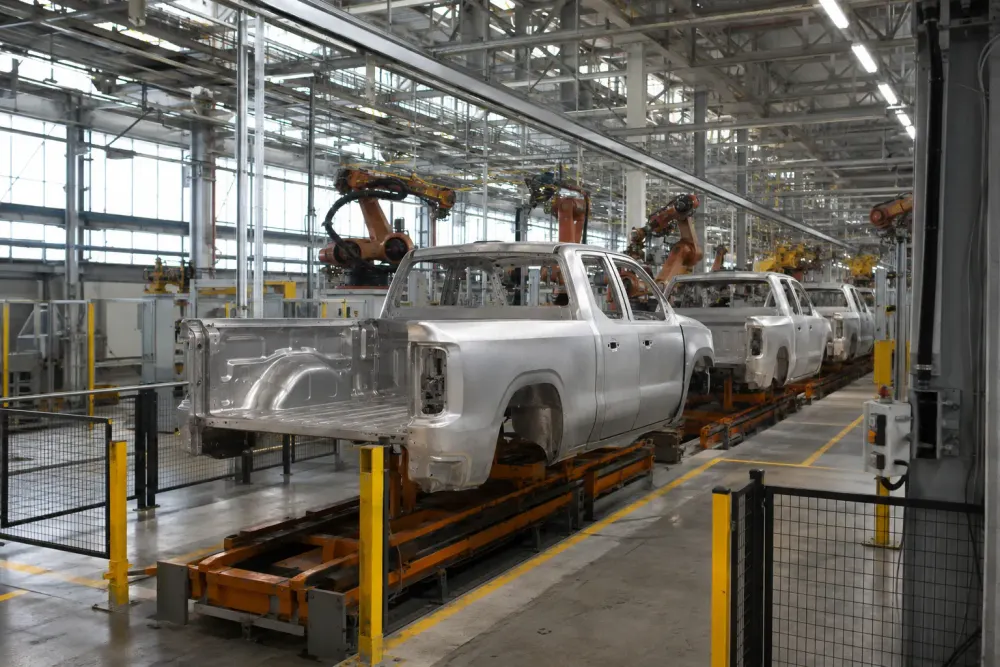
Oshawa receives the clearest production award. The C$144 million allocation would add a next-generation heavy-duty Sierra to a plant already capable of building light- and heavy-duty pickups on the same line. That flexibility gives GM another way to balance models and shifts as demand changes. It also gives Unifor a named future vehicle program rather than a general promise of investment, although launch timing and employment levels were not disclosed in the public account.
St. Catharines receives two propulsion programs with different horizons. The C$691 million V8 project reinforces a factory that already produces truck and sport-utility engines, while the C$215 million transmission commitment extends planning into 2029. GM’s own plant profile identifies St. Catharines as a supplier to assembly operations worldwide. Engines and transmissions can therefore support multiple final-assembly locations, reducing dependence on any single vehicle line.
CAMI gets no confirmed replacement product. Instead, GM agreed to keep the Ingersoll site from an immediate sale or closure while considering other production, including potential defense work if it wins a Canadian Armed Forces contract. That distinction is material. It preserves an asset and a bargaining option, but it does not create an order book, start date or guaranteed employment. The BrightDrop electric delivery-van cancellation left the plant without the kind of volume program Oshawa now stands to receive.
Tariffs Turn Factory Allocation Into a Trade Bet
The agreement arrives after tariffs have already changed the economics of moving vehicles across the border. Canadian government trade notes say the United States applies 25% duties to Canadian vehicles that fail regional-content rules and to the non-U.S. content of qualifying vehicles. Noncompliant parts also face 25% duties, while treatment of qualifying parts awaits a process that isolates their non-U.S. value.
Those rules matter because a Canadian-built pickup is not simply Canadian in economic terms. The USMCA requires 75% North American content for passenger vehicles and light trucks, along with separate standards for core parts, metals and high-wage production, according to the U.S. trade representative’s auto report. Components can cross borders several times before a finished truck reaches a dealer. A duty based on national rather than regional content therefore penalizes a supply system the trade agreement was designed to deepen.
The White House argues that the tariffs and temporary offsets reward U.S. assembly, strengthen domestic capacity and reduce supply-chain vulnerability. Its policy summary says qualifying manufacturers can offset part of the parts duty for U.S.-assembled vehicles through April 2027. GM must therefore compare the operating advantages of its Canadian plants with a policy structure that explicitly improves the economics of locating more final assembly in the United States.
GM Is Spending on Both Sides of the Border
The Canadian package does not reverse GM’s larger U.S. investment shift. In its latest annual filing, the company said it planned roughly US$4 billion for plants in Tennessee, Kansas and Michigan and nearly US$1 billion for a new generation of V8 engines in New York. Those commitments expand American production while the Ontario programs preserve complementary capacity and labor skills.
The financial pressure is large enough to shape that allocation. GM’s 2026 outlook assumes US$3 billion to US$4 billion in gross tariff costs, plus US$1 billion to US$1.5 billion in added expense from onshoring, supply-chain investment and software, according to its investor deck. The company also expects US$10 billion to US$12 billion in capital spending. Against those totals, C$1.1 billion in Canada is meaningful for three communities but manageable inside GM’s broader North American budget.
That portfolio approach helps explain why GM can invest in Ontario while responding to tariff incentives in the United States. Truck demand rewards capacity and flexibility; propulsion plants spread capital costs across several models; and retaining CAMI preserves an option that would be costly to recreate later. The strategy does not eliminate tariff exposure. It keeps GM from making an irreversible exit while politicians continue negotiating the rules under which the factories will operate.
Canada Has More at Risk Than One Automaker
Canada’s auto industry contributed C$16.8 billion to gross domestic product in 2024, directly employed more than 125,000 people and supported roughly 427,000 additional jobs, according to the federal industry profile. Nearly 700 parts manufacturers surround assembly plants operated by five global automakers. A product decision at Oshawa or CAMI therefore reaches toolmakers, logistics providers and component suppliers well beyond the employees covered by the contract.
The dependence on the U.S. market is unusually concentrated. More than 90% of Canadian-made vehicles and 60% of Canadian-made parts are exported south, while Canadian factories produced more than 1.2 million passenger vehicles in 2025, federal strategy data show. Automotive trade with the United States totaled C$152 billion in 2024. A higher border charge can therefore affect factory utilization long before a company formally announces a closure.
That risk was visible at Oshawa earlier this year. GM cut roughly 500 jobs when it returned the plant from three shifts to two, while Unifor estimated that as many as 1,200 supply-chain workers would also be affected. GM said the change reflected the end of a temporary post-pandemic shift rather than tariffs; the union blamed the new trade barrier. The competing explanations in the January record underscore why a capital commitment is more informative than rhetoric but still not equivalent to sustained production.
Ratification Is the First Test, Trade Policy the Larger One
Workers must first decide whether wages, benefits and product commitments justify approving the tentative contract. Rejection would send negotiators back to the table and could place the investment timetable in doubt. Approval would make the allocations contractual, but it would not remove normal contingencies such as market demand, launch execution, regulatory approvals or the need for GM to secure any defense work contemplated for CAMI.
The second test is whether Ottawa and Washington can settle automotive trade before the threatened January escalation. Canada has linked any broader agreement to the survival of domestic assembly and parts manufacturing, while U.S. policy is built to pull more production south. Medium- and heavy-duty vehicles are especially important because the Oshawa award sits directly in the segment still contested in bilateral talks.
For now, the package keeps GM’s Canadian footprint commercially relevant rather than frozen in place. Oshawa gains a named truck, St. Catharines gains engine and transmission work, and CAMI gains time. The larger business conclusion is more cautious: C$1.1 billion can preserve capacity and flexibility, but it cannot by itself overcome a 50% tariff. The value of the agreement will ultimately be measured in launched programs, stable shifts and a trade framework under which vehicles can still move profitably across North America.