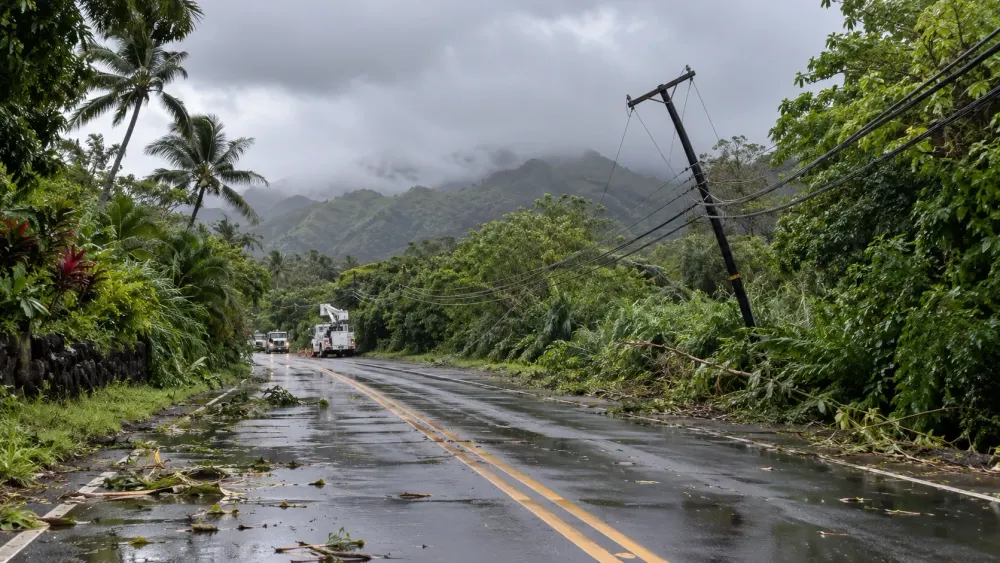
More than 33,300 electricity customers on Kauaʻi—nearly 91 percent of the island utility’s membership—were without power by 8 a.m. Hawaiʻi time Tuesday after Hurricane Lowell passed west of the island, turning a forecast emergency into a broad infrastructure failure. The verified outage count reported by HPR represents the clearest measure yet of the storm’s reach across an island of roughly 73,000 residents.
The storm downed trees and power lines, blocked roads and forced emergency officials to ask residents and visitors to remain off the streets while crews assessed damage. Līhuʻe Airport, Kauaʻi’s principal commercial gateway, remained closed pending inspections of its runway and terminal facilities. About 300 people had used shelters, according to the Associated Press.
Lowell’s center did not cross Kauaʻi, and the hurricane warning was lifted Tuesday morning as the system moved north of the islands. That distinction matters meteorologically, but it does not diminish the operational emergency on the ground. A storm can remain offshore while its broad wind field, rain bands and surf damage utilities, transportation and communications across an exposed island. The immediate question is no longer whether Lowell will come close enough to cause disruption; it is how quickly public agencies and the island’s utility can determine the extent of damage and restore essential services safely.
The storm has passed, but the emergency has not
Hurricane Lowell was about 245 miles northwest of Honolulu at 8 a.m. Tuesday and moving north at nearly 18 mph, according to the latest consolidated storm update. Maximum sustained winds remained near 105 mph, making Lowell a Category 2 hurricane even as it moved away. On Kauaʻi, gusts reached roughly 80 mph, while sustained winds at Līhuʻe Airport exceeded 50 mph. Those readings help explain how an offshore track still produced islandwide consequences.
The Hawaiʻi EMA continued to direct residents toward official county alerts, shelter information and National Weather Service products. Although hurricane and tropical-storm warnings for Kauaʻi, Niʻihau and Oʻahu were discontinued Tuesday morning, flash flooding and mudslides remained possible as moisture trailed behind the storm. High surf and dangerous currents also persisted across several islands, extending the hazard beyond the period of strongest wind.
That sequence is common in tropical cyclones: a warning can expire because sustained winds have fallen below the relevant threshold even while floodwater, unstable slopes, damaged electrical equipment and debris continue to endanger the public. For residents, the lifting of a hurricane warning is therefore not the same as an all-clear. For emergency managers, it marks a transition from protective sheltering toward search, damage assessment, road clearance and restoration—work that can expose crews and residents to secondary hazards.
A near-total outage changes the recovery calculus
The power failure is the most consequential confirmed development. The KIUC map showed more than 33,300 customers affected at 8 a.m., and the utility said extensive damage made restoration attempts unsafe until the storm had moved farther away and crews could assess conditions. The figure may change quickly as circuits are inspected, isolated and reenergized, but it establishes that the disruption was not confined to one community or a small number of damaged lines.
Electricity supports far more than household lighting. Extended outages can interrupt refrigeration, communications, fuel distribution, water pumping and medical equipment. Kauaʻi’s Department of Water had already asked customers to conserve before the storm because power failures can affect wells and pumps. The county’s detailed Monday briefing advised residents to limit water use to essential needs and warned that pressure could fall even where homes suffered no direct physical damage.
The duration of the outage will determine whether an acute disruption becomes a wider public-health and economic problem. Utility crews must first identify downed conductors, damaged poles, blocked access routes and any generation or substation problems before issuing reliable restoration estimates. Broad percentages can improve rapidly when a major circuit returns, then plateau as crews confront scattered damage. Until KIUC publishes a restoration timetable, neither the morning outage total nor isolated reports of returning power establish how long individual communities will remain without service.
Airport and road closures isolate an island response
The Hawaiʻi Department of Transportation closed Līhuʻe Airport Monday afternoon as Lowell approached. A local airport report cited the department’s decision, while Tuesday’s state updates said operations would resume only after officials inspected the runway and terminal and determined they were safe. The closure interrupts passenger travel, but it also constrains the movement of personnel, replacement equipment and time-sensitive supplies until aviation operations restart.
Road access is equally important. Officials reported fallen trees, downed lines and debris, and the Hanalei Bridge was closed because of elevated water. On Oʻahu, floodwater and storm-driven debris affected a coastal highway. Kauaʻi emergency administrator Elton Ushio asked people to stay off the roads so first responders and public works crews could assess damage without creating additional emergencies, the AP reported.
These restrictions are not merely travel inconveniences. A blocked bridge can separate communities from medical care and repair crews; an airport inspection delay can strand visitors and complicate supply logistics. The practical measure of recovery will be the restoration of safe access, not simply the hurricane’s distance from the islands. Officials have not yet published a comprehensive count of impassable roads, damaged structures or canceled flights, so the full transportation impact remains incomplete.
The forecast threat became a measured impact
Before Lowell arrived, officials warned of an unusually broad set of hazards. The county said six to 10 additional inches of rain were expected in some areas, with isolated totals as high as 16 inches, while surf along south-facing shores could reach 20 to 30 feet and storm surge could raise water two to four feet above normally dry ground. Those were forecasts rather than observed islandwide totals, and they should not be reported as completed damage. They explain, however, why officials closed schools, government offices, parks and other facilities before the strongest conditions arrived.
Governor Josh Green said state, county and federal agencies had positioned personnel and equipment, lowered reservoir levels, cleared waterways and coordinated with utilities and fuel providers. The governor’s office also urged residents and visitors to avoid floodwater and dangerous surf and to monitor official alerts. Those preparations reduced avoidable exposure, but they could not prevent a wind-driven electrical failure spread across much of Kauaʻi.
The change from projected risk to documented outage also makes this a distinct development from The American Quorum’s earlier report, which described closures and travel disruption while the storm was still approaching. Tuesday’s evidence establishes an operational outcome: tens of thousands of customers actually lost electricity, roads were obstructed and damage assessments began. It does not yet establish the total economic loss, the number of damaged homes or the time required for a full recovery.
What remains unknown
No broad official fatality count or comprehensive injury report had been announced by the source cutoff. That is encouraging but preliminary, because emergency officials were still beginning assessments after sunrise. Likewise, reports of fallen trees and infrastructure damage do not yet support a statewide or islandwide dollar estimate. Early disaster estimates often change as inaccessible areas are reached and utilities distinguish damaged equipment from precautionary shutdowns.
Lowell also should not be described as making landfall on Kauaʻi. The hurricane’s center passed west of the islands, while its outer wind field and rain bands produced the damaging conditions. The NHC advisory documented the storm’s position, intensity and warning structure as it passed the state. Maintaining that distinction avoids overstating the meteorological event while still recognizing the severity of its effects.
The initial recovery priorities are now measurable: reopen critical roads and Līhuʻe Airport when inspections permit, restore electricity without exposing crews to energized or unstable lines, maintain water and communications service, and complete damage checks in communities that were difficult to reach during the storm. Residents should continue using the official state hub and county alerts rather than treating the canceled hurricane warning as proof that every local hazard has ended.
Lowell’s most important confirmed result is the breadth of Kauaʻi’s power failure, not the storm’s category at its closest approach. The center is moving away, but restoration will depend on what crews find along roads, electrical circuits, airport facilities and water systems. The next authoritative updates should show whether the outage contracts rapidly or becomes the defining measure of a longer island recovery.