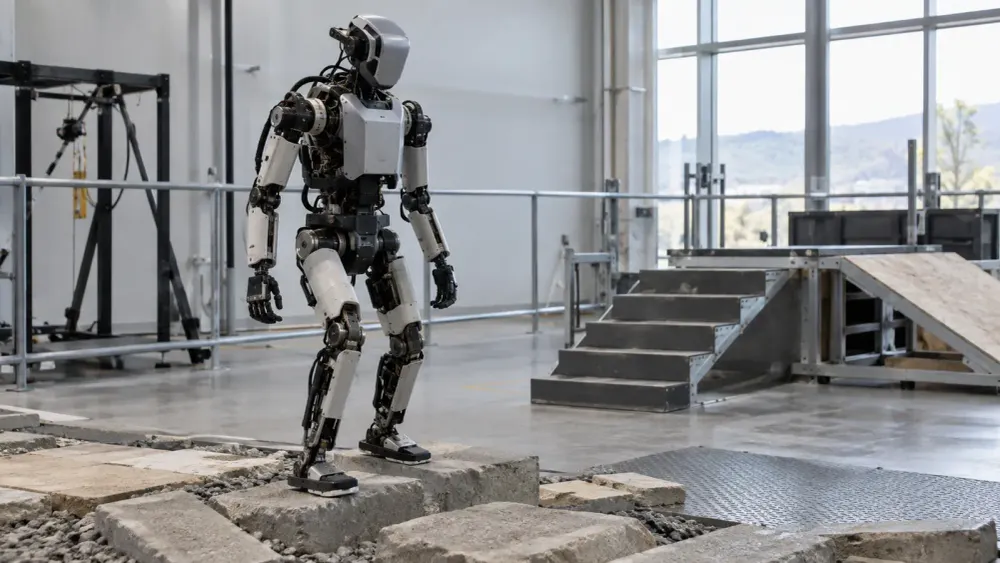
More than 100 Chinese military procurement notices, academic studies, patents and official records show that the People’s Liberation Army is building a research pipeline for humanoid robots that could eventually work alongside troops. A new Reuters investigation found accelerating work on perception, dexterous manipulation and battlefield training data during 2025 and 2026. The evidence documents intent and experimentation, however, not a fielded robotic infantry force.
That distinction matters. Reuters found no evidence that China has deployed an armed humanoid robot with an operational PLA unit. Current machines remain power-hungry, mechanically fragile and unreliable outside controlled demonstrations. Yet the military interest is concrete enough to reshape procurement: researchers are testing how human-shaped platforms might navigate buildings, handle tools and absorb risks that commanders would otherwise assign to soldiers.
China enters that experiment with an unusual industrial advantage. Chinese manufacturers accounted for an estimated 95% of global humanoid shipments in 2025, according to Bank of America Global Research figures cited by Reuters. Scale can lower component costs and accelerate iteration, but commercial shipments are not a measure of combat readiness. A warehouse demonstration does not reproduce mud, electronic warfare, damaged communications or the legal judgments required in a populated battlespace.
Procurement Moves Beyond Robot Bodies
The procurement trail suggests the PLA is assembling an ecosystem rather than buying a finished weapon. A May 2025 tender sought a humanoid platform, while a September solicitation emphasized perception and dexterous operation. In June 2026, another project offered roughly $300,000 for a system to label and manage humanoid training data. Those purchases target the sensors, software and datasets needed to turn coordinated movement into useful military behavior.
Official thinking has moved in parallel. An August 2025 National University of Defense Technology study modeled six combat robots divided into two assault teams clearing a building and projected a five-to-ten-year development horizon. A PLA Daily discussion described a possible progression from support duties toward primary combat roles, while retaining human confirmation for target decisions. Neither document proves that the modeled capability works in the field.
State-owned defense group Norinco has advertised its Fuxi humanoid for sentry, reconnaissance, patrol and hazardous tasks, including remote operation. Teleoperation could let a machine enter a contaminated room or exposed position while keeping a soldier behind cover. It also creates a dependence on links that can be jammed, intercepted or delayed. A robot that loses contact at a doorway may become an obstruction rather than an asset.
Human Shape Brings Trade-Offs
A humanoid form has a straightforward appeal: cities, ships, tunnels, staircases and equipment are designed around human bodies. Two arms can open doors, lift irregular objects and use tools without rebuilding the environment. Legs can cross steps that stop many wheeled vehicles. For forces expecting dense urban combat, those features could support casualty evacuation, explosive-ordnance work, resupply and reconnaissance before commanders consider direct engagement.
The same shape imposes penalties. Balancing on two legs consumes energy and computing power; a fall can damage expensive joints and sensors. Hands that manipulate diverse tools are harder to harden than a simple gripper. Dust, rain, heat, blast pressure and debris punish systems that look polished on a dance floor. Tracked vehicles and quadrupeds can often carry more weight, run longer and cost less for routine logistics.
Those constraints explain why near-term value is likely to come from bounded tasks. A human operator could guide a robot through a suspected minefield, inspect a chemical hazard or move ammunition over the final hundred meters. Autonomy might handle balance and route planning while a person authorizes consequential actions. That layered arrangement is less dramatic than an independent robotic soldier, but it is closer to how dependable military systems usually mature.
Industrial Scale Changes the Contest
China’s wider robotics base could shorten that maturation cycle. Manufacturers can draw on domestic suppliers of motors, actuators, batteries, cameras and rare-earth magnets, then feed lessons from factories and service applications into military prototypes. At a major Beijing showcase, companies displayed rapidly improving machines while acknowledging that mass commercial adoption remains uncertain, as industry reporting documented in August.
Unitree illustrates both the scale and the ambiguity. The company sold more than 5,500 humanoids and 18,000 quadrupeds in 2025, according to a separate Reuters review. Unitree says its products are for civilian use and has signed an anti-weaponization pledge. Modified quadrupeds resembling its designs have nevertheless appeared with the PLA and with weapons in Chinese state media, showing how commercial platforms can migrate beyond a maker’s stated policy.
Volume also generates data. Thousands of machines operating in factories and laboratories produce failures, maintenance records and motion examples that can improve later models. But shipment counts can conceal weak utilization, frequent repairs or human supervision. The indicators that matter militarily are endurance under load, recovery after falls, secure communications, resistance to jamming, repair time and performance across repeatable field trials—not choreography or a single successful obstacle course.
The United States Is Testing Similar Concepts
China is not alone in exploring the category. The U.S. Army’s xTechHumanoid competition selected ten finalists for experimentation in August and September 2026. The program offers as much as $1.25 million in potential follow-on contracts and asks for systems that can support security, obstacle reconnaissance, hazardous-material clearing, firefighting, maintenance and urban operations. Its description says humanoids should augment service members rather than replace them.
The Army also seeks advanced sensors, protection, autonomous mission planning and control of other unmanned systems. That scope places a humanoid less as a standalone weapon than as a mobile node able to carry equipment and direct smaller drones. The modest prize and follow-on funding indicate an exploratory program, not a large acquisition. Both Washington and Beijing are testing concepts while more mature aerial and ground drones already shape battlefields.
Ukraine’s experience reinforces the gap between prototypes and useful systems. Cheap drones succeed when they can be produced quickly, repaired locally and adapted faster than countermeasures. Humanoids would face the same cycle at much higher mechanical complexity. China’s manufacturing depth may help, but battlefield relevance will depend on whether commanders can sustain fleets under attrition rather than whether engineers can produce an impressive individual machine.
Control and Law Remain Unresolved
A humanoid robot is not automatically an autonomous weapon. The ICRC defines such a weapon by its function: after activation, it selects and applies force to targets without human intervention. A teleoperated scout and an independently firing platform therefore raise different questions. The critical design choice is who identifies a target, who authorizes force and whether that judgment remains meaningful under time pressure or disrupted communications.
International humanitarian law still requires distinction, proportionality and precautions in attack. Machines may struggle with context-dependent signals such as injury, surrender or civilians moving through a contested space; the ICRC’s legal guidance specifically warns about recognizing surrender. The U.S. Defense Department’s weapons directive requires appropriate human judgment and rigorous verification for autonomous and semi-autonomous systems. China said in March that AI-enabled weapons should remain under human control.
Calls for international limits are becoming more urgent. The United Nations secretary-general and the ICRC have pressed states to establish legally binding rules for autonomous weapons, with recent negotiation reporting emphasizing a narrowing window. Humanoid platforms complicate that debate because the same machine can carry supplies one day and sensors or weapons the next. Regulation must therefore focus on functions and human control, not silhouette alone.
The evidence now supports a sober conclusion: China is investing in the components, data and doctrine that could make humanoid robots militarily relevant, and its manufacturing scale may let it iterate faster than rivals. It does not yet support claims of operational robotic infantry. The decisive signals will be repeatable field exercises, larger contracts, measured endurance, secure command links, written rules of engagement and disclosed legal reviews. Until those appear, this is a consequential research race—not a deployed revolution.