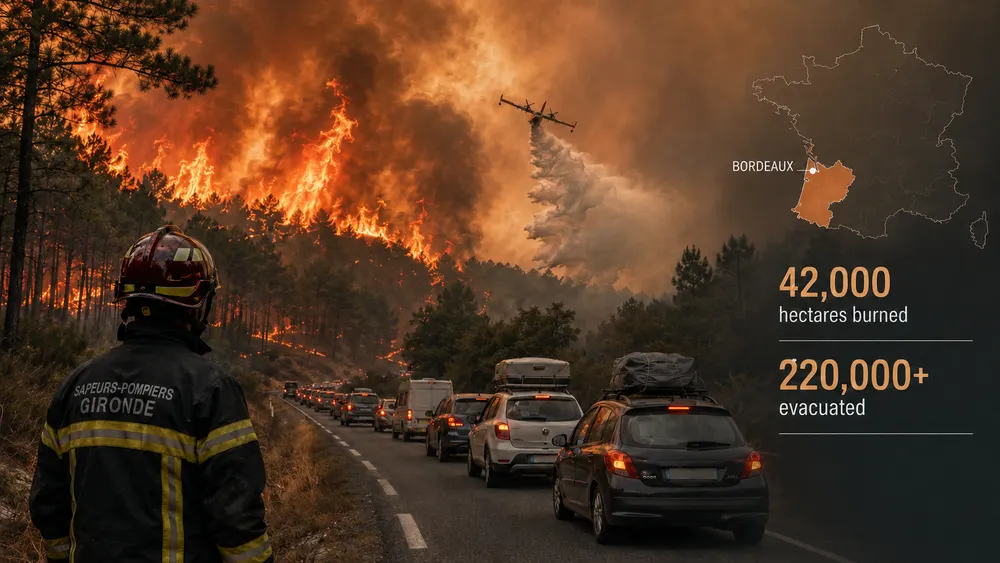
Southwestern France is emerging from what officials call the country's largest wildfire evacuation since World War II, after flames near Bordeaux consumed nearly 42,000 hectares — an area four times the size of Paris — and forced more than 220,000 people from their homes. By Thursday, authorities allowed 84,000 evacuees to return, while a parallel wildfire crisis in Spain burned roughly 55,000 hectares and displaced about 100,000 more. Firefighting crews from across the continent converged on the Gironde region under the EU's civil protection mechanism, underscoring the scale of a blaze that officials say has outstripped anything the region has seen in more than eight decades.
The Fire: By the Numbers
The Gironde fire near Bordeaux ignited in mid-July and grew into what regional officials describe as the largest wildfire in France since the Second World War, both in area burned and in the scale of evacuations. At its peak, the blaze spanned 420 square kilometers, destroyed roughly 100 buildings, and injured 93 firefighters. Two firefighters died battling flames near Bordeaux-Mérignac Airport, and combined fires across France and Spain forced an estimated 330,000 people to flee at the height of the crisis. Some 3,300 firefighters and two dozen aircraft were deployed against the Gironde blaze alone, with reinforcements arriving from Croatia, Portugal, the Czech Republic and Slovakia through the EU civil protection mechanism.
A Fast-Moving, Escalating Crisis
The fire's growth outpaced early containment efforts by a wide margin. An initial evacuation order on July 25 covered roughly 4,000 residents as flames first threatened the outskirts of Bordeaux, but within a day the fire's spread pushed that figure past 220,000, a fiftyfold jump in the space of 24 hours. French officials reported the blaze was "stabilised" by July 28, and cooler temperatures, higher humidity, and light rain over the following days allowed crews to gain ground. By July 31, 144,000 of the more than 220,000 evacuees had been cleared to return home, a figure that climbed to 84,000 in a separate same-day tally as officials continued phasing in returns neighborhood by neighborhood. Even so, Bordeaux's Gironde prefect, Sophie Brocas, cautioned residents to keep phones charged and bags packed "in case they have to be evacuated again."
Air Quality and Public Health Impact
Air quality data compiled by the Copernicus Atmosphere Monitoring Service show the scale of the pollution exposure: fine particulate matter (PM2.5) in Bordeaux peaked at just over 300 micrograms per cubic meter on July 26 — twelve times the EU's daily limit of 25 µg/m³ — while ozone levels reached nearly 130 micrograms per cubic meter. In Madrid, wildfire smoke combined with traffic pollution and Saharan dust pushed PM2.5 to between 80 and 100 µg/m³, a level public-health officials associate with breathing difficulty for sensitive groups. France's cumulative fire-carbon emissions for July reached 0.89 megatonnes of carbon, surpassing the previous record of 0.64 megatonnes set in 2022.
A Wider European Wildfire Season
Beyond France and Spain, Copernicus data indicate 2026 is shaping up as one of the most severe European wildfire years in the 24-year satellite record. Algeria's fire emissions hit an all-time high for the period, while Spain's year-to-date emissions ranked second only to 2022. Wildfire activity also intensified in Portugal's Braga, Aveiro and Viseu regions, in Sicily — where a firefighter died and authorities blamed arsonists — and even in the United Kingdom, where blazes broke out in North Wales and Derbyshire following a dry start to summer. Officials in several countries noted that dry vegetation and low humidity across the region left firefighting crews stretched across multiple simultaneous incidents.
What Comes Next
With the Gironde fire stabilized but not fully extinguished, authorities say the coming weeks will focus on completing evacuee returns, assessing structural damage to the roughly 100 destroyed buildings, and restoring agricultural and vineyard access in a region known for wine production. The EU civil protection deployment — drawing crews and aircraft from four partner nations — is expected to wind down as containment holds, though officials have not set a firm timeline for fully lifting the remaining evacuation zones. The scale of the response, and the fact that two firefighters lost their lives, has renewed attention on France's wildfire preparedness ahead of what is typically the peak of the country's fire season in August. For now, the immediate numbers tell the story: tens of thousands still displaced, a burned area four times the size of Paris, and a firefighting operation that drew personnel from across the continent to contain it.