
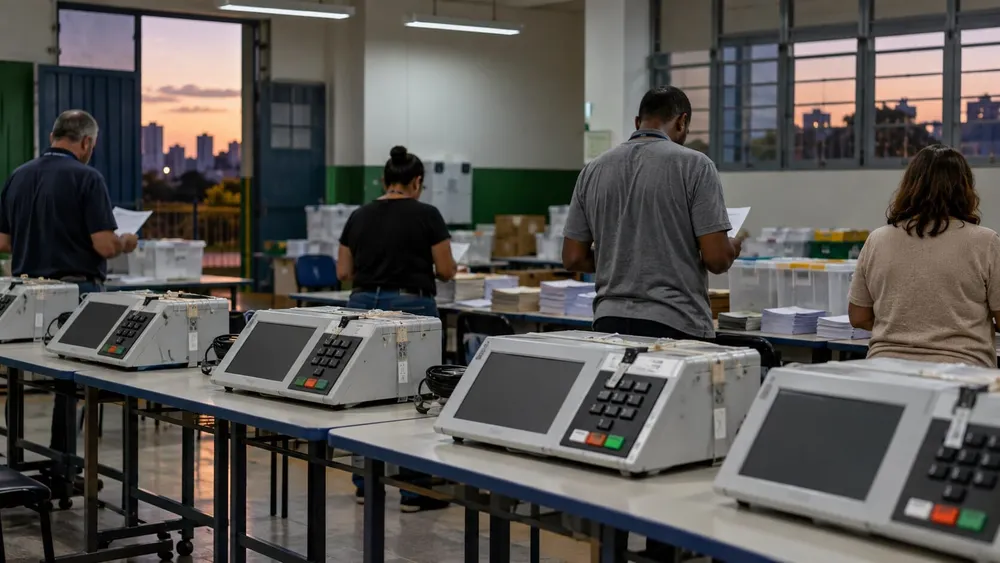
Flávio Bolsonaro finished first in Brazil’s presidential election with 47.03% of valid votes, pushing President Luiz Inácio Lula da Silva into a runoff after a result that reversed the order most polls had forecast and immediately moved global markets.
With 99.99% of ballot boxes counted, Bolsonaro received 56,104,268 votes and Lula received 53,876,617, according to the official count published early Monday by Brazil’s Superior Electoral Court. Bolsonaro’s margin was 2,227,651 votes, or 1.87 percentage points. Because neither candidate cleared 50%, they will meet again Oct. 25.
The result is more consequential than the runoff itself, which had been widely expected. Lula had generally been projected to finish first, and a final Reuters assessment said private polls pointed to an advantage of roughly three percentage points for the incumbent. Instead, Bolsonaro led by nearly two points — a reversal of about five points from that expectation. The earlier preview from The American Quorum described a close contest in which Lula entered Election Day with the polling edge; the completed count now puts Bolsonaro in the stronger opening position for the three-week second round.
A result markets did not price in
Financial markets treated the first-place finish as a major change in the probability of a Bolsonaro presidency. Brazil’s real rose more than 4% against the dollar Monday morning, while Brazilian stock futures and overseas-listed funds surged. Reuters reported that the Frankfurt-listed MSCI Brazil fund rose more than 16% and the country’s 2056 international bond gained 1.4 cents on the dollar. The market rally reflected investors’ expectation that Bolsonaro would pursue tighter spending, privatization and lower taxes.
Those price moves are not a forecast of the final vote. They measure how sharply the first-round result changed expectations. Recent head-to-head polls placed Bolsonaro and Lula in a statistical tie, and three weeks of campaigning remain. The runoff will also depend on voters who backed eliminated candidates, as well as turnout in a country where voting is compulsory for most adults.
The U.S. stakes are unusually direct
The runoff carries immediate significance for Washington. President Donald Trump has not formally endorsed Bolsonaro, but he has hosted the senator at the White House and praised him publicly. The Trump administration also imposed tariffs and sanctions during the elder Jair Bolsonaro’s prosecution, actions Lula’s allies described as interference and Washington rejected as a baseless accusation. Both Reuters and The Post reported that Brazilian officials are now watching whether the stronger-than-expected first-round showing draws a more active U.S. posture.
A Bolsonaro victory would likely move Latin America’s largest economy closer to Trump on security, trade and regional diplomacy. Lula has instead cast the election as a defense of Brazilian sovereignty and has resisted pressure from Washington. That divergence means the Oct. 25 vote could affect not only bilateral relations but also U.S. strategy across a region where several governments have recently shifted to the right.
A campaign reset
Bolsonaro told supporters the vote showed that Brazil wanted change. Lula acknowledged that the result was unexpected and said the runoff would become a clearer comparison between the two candidates. Their remarks were recorded by the public state broadcaster, which cited the electoral court’s tally.
The contest also carries a family and institutional legacy unusual for a presidential election. Flávio Bolsonaro, 45, is a senator making his first run for the presidency. His father, former President Jair Bolsonaro, is serving a 27-year sentence after his conviction for plotting to remain in power following the 2022 defeat. Flávio has said he would seek to free his father. Lula, 80, is seeking a fourth nonconsecutive term after returning to office in 2023.
That history ensures that the runoff will be argued on two levels at once. Voters will assess crime, prices and public spending, but they will also decide whether the Bolsonaro movement should return to the presidency after the elder Bolsonaro’s conviction and the attacks on government buildings that followed his loss. Lula’s challenge is to make that institutional warning outweigh dissatisfaction with his current government; Bolsonaro’s is to turn a demand for change into a majority.
The challenger now has momentum, but not a majority. Bolsonaro must consolidate voters who chose other conservative candidates without intensifying concerns about democratic institutions tied to his family’s political movement. Lula must rebuild a coalition around cost-of-living relief, social programs and institutional stability while answering the electorate’s apparent demand for change.
The broader first-round picture also favored the right. The Guardian reported strong conservative performances in congressional and state races, a backdrop that could strengthen Bolsonaro’s governing case in the runoff. But the presidential choice remains unsettled: the first round established a lead, not a mandate.
The next definitive event is the Oct. 25 vote. Until then, polling on transfers from eliminated candidates, endorsements from their parties and any shift in turnout will be more informative than the immediate market rally. What changed overnight is clear: Lula is no longer defending a first-place finish. He is trying to erase a 2.23 million-vote deficit against a challenger whose support was materially underestimated.