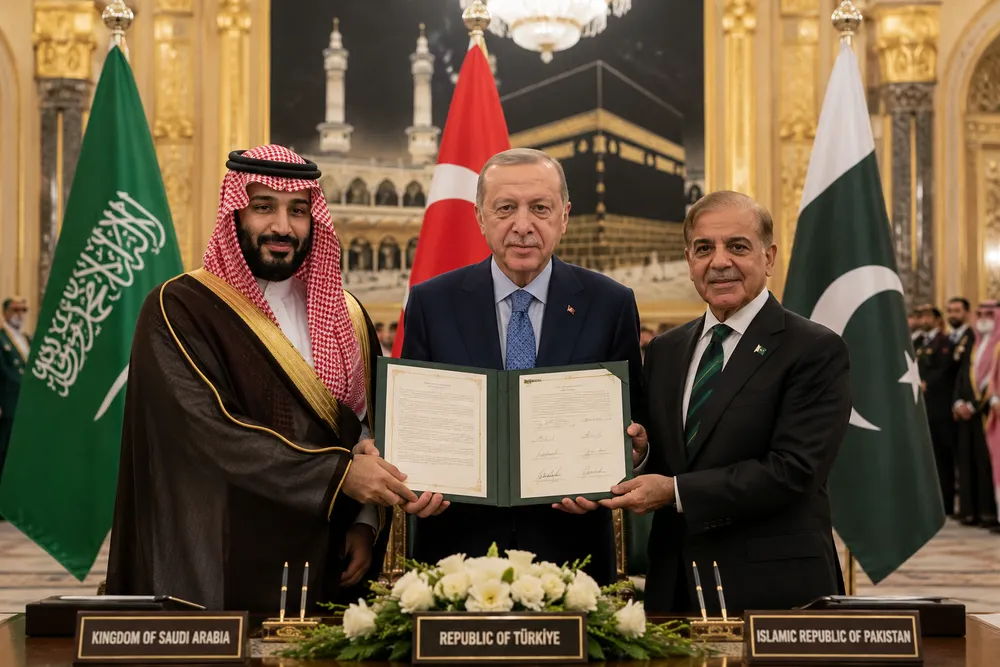
Three militaries commanding NATO's second-largest army, the Arab world's deepest financial reserves, and the Islamic world's only declared nuclear arsenal are now bound by a single sentence: an armed attack on any one of them "shall be regarded as an attack against them all," according to the joint statement issued after Saudi Arabia, Türkiye and Pakistan signed the Makkah pact Friday in Islam's holiest city.
The pact was sealed at Al-Safa Palace in Mecca by Crown Prince Mohammed bin Salman, President Erdoğan and Prime Minister Sharif, formalizing talks pursued for nearly two years, according to Reuters. The timing is no accident: the signing comes as the region absorbs fallout from the ongoing war between the United States, Israel and Iran, alongside Houthi missile and drone strikes that have repeatedly hit Gulf shipping lanes and, at times, Saudi territory. Fidan said Saturday the accord is "technically the same" as NATO's Article 5, while insisting it is "not directed against Iran or any other country," according to The News.
From bilateral hedge to trilateral shield
The agreement did not emerge from nowhere. Pakistan and Saudi Arabia had already signed a bilateral Strategic Mutual Defence Agreement in September 2025, struck after an Israeli strike on Doha, according to Reuters. That pact drew attention chiefly because it extended a nuclear-armed state's defense guarantee to Saudi Arabia, which has none. Friday's deal folds in a long-standing Turkish-Pakistani defense understanding, elevating the arrangement into a three-way architecture, according to a Moneycontrol analysis.
Foreign ministers from the three countries first floated the concept at an Islamic summit in Riyadh in March, but negotiations accelerated once the U.S.-Israeli military campaign against Iran began in February, sending missile and drone fire toward Gulf oil exporters and choking traffic through the Strait of Hormuz. Yasmine Farouk of the International Crisis Group wrote in a July 20 commentary that regional officials had concluded their security "can no longer be left at the mercy of rivalry between the U.S. and Israel, on one side, and Iran, on the other," a judgment reached before the war began and sharpened by it, according to the Crisis Group.
What the text actually says — and doesn't
Officials have chosen their language carefully. Erdoğan wrote on X the agreement "targets no country and is open to the participation of all brotherly countries," framing it under Article 51 self-defense rights rather than as an offensive coalition. A Turkish official told Reuters the pact is "purely defensive" and does not supersede Ankara's NATO commitments. Saudi Deputy Minister Rayed Krimly added the accord "does not represent an effort to establish a military axis or a sectarian bloc" and is "not linked to any nuclear ambitions or arms race," according to France 24.
Yet the full legal text remains unpublished, and the statement stops short of specifying what each signatory would fulfill if a partner came under attack. Fidan said the governments would decide "through consultations" what support to offer, with a ministerial committee and Saudi-based secretariat — echoing NATO's structure — to be established, according to The News. Analysts at the Atlantic Council similarly cautioned the pact is not a NATO-like alliance and does not signal a discrete new regional bloc, even as it reflects a growing desire among the three governments for greater strategic autonomy from Washington.
Complementary strengths, competing interests
The three partners bring distinct assets. Türkiye operates NATO's second-largest army and an expanding drone and defense-manufacturing sector already supplying Pakistan with naval platforms and unmanned systems. Saudi Arabia contributes financial firepower as the world's top oil exporter, atop a defense sector still reliant on imported American hardware Riyadh wants to domesticate. Pakistan supplies battlefield-tested manpower and the Muslim world's only nuclear arsenal, according to Reuters.
Whether those strengths yield a durable alliance is another matter. Murat Aslan of Hasan Kalyoncu University pointed to Iran as the common thread binding Riyadh, Ankara and Islamabad, citing a "great sense of threat in the minds of Saudis that Iran may have an impact on their security." Yet the three diverge elsewhere: Turkey pursues an independent regional agenda often at odds with Gulf capitals, Pakistan remains economically constrained despite its military scale, and Saudi Arabia has simultaneously deepened ties with India, which eyes Ankara-Islamabad defense cooperation warily.
Reactions ripple outward
Iran's government issued no official response, though Iranian parliamentarian Ebrahim Rezaei dismissed the pact on social media, writing that "a paper agreement with Türkiye and Pakistan will not bring them security, just as years of one-sided dependence on the Americans did not bring them security." Israeli officials stayed silent, though former Prime Minister Naftali Bennett had warned in February that Ankara was becoming "the new Iran" and building a hostile Sunni axis, a claim Turkish officials reject as disinformation, according to CGTN.
In New Delhi, reaction has been measured. Analysts say India's real concern is not an "Islamic NATO" label but deepening Turkish-Pakistani military-technology ties, already straining India-Turkey relations after Ankara's criticism of India's military operations. Dr. Imran Khurshid of New Delhi's International Centre for Peace Studies advised "strategic patience," noting India's robust ties with Saudi Arabia and the UAE give it room to avoid reactive policymaking, according to Moneycontrol.
What is clear is that the Makkah agreement marks a structural shift regardless of how its ambiguities resolve. Three of the Muslim world's most consequential powers have, for the first time, agreed in writing to treat each other's security as their own — a commitment whose real strength will only be tested the day it is invoked.