A Security Pitch Wrapped in Agreements
China and Egypt signed more than 20 cooperation documents on September 2 as President Xi Jinping used his first Cairo visit in a decade to propose a new security architecture for the Middle East. The package covered the digital economy, science, education and transportation, while the leaders separately endorsed work on artificial intelligence, trade and industrial supply chains, according to China’s official account.
The breadth matters because Xi did not present security as a narrow military project. He linked it to development, maritime access and political autonomy, arguing that regional governments should manage their own affairs and reject outside interference. Egypt’s President Abdel Fattah el-Sissi endorsed exploring a regional framework while calling for deeper Chinese coordination. The language was ambitious, but the meeting produced no treaty, command structure or enforcement mechanism.
The immediate setting gave that proposal urgency. A six-month U.S.-Iran war has disrupted energy flows and shipping, while fresh strikes this week again exposed Gulf states to retaliation. Xi said China was prepared to help protect international sea lanes and urged comprehensive solutions across connected conflicts. Reuters reported that Cairo and Beijing also agreed to deepen counterterrorism coordination and security cooperation.
That combination lets Beijing offer a pointed contrast: investment without alliances, diplomacy without permanent regional bases, and security language centered on sovereignty. Yet it also reveals a central tension. China benefits from trade routes protected largely by others and has limited experience organizing collective defense among rivals. The Cairo proposal is therefore best read as an opening bid for influence, not an operational replacement for the existing U.S.-led order.
Why Egypt Is the Pivotal Partner
Egypt gives China three assets in one relationship: a market of more than 110 million people, control of the Suez Canal and diplomatic reach across the Arab world and Africa. Xi’s trip marked 70 years of bilateral relations and his first visit to the region since Saudi Arabia in 2022. The Associated Press described Cairo as a platform from which Beijing can project economic and political influence far beyond Egypt.
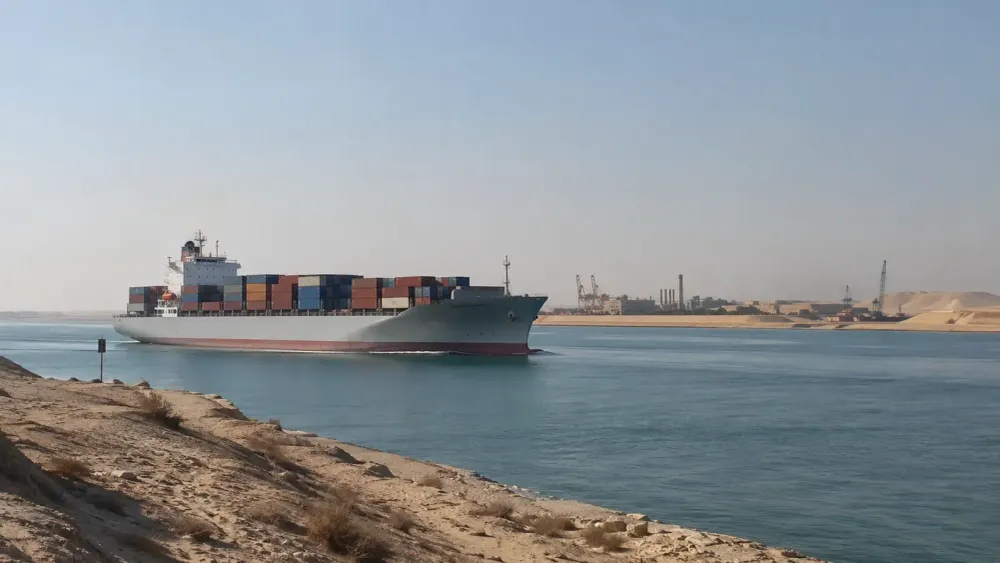
Suez has become more strategically valuable as attacks and restrictions complicate transit through the Strait of Hormuz and Bab al-Mandeb. For China, the world’s largest crude importer and a major exporter to Europe, keeping the Red Sea-Mediterranean corridor open is a commercial necessity. For Egypt, canal traffic generates scarce foreign currency. That shared interest creates practical grounds for maritime coordination even if neither government has defined what Chinese participation would entail.
Cairo, meanwhile, calls its approach “strategic balance.” It wants Chinese investment and technology without severing the American defense relationship that has underpinned Egyptian security policy for decades. This is not simple bloc switching. A recent Carnegie analysis found that China and the United States often operate in different domains across the region: Beijing is stronger in trade, while Washington retains unmatched military and diplomatic infrastructure.
Egypt can use that overlap to increase its options. It joined the expanded BRICS group, participates in China’s Belt and Road projects and maintains close ties with Washington. It also conducted air-combat drills with China in August involving Chinese J-16 and Egyptian Rafale fighters. Those exercises signal diversification, but they do not erase Egypt’s inventory of U.S. equipment, training links or the institutional habits built since the 1979 peace treaty with Israel.
Economic Ties Carry Hard Edges
The commercial relationship already exceeds ceremony. Chinese investment in the Suez Canal Economic Zone totals about $4 billion, Egypt’s cabinet says, and Chinese goods imported by Egypt reached roughly $10 billion in the first half of 2026. During Xi’s visit, authorities announced an expansion of a Chinese-developed industrial area, while ZC Rubber proposed studying a $500 million tire complex. Those projects turn geopolitical language into factories, logistics and employment.
Earlier deals show the model at smaller scale. The canal-zone authority signed three Chinese textile projects worth $52.6 million in July 2025, expecting 3,500 direct jobs. It said the Qantara West zone then had 28 contracted projects totaling $734.1 million and nearly 38,500 planned jobs. Those project figures are promises rather than completed output, but they show why Cairo prizes manufacturing capital over abstract partnership declarations.
The imbalance is equally important. Bilateral trade reached about $20 billion, but Egyptian purchases from China dominate the flow. China’s wider African policy now grants tariff-free access to 53 of 54 countries, including Egypt. Yet continental data show China exported $225 billion to Africa in 2025 and imported $123 billion. Market access helps only if Egyptian firms can meet standards, scale production and overcome financing constraints.
Those constraints are severe. Egypt remains in an International Monetary Fund program after currency shortages, inflation and external shocks. Red Sea disruption cut Suez foreign-exchange inflows by $6 billion in 2024, according to the IMF review. By early 2025, canal income was still depressed even as remittances and tourism improved. Chinese factories can support exports, but opaque financing or import-heavy projects could deepen rather than solve the dollar gap.
Washington Still Holds the Security Advantage
The United States remains embedded in Egypt in ways China is not. Washington provides roughly $1.3 billion a year in military financing, funds U.S.-made weapons and ties cooperation to the Egyptian-Israeli peace framework. A congressional review also documents recurring disputes over human-rights conditions and withheld funds. That friction gives Cairo reasons to diversify, but the scale and persistence of U.S. support are difficult to replicate quickly.
Economic competition is less one-sided. U.S. goods and services trade with Egypt totaled $16.1 billion in 2025, including $9.4 billion in American goods exports, according to the trade office. China’s overall trade is larger, but the comparison shows Egypt is adding partners rather than substituting one relationship for another. Washington sells security, aircraft and services; Beijing emphasizes infrastructure, industrial capacity and faster political deals.
China’s restraint also has limits. Beijing brokered the 2023 Saudi-Iranian diplomatic restoration, but it could not prevent relations from deteriorating or the current war from closing trade routes. It buys most Iranian oil exports while courting Tehran’s Gulf rivals, and it opposes outside interference while seeking a larger regional role itself. A durable security architecture would require China to arbitrate these contradictions and accept costs when diplomacy fails.
Delivery Will Decide the Visit’s Importance
The next test is whether the documents signed in Cairo produce financed projects with transparent terms, local employment and export capacity. Egypt’s current-account deficit narrowed to $2.1 billion in the first quarter of 2025, but foreign direct investment dropped sharply from an exceptional prior-year level. The central-bank data underline Cairo’s need for dependable capital rather than announcements that create new import bills.
Security delivery will be harder to measure. Watch for regular maritime coordination, intelligence exchanges, joint exercises and a formal forum that includes competing Gulf powers, Iran, Turkey and Egypt. Without those components, Xi’s four-point proposal will remain diplomatic positioning. With them, it could begin shifting regional agenda-setting toward Beijing even while American forces continue providing the deterrence and logistics on which many governments rely.
The Cairo summit therefore represents a meaningful expansion of Chinese ambition, not a completed transfer of power. Egypt is testing how much economic leverage and diplomatic room it can gain by engaging both superpowers. China is testing whether commercial weight can be converted into security influence. The answer will come from implementation: who finances the factories, keeps sea lanes open and absorbs political risk when the next regional crisis arrives.