A new U.S.-Venezuela oil agreement targets 17 fields with more than 65 billion barrels of proven potential, a volume equal to roughly one-fifth of Venezuela’s vast reserves but still years away from becoming usable supply. President Donald Trump and acting Venezuelan President Delcy Rodríguez announced the arrangement Friday, presenting it as a route to lower U.S. fuel costs and revive an industry weakened by underinvestment, sanctions and deteriorating infrastructure.
The agreement would give the United States a 55% effective share of output from a new private company, including an ownership interest and rights to buy crude at cost, according to an official who described the structure to the Associated Press. The operator has not been identified. Rodríguez said the projects could attract $100 billion in investment and ultimately generate more than $209 billion in Venezuelan taxes, but those figures are projections supplied by the parties, not committed capital or independently audited revenue estimates.
The announcement is consequential because it would place the U.S. government and American companies at the center of one of the world’s largest pools of petroleum. It is also preliminary in crucial respects. Trump did not release the agreement, identify the fields or explain how “majority control” would work under Venezuelan law. Reuters reported that the legal basis, financing and allocation of commercial risk remained unclear.
The Agreement Promises Access, Not Immediate Production
The distinction between reserves and production is central. Proven reserves are volumes judged recoverable under existing economic and technical conditions; they are not oil already extracted, transported or ready for refining. Venezuela holds an estimated 303 billion barrels, about 17% of global proven reserves, according to the U.S. energy agency. Yet the country currently produces about 1.25 million barrels a day, roughly 1% of world output and far below the more than 3 million barrels a day it pumped near the turn of the century.
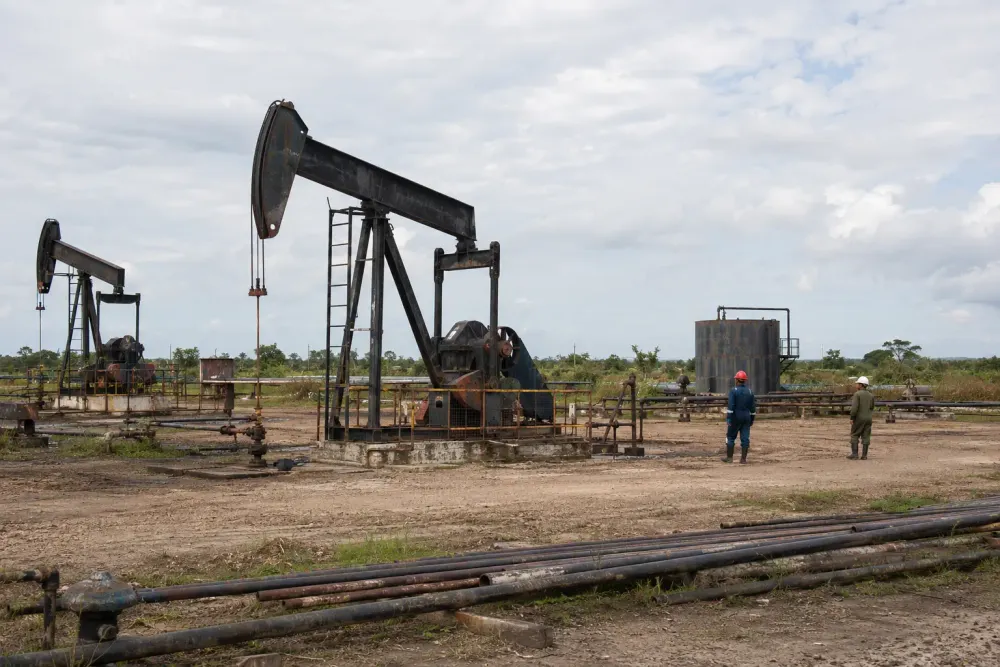
Most Venezuelan reserves are extra-heavy crude in the Orinoco Belt. Producing and marketing that oil requires wells, electric power, gathering systems, pipelines, upgrading or blending with lighter hydrocarbons, storage and export terminals. Refineries also need configurations capable of handling heavy, sulfur-rich feedstock. The oil may be mapped, but converting it into reliable supply is an industrial program rather than a simple transfer of title.
That reality makes short-term gasoline claims uncertain. Oil prices respond to expected future supply, but retail fuel costs depend on global crude markets, refining capacity, transport, taxes and seasonal demand. The International Energy Agency previously warned that Venezuela’s antiquated infrastructure would limit rapid gains; its assessment emphasized that the country’s large reserves are difficult to bring to market quickly.
Venezuela Rewrote the Rules for Private Operators
The agreement follows a sharp change in Venezuelan petroleum law. A reform published January 29 expanded private participation in exploration, extraction, collection, initial transport and storage while preserving public ownership of underground hydrocarbons. A detailed legal review found that the law created more flexible operating structures and a 180-day transition period for older joint ventures and production-sharing agreements.
Regulations issued in July supplied additional tax, royalty and contractual rules intended to attract outside capital. The reforms mark a retreat from the model under which state oil company Petróleos de Venezuela, or PDVSA, controlled primary operations and foreign companies participated mainly through state-led ventures. They do not eliminate constitutional principles of state ownership or automatically authorize another government to hold petroleum rights.
That tension is one reason the undisclosed structure matters. A U.S. official told AP that Rodríguez granted the new company 100-year development rights. Analysts told Reuters that an auction or lease model had been considered, but questioned whether a U.S. government lease has a clear precedent under Venezuela’s constitution and revised hydrocarbons law. Any project must also specify who finances capital spending, controls operations, receives revenue and bears losses if production falls short.
Commercial Commitments Will Determine the Deal’s Scale
Major producers have not yet publicly committed the $100 billion described by U.S. and Venezuelan officials. The new company’s private operator remains unnamed, and Friday’s announcement contained no production schedule. Those omissions are material because global oil companies must evaluate contract enforceability, fiscal terms, field quality, security, environmental liabilities and the probability that a future Venezuelan government will honor agreements made during the current transition.
There are signs of commercial movement. Chevron is preparing to migrate its Venezuelan ventures into the new framework, which could give the company greater operating control and allow its Petropiar heavy-crude project to expand into the neighboring Ayacucho 8 block. Two people familiar with the negotiations told Reuters that the arrangement may be signed next week, although Chevron declined to comment.
One company’s expansion would not validate every assumption in the broader agreement, but it would establish a practical test. Existing ventures can often raise output sooner because they already have wells, staff and export relationships. New fields require longer appraisal and construction. The distinction will determine whether the first gains are modest additions from established assets or the beginning of a much larger development cycle.
Investment history encourages caution. Venezuela nationalized its petroleum industry in the 1970s and later forced foreign projects into state-controlled ventures, expropriating some assets. Years of weak maintenance, financial stress and sanctions followed. An earlier industry review found that restoring production would require extensive spending on power, pipelines, processing, ports and field services, not only drilling.
Washington Sees Supply, Strategic Stocks and Influence
For Washington, the deal serves several objectives. More Venezuelan heavy crude would fit some U.S. Gulf Coast refineries and diversify supply at a time when war involving Iran has reduced traffic through the Strait of Hormuz. Rubio said the arrangement would provide stable, low-cost oil. The administration also wants crude from the new company for military use and the Strategic Petroleum Reserve, according to the U.S. official who briefed AP.
The reserve had 294.1 million barrels on August 20, less than half its authorized 714 million-barrel capacity, Department of Energy data show. That inventory fell after a 172 million-barrel release authorized in March. Venezuelan supply could support replenishment over time, but the government has not explained whether crude would be purchased, exchanged for future deliveries or supplied through the new company’s ownership structure.
The geopolitical objective is equally significant. Long-term U.S. participation could reduce the role of China, Russia and Iran in Venezuela’s energy sector while tying Caracas more closely to American capital and refining markets. Supporters describe that as hemispheric energy security. Critics view majority foreign control over Venezuelan reserves as an infringement on sovereignty, particularly because the agreement was negotiated by an interim government without a published contract or electoral mandate.
The Next Documents Matter More Than the Announcement
The agreement’s credibility will depend on documents and commitments expected in the coming days. The identity of the operator, the 17 fields, reserve certifications, bidding process, ownership percentages, governing law, dispute-resolution provisions and investment timetable will determine whether the arrangement is commercially financeable and legally durable. Public disclosure will also show whether the 55% figure refers to equity, production, purchase rights or a combination of them.
Independent production targets will be especially important. A credible plan should distinguish output from existing fields, rehabilitation of damaged facilities and greenfield development. It should also account for the diluent required to move extra-heavy crude and the refinery capacity available to process it. Without those details, 65 billion barrels is a statement of geological potential, not a forecast of supply.
Friday’s announcement establishes a major strategic direction: the United States and Venezuela intend to combine government authority with private capital to develop a large share of the country’s petroleum base. It does not yet establish how much money companies will invest, when production will rise or whether consumers will see lower prices. Those outcomes will be measured in signed contracts, field spending and barrels delivered—not in the reserve total alone.