U.S. forces struck two Iranian launchers on Larak Island on Sunday, and Iran responded hours later with ballistic missiles aimed at two sites hosting American forces in Jordan, ending more than a month without a confirmed direct exchange. Jordan’s military said its air defenses intercepted eight missiles that entered the kingdom’s airspace early Monday. The AP report said no significant impact from the Iranian attack had been reported.
U.S. Central Command said Revolutionary Guard forces had been preparing launchers to fire rockets carrying sea mines into the Strait of Hormuz. Iran’s Revolutionary Guard said the American attack killed and wounded fighters and civilians, but it released no casualty total, according to Reuters. The Guard called the strike aggression; Central Command described it as a limited, precise action against an imminent threat to mariners and commerce.
Those competing accounts define the immediate uncertainty. The strike and retaliation are confirmed by the governments involved, but the United States has not publicly released evidence showing the preparations it said were underway, and Iran has not documented its casualty claim. A later assertion by President Donald Trump that Kharg Island, Iran’s main oil-export hub, was under attack remained unverified; Reuters found that the video accompanying his post was probably synthetic.
A mine threat at the center of the dispute
Larak sits inside the Strait of Hormuz near the narrow passage connecting the Persian Gulf with the Gulf of Oman. Mines launched or placed from that area can threaten ships without requiring Iran to close the entire waterway physically. They also impose costs beyond any direct damage: crews, owners and insurers must judge whether a route can be used safely when a relatively small number of weapons can halt or delay traffic.
Washington said last week that international shipping lanes had been cleared of mines and warned that any vessel attempting to place new ones would be destroyed. Trump’s warning presented surveillance and immediate force as the enforcement mechanism for keeping the route open. The Larak strike shows that the policy is operational, not merely rhetorical, but it also demonstrates how quickly enforcement can restart the broader conflict.
The U.S. account would make the action anticipatory rather than punitive: forces allegedly saw an immediate mine-laying operation and disabled the equipment. Iran’s response treats the same event as a new attack on its territory after a weeks-long pause. Without public imagery, sensor data or other corroboration, outsiders cannot independently evaluate the claimed imminence. What is clear is that both sides have linked military action directly to control of the strait.
Iran moves retaliation into Jordanian airspace
Iran’s Revolutionary Guard said it targeted the King Hussein and Al Azraq bases in Jordan with ballistic missiles, according to a separate Reuters report. Jordan said eight missiles breached its airspace and were intercepted. The available reporting did not establish whether all were aimed at the named facilities, whether debris caused damage, or whether Iran launched additional weapons that did not cross Jordan’s borders.
The geographic shift matters even when interceptors work. Jordan hosts American forces but is not a party to the U.S.-Iran dispute over shipping, and every Iranian volley forces it to defend populated airspace and accept the risk of falling debris or interception failures. Similar attacks during the six-month war have placed Gulf states hosting U.S. personnel in the position of absorbing consequences from decisions made in Washington and Tehran.
Interception also does not automatically equal de-escalation. A failed Iranian strike can still prompt another American response, while a successful hit could rapidly widen the target set. The absence of reported major damage after Sunday’s exchange lowers the immediate pressure for retaliation, but the Guard’s public acknowledgment of its missile attack makes the action part of an explicit sequence rather than an ambiguous proxy incident.
Shipping and energy markets register the risk
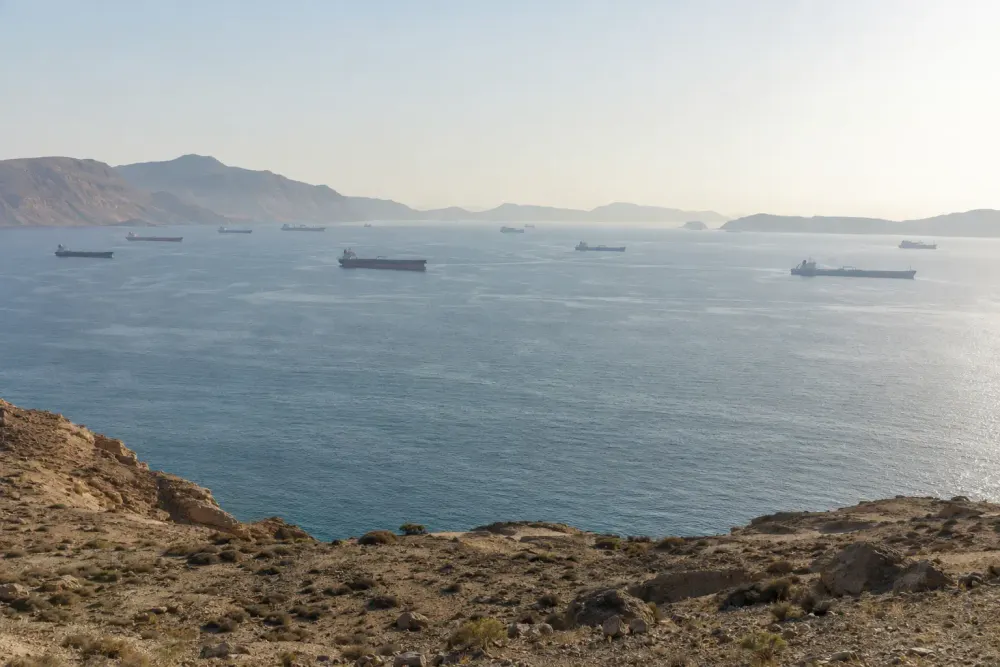
Visible commodity-vessel transits through Hormuz fell to about five a day over the weekend, compared with roughly 130 ships a day before the war, the AP reported. A British military monitoring center also said a tanker was struck by an unknown projectile Saturday, although no casualties or environmental damage were reported. Responsibility for that incident had not been established.
The volume loss is measurable. The U.S. Energy Information Administration estimated in its latest outlook that crude oil and petroleum liquids moving through Hormuz averaged 4.9 million barrels a day in the second quarter, down from 21.6 million in the final quarter of 2025 before the war. EIA estimated global inventories fell by an average 4.2 million barrels a day in the second quarter and projected another 3.8 million-barrel daily decline in the third.
Markets responded before the military consequences were fully known. Brent crude rose 2.85% to $90.61 a barrel in early Monday trading, while U.S. West Texas Intermediate gained 2.55% to $85.53, according to market data. The increase reflected renewed escalation risk rather than proof of an additional supply loss. Oil flows had risen modestly before the exchange, leaving traders to judge whether the new fighting will reverse that improvement.
Even the traffic measurements require caution. EIA says automatic ship-identification signals around Hormuz have become especially unreliable since February and that its 2026 estimates are repeatedly revised using cargo origins, destinations and commercial tracking data. That methodology explains why visible vessel counts provide a useful direction of travel but cannot measure all barrels moving through the passage in real time.
A military flare-up during an economic campaign
The last confirmed American strikes on Iran came on July 29. Two days later, Trump said he would pause further attacks after requests from Qatar, Saudi Arabia and the United Arab Emirates, while mediators pursued arrangements for the strait. The administration then emphasized secondary sanctions designed to penalize foreign banks and companies that continue doing business with Tehran. That shift appeared to create space for negotiation without resolving the underlying blockade.
Sunday’s action exposes the fragility of that approach. Economic pressure depends on persuading Iran that the cost of continued restrictions exceeds the value of its leverage; military enforcement against mine-laying changes that calculation by creating immediate physical risk. Tehran, meanwhile, can retaliate against regional bases or shipping without reopening a full campaign against every American target. Both strategies operate below total war but repeatedly create opportunities for miscalculation.
The humanitarian and commercial burden extends beyond governments. The International Maritime Organization said in July that hundreds of ships and about 6,000 seafarers remained stranded in the Persian Gulf and urged operators not to expose crews to unnecessary danger. Its statement underscores why threats to mining and renewed missile exchanges matter even when no merchant vessel is sunk in the immediate incident.
What is verified and what comes next
The most consequential new claim remains the least substantiated. Trump said Kharg Island was being “blown to smithereens,” but the White House and Defense Department offered no confirmation, Iranian media reported no corresponding attack, and the accompanying video was probably AI-generated, according to the Reuters review. Kharg handled most Iranian oil exports before the war, so treating that claim as established would materially overstate the known escalation.
The verified record is serious enough: two launchers struck on Iranian territory, Iranian casualty claims, eight missiles intercepted over Jordan and a sharp oil-price response. The next indicators are concrete. They include independent evidence about damage at Larak, verified casualties, any debris or impact at the Jordanian sites, confirmed attacks on other Iranian facilities, and whether commercial transits fall below the already depressed weekend level.
The exchange ended a military lull without yet demonstrating a return to the sustained strike cycle seen earlier in the war. That distinction could disappear quickly if either side expands its targets or if a missile reaches a populated area. For now, the evidence shows that the dispute over mining and access to Hormuz remains capable of converting a contested shipping rule into direct U.S.-Iran combat within hours, while diplomacy and economic pressure have not removed the trigger.