The Democratic Republic of Congo’s Ebola outbreak reached 6,041 confirmed cases and 2,911 deaths by August 29, making it the country’s largest recorded Ebola epidemic and leaving nearly half of confirmed patients dead. The latest government figures mark a sobering threshold in an emergency that has expanded from an initial cluster in Ituri Province into 60 health zones across six eastern and northeastern provinces.
The outbreak is not yet approaching the scale of West Africa’s 2014–2016 catastrophe, which infected more than 28,600 people and killed 11,325, according to the WHO record. But it has already surpassed Congo’s 2018–2020 epidemic in confirmed infections, and its acceleration is unusually fast. The CDC says this outbreak reached 1,000 cases within 40 days of response activation; the earlier Congo epidemic needed about 235 days to reach that point.
Those comparisons carry a warning rather than a forecast. This epidemic is caused by Bundibugyo virus, a less frequently encountered member of the Ebola family, and it is unfolding in a region where armed conflict, displacement, weak health infrastructure and high population mobility frustrate the basic work of finding patients and tracing contacts. The decisive question is no longer whether the outbreak is historically large. It is whether the response can become faster than transmission.
A Rare Strain Changes the Response
Bundibugyo virus disease is transmitted through direct contact with infected bodily fluids or contaminated materials, not through casual airborne exposure. People are not infectious before symptoms begin, but early fever, fatigue and gastrointestinal symptoms can resemble malaria or other common illnesses. That makes laboratory confirmation essential and delays isolation when testing, transport or trust breaks down. Past Bundibugyo outbreaks had reported fatality rates between 30% and 50%; Congo’s current rate is about 48%.
The strain also removes tools that transformed the response to Zaire ebolavirus. There is no approved vaccine or specific antiviral treatment for Bundibugyo disease. Antibody therapies recommended for Zaire ebolavirus cannot simply be assumed to work against a different virus species. The WHO update therefore describes supportive care, rapid diagnosis, isolation, safe burials and contact tracing as the foundations of control while experimental options are tested.
Supportive care is not a minor intervention. Early rehydration, correction of electrolyte abnormalities, treatment of secondary infections and careful management of organ complications can improve survival. Yet access must come early enough to matter. Fear of isolation, distance to treatment centers and attacks on health facilities can keep ill people at home, where relatives providing intimate care face the greatest exposure and where a death may lead to further transmission during burial rituals.
Transmission Outpaces Earlier Congo Epidemics
Ituri remains the center of the emergency. WHO counted 4,802 confirmed cases there through August 26, more than four-fifths of Congo’s total at that point. North Kivu had 775 cases and a reported fatality rate of 68%, an unusually high figure that authorities were investigating. Tshopo, Haut-Uele, Bas-Uele and South Kivu had smaller totals, but their inclusion shows that the epidemic is no longer confined to one connected cluster.
The numbers require careful reading. WHO recorded 5,794 confirmed Congolese cases and 2,786 deaths through August 26, while the national tally reached 6,041 cases three days later. Some recent increases reflect expanded surveillance, improved testing and reconciliation of delayed records. They do not all represent people infected within a single reporting day. Even after accounting for those corrections, however, WHO says sustained transmission is continuing across interconnected geographic clusters.
Independent trackers show the same trajectory with slightly different cutoffs. The ECDC listed 5,945 confirmed cases and 2,862 deaths using data through August 28. That one-day lag explains the difference from the later national total, rather than contradicting it. Transparent date-stamping matters in a fast-moving epidemic because apparent discrepancies can erode public trust precisely when health teams need cooperation.
Conflict Weakens the Containment System
Contact tracing illustrates the response gap. As of August 26, teams had identified 26,850 people who needed follow-up and reached 22,091 of them, or 82.3%, that day. That is substantial work across difficult terrain, but the unmonitored remainder still numbered nearly 4,800. With an incubation period of two to 21 days, every missed contact is a possible delayed diagnosis and a new chain of transmission.
The operational burden extends far beyond Ebola wards. Roughly one million people are displaced in Ituri, while about 26 million people across Congo face acute food insecurity. Mining routes, crowded settlements and cross-border trade keep communities moving. Insecurity limits access for surveillance teams, and attacks on medical facilities have interrupted care. Health-worker strikes and shortages further weaken ordinary clinics, where an undetected Ebola patient can expose staff and other patients before referral.
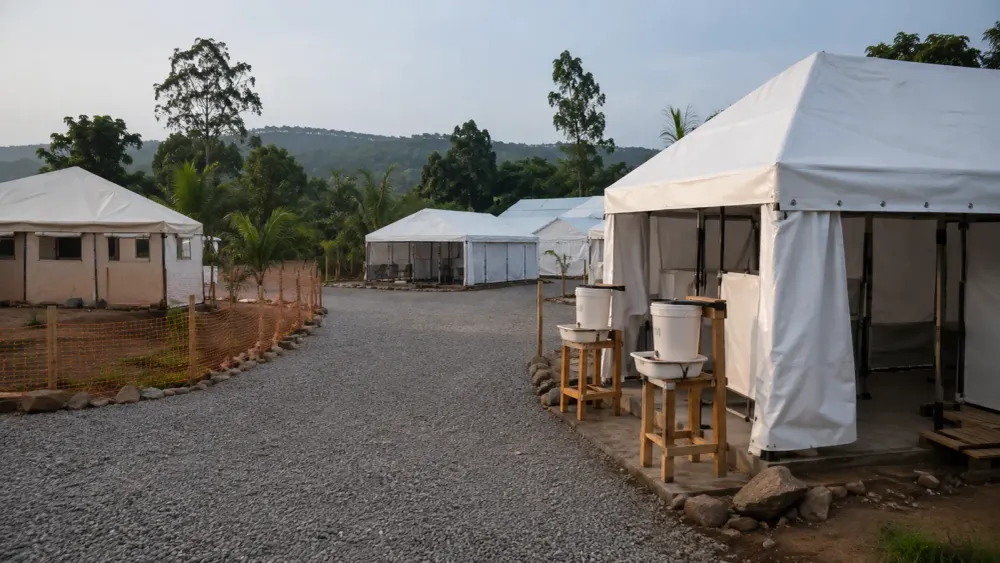
International responders are expanding capacity, but beds alone cannot solve those constraints. MSF said on August 21 that it was operating six treatment centers and isolation units with more than 400 beds, about one-third of overall response capacity, supported by more than 1,400 staff. It has argued for treatment closer to communities, especially in newly affected places with little Ebola experience, so patients do not have to choose between long travel and remaining at home.
An Unproven Vaccine Strategy Begins
Congo began vaccinating some health workers with Ervebo on August 27, including in Kisangani. The move should not be confused with a proven Bundibugyo vaccination campaign. Ervebo is licensed against Zaire ebolavirus, and protection against Bundibugyo infection in humans is unknown. WHO advisers recommended using it within a randomized clinical trial so the response can measure whether it offers meaningful protection rather than infer effectiveness from laboratory evidence alone.
The ethical and practical balance is difficult. Frontline workers need protection immediately, yet a poorly designed rollout could consume scarce doses without establishing whether the vaccine works. Randomization offers the clearest evidence, but communities and workers must understand why access may differ during a deadly emergency. The trial will depend on informed consent, independent safety monitoring and transparent explanation of uncertainty—conditions that are harder to sustain where institutions already face distrust.
A parallel treatment study offers another route to reduce mortality. WHO’s PARTNERS trial began enrolling patients in Ituri on July 2 and had recruited more than 100 confirmed cases by mid-August. Until results are available, clinicians must rely on optimized supportive care. Research cannot substitute for basic infection control, but evidence generated now could change the options available in this outbreak and in the next Bundibugyo emergency.
Regional Risk Depends on Local Control
The outbreak has already demonstrated its ability to cross borders. Uganda has recorded imported cases, while France treated one imported patient without secondary transmission. WHO continues to rate the risk inside Congo as very high and the risk for neighboring countries as high, particularly along the eastern Congo–western Uganda corridor. It rates the risk to the rest of Africa and globally as low and advises against general travel or trade restrictions.
That assessment is not reassurance that distant countries can ignore the epidemic. It reflects where transmission is occurring and the effectiveness of surveillance around imported cases. Border screening can support detection, but it cannot replace cooperation among neighboring health systems, fast laboratory referral and shared contact information. The joint response plan from Africa CDC and WHO is intended to coordinate those functions and direct resources toward the countries most exposed.
Congo’s immediate benchmarks are concrete: shorten the time from symptoms to isolation, raise daily contact follow-up above its current level, protect ordinary clinics, expand dignified safe burials and keep treatment accessible when security deteriorates. The 6,000-case threshold is evidence that the response has not yet achieved those goals at sufficient scale. Whether this becomes a contained national emergency or a wider regional crisis will be determined less by the headline total than by how quickly those operational gaps close.